
 Ryan Garcia

Munetaka Murakami has been the most-heralded hitter from Japan in quite some time, and the Yankees actually have a shot at him unlike when Shohei Ohtani hit the market.
He’s stated publicly that the Yankees were a team of interest to him, and after posting an OPS over 1.000 in 2025, it would feel like an obvious way for the franchise to re-enter the Japanese market.
Given how vocal I’ve been about needing more starpower on the roster, it would be odd to staunchly oppose the idea of Brian Cashman signing him this winter, but there’s more to baseball than just fan hype and gaudy production.
A third baseman who will have to play first base when he comes stateside, his fit on the Yankees’ roster is poor, and there are concerns with his bat that could make him unplayable in the middle of a contender’s lineup.
READ MORE: Yankees set to lose free agent infielder who hit .336 against lefties
No Room For Munetaka Murakami on the Yankees’ 2026 Roster
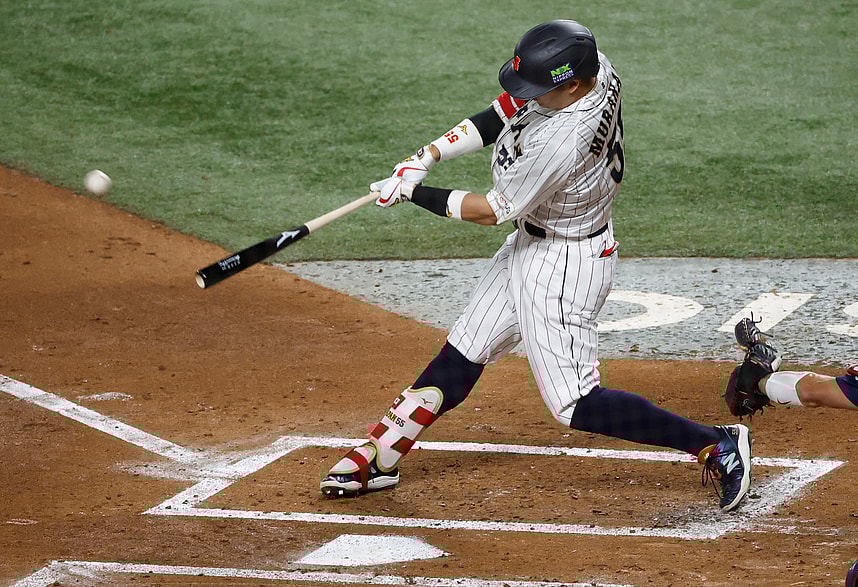
Munetaka Murakami is an extremely talented hitter, he mirrors the skillset that top outfield prospect Spencer Jones has, leaning on outlier power output to overshadow massive contact woes.
To further add to his appeal, he’s a patient eye at the plate which allows him to work walks and get on-base, something that Jones struggles with at the moment.
The issue with this kind of profile in Japan isn’t that it can’t result in production, Murakami’s been the fourth-best qualified hitter in Japan over the last three seasons with an .891 OPS.
Where these strikeouts become an issue is when transitioning from the NPB to MLB, where hitters will face much better pitching and harder velocity.
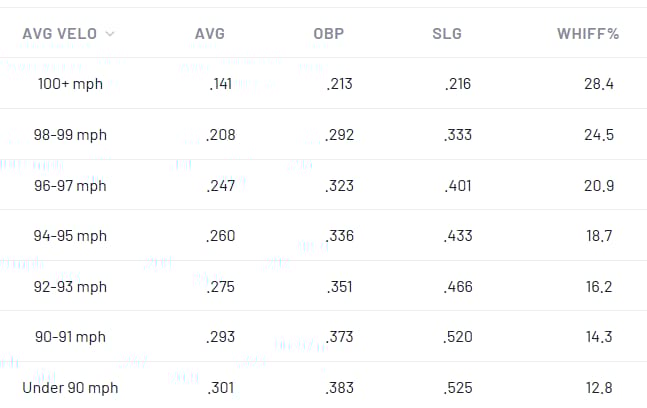
The average fastball in MLB sits between 94-95 MPH, whereas the average fastball in the NPB is closer to the 90-91 MPH range, a 4.4% decrease in average Whiff% for MLB hitters.
Murakami made contact at a slightly lower rate than Giancarlo Stanton this season while facing much slower fastballs, if you increase the fastball velocity he faces, you could also project an increase in Whiff%.
This doesn’t factor for the discrepancies in breaking ball quality as well, which could result in even greater swing-and-miss woes for Murakami than the ones we already saw in Japan.
He’s only seen the swing-and-miss balloon as the years have gone on, and they create questions about whether opposing pitchers have figured out some bigger holes in his approach over the years.
Since 2020, 36 MLB hitters have recorded a Contact% at or below Murakami’s 63.9%, the median wRC+ for that group was a whopping 99.
Only 12 of those seasons resulted in wRC+ above the average mark for a first baseman this season (107), and that’s the crux of my offensive concern here.
If Munetaka Murakami isn’t a great hitter, its unlikely he’ll provide more than 2-2.5 WAR since most first baseman accumulate negative defensive value when using positional adjustments, and the Yankees already have a lefty there.
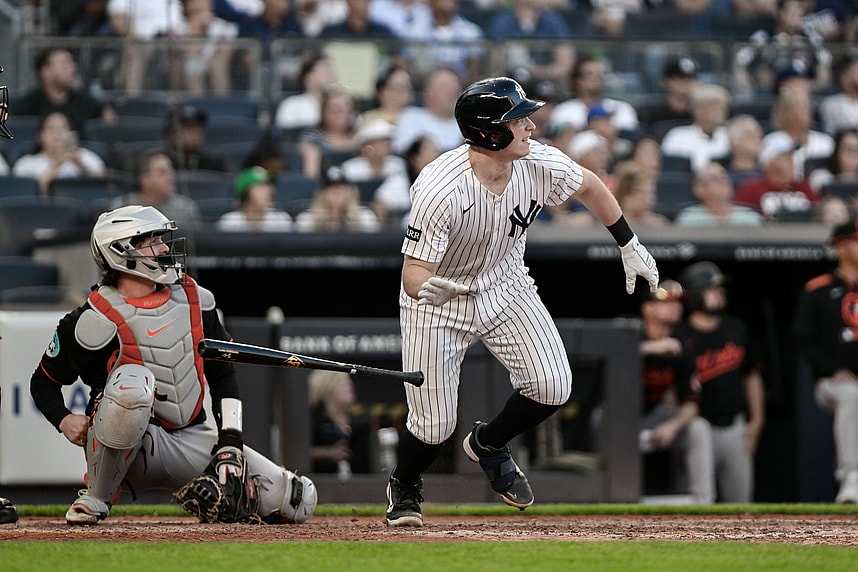
Ben Rice wrapped up a season where he finished inside the top 25 in wRC+ and inside the top 10 in Expected OPS, which indicates he has tons of potential to improve in 2026.
He could finish as a hitter who is 35-40% better than the league-average bat, and it’s incredibly difficult to project a hitter who could strike out over 35% of the time to even be an above-average hitter.
If the Yankees move Rice to catcher they could make room for Murakami, but the team would be benching Austin Wells, who has been worth 3 WAR in each of the last two seasons.
For all of his disappointments offensively this year, his .712 OPS is nearly 20 points better than the league-average at the catching position this year (.696).
Wells also finished fifth in Fielding Run Value (+11), meaning he was an above-average hitter relative to the position he plays while being an elite defender.
I’m not entirely against the idea of starting Ben Rice at catcher if the team believes he’s going to make a massive defensive leap, since that could result in a 4-5 WAR player, but Munetaka Murakami wouldn’t be why I take that risk.
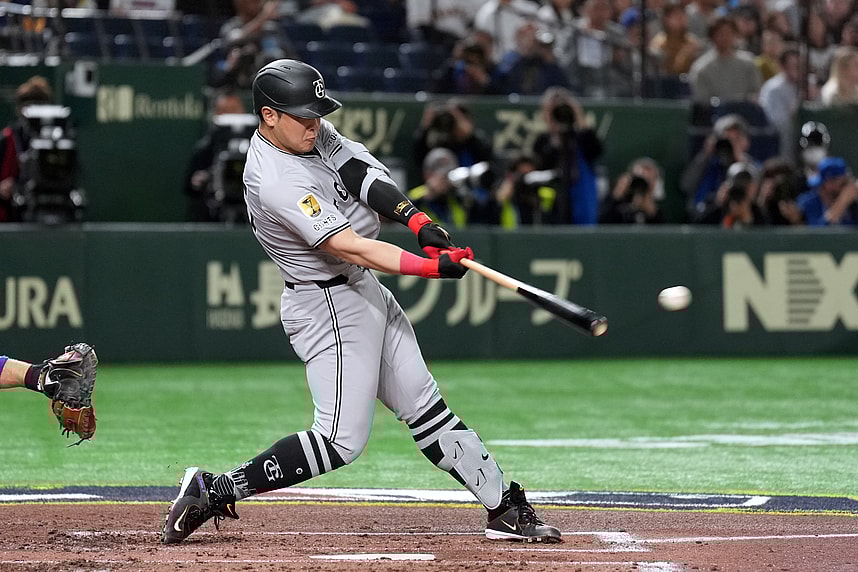
Kazuma Okamoto entices me far more; I do agree with people who think the Yankees should land a Japanese free agent because they need to re-establish their presence there.
Instead of signing another left-handed hitter who could struggle to be an above-average hitter due to his hit tool, the Yankees should pursue Okamoto who is a better defensive player and has a very well-rounded skillset.
He turned a 97.7 MPH fastball from Daniel Palencia (2.84 ERA in 2025) into the left-center gap at 112.6 MPH earlier this year, having 55-60 grade raw power with an excellent feel for the strike zone and making contact.
Okamoto can play some third base, unlike Murakami who is a butcher at the position, and he can also play some corner outfield in a pinch on top of first base.
There’s a lot of versatility that allows him to co-exist with Austin Wells and Ben Rice in their current roles, but also gives the Yankees a player they can insert into the lineup if their homegrown catcher takes another stepback.
It would give Rice another chance to become the starting catcher if the situation calls for it, helps the Yankees remain balanced in terms of handedness, and also gives them a necessary insurance policy for when Giancarlo Stanton gets hurt.
This isn’t an quote on the Fireside Yankees’ Podcast about how Munetaka Murakami isn’t a big leaguer or will never progress as a hitter, but it’s one that points out how poorly his flaws fit into this team’s composition.
Spending money to get more left-handed, increase your strikeout rate, and create the risk of having a player on a guaranteed deal that could strike out 40% of the time is not necessary at first base.
There isn’t defensive value or speed to lean on like Spencer Jones, and he isn’t the best Japanese position player coming over this winter.
You could sign Kazuma Okamoto and get a key right-handed bat with versatility who was the captain of Japan’s most prestigious baseball franchise and has a more stable projection for 2026.
I hope Murakami makes it to the big leagues, and I hope he ends up being a good player, but based on how Whiff% numbers tend to increase significantly when a hitter comes from Japan to the US, he has a lot of bust potential.
Can the Yankees afford to have a liability at first base at this stage of their contention window? No.

More about:New York Yankees
