Ryan Garcia
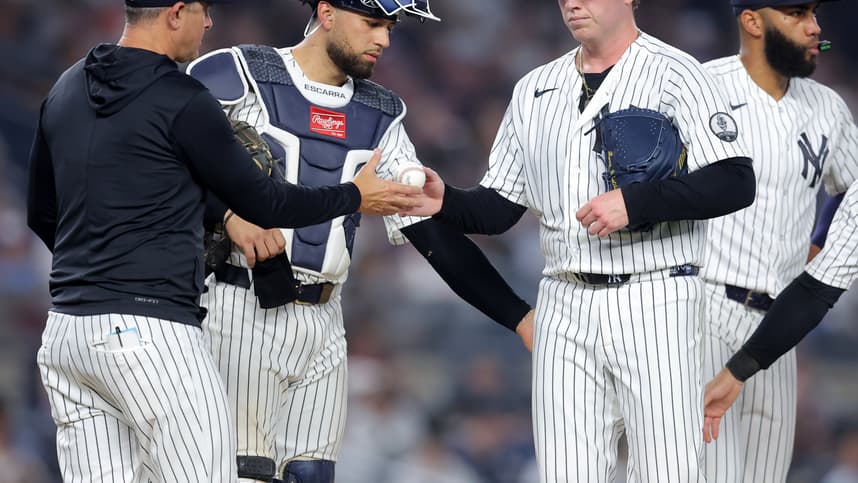
Ryan Weathers delivered a seven-inning shutout performance to help the Yankees defeat the Rays despite an anemic offensive performance once again.
The left-hander lowered his ERA on the season to 3.14 as he has become a reliable part of the rotation, pitching like a no. 2 starter for the Bronx Bombers.
When the Yankees first acquired Weathers, he was viewed as a backend starter who would shift to the bullpen when everyone was healthy, but he’s pitched far better than that pre-season evaluation would have suggested.
In a trade market that saw some hefty prospect packages sent over to acquire viable MLB starters, the Yankees look like geniuses for their trade of Ryan Weathers.
READ MORE: The Yankees’ starting center fielder is waking up
Why Ryan Weathers Is Dominating With the Yankees
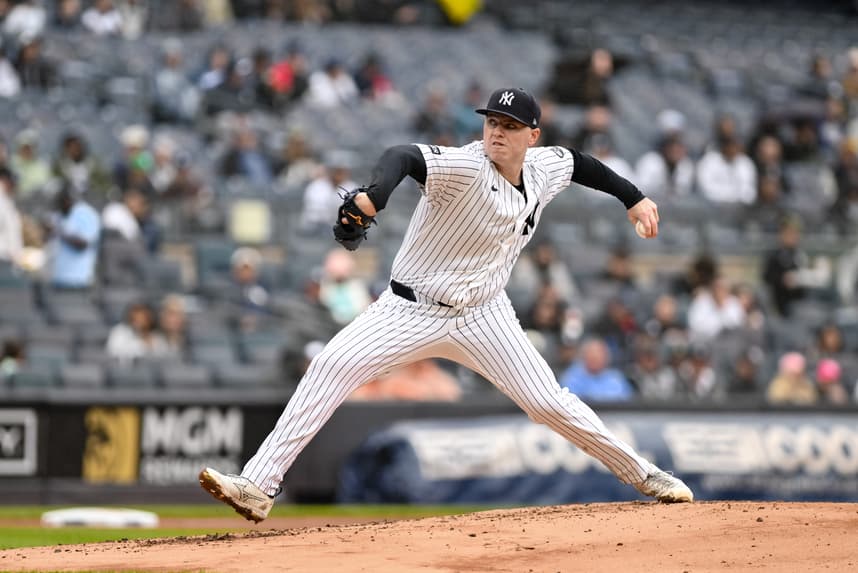
With the Miami Marlins, Ryan Weathers had a very vertical profile, sporting a four-seam fastball with carry, a sweeper that lacked lateral movement, and a good changeup.
He didn’t have the ability to move the ball into lefties or away from them, creating stark reverse splits that the Yankees attempted to solve with a few tweaks.
They’ve had him lower his arm angle and release height which allowing him to get around the ball better, which leads to those sinkers and sweepers that he’s had some success with.
Ryan Weathers gained over an inch of run on his two-seamer and over three inches of sweep on his slider as a result of these alterations to his release point, eliminating the left-on-left issues he had in 2025.
Left-handed batters are striking out over 36% of the time against Weathers in 2026 without recording a single extra base hit, a massive departure from 2025 where he had a 3.68 HR/9 against them.
Another quirk from Ryan Weathers changing his release points is that he now has one of the widest releases in the sport for a left-handed pitcher.
He’s using this unique release point to his advantage; not only are the pitches he’s throwing coming in at an angle that hitters don’t see often, but he’s locating them in a way that allows for easy called strikes and swings out of zone.
Weathers can throw his sinker to his gloveside in order to steal strikes consistently, as the pitch starts as if it’s heading off the plate before the late breaking action causes it to clip the edge of the plate for a strike.
He also does this effectively with his four-seamer, and by sprinkling in both four-seamers and sinkers he can keep hitters off-balance since they have distinct movement profiles.
You’ll also see Weathers steal strikes by throwing his sweeper to his arm-side, as the pitch also looks like it won’t clip the zone before seemingly floating onto the corner for a strike.
Ryan Weathers has the second-lowest Zone Swing% against (61.3%), and it’s thanks to his brilliant command which has taken massive leaps from his time in Miami.
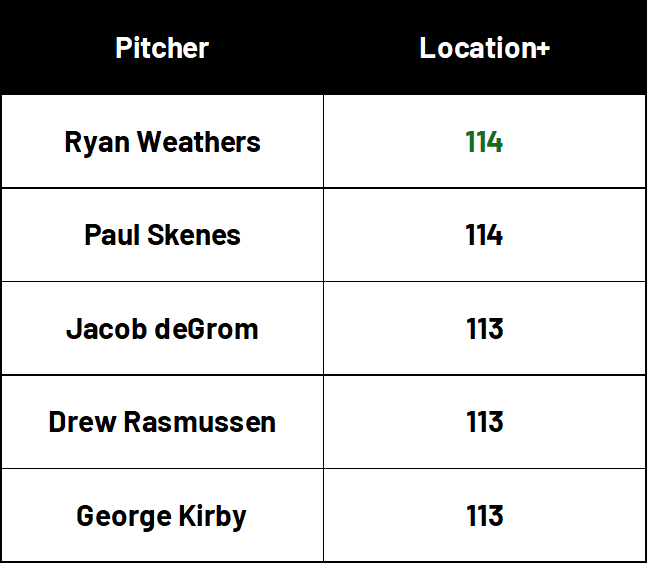
FanGraphs’ Location+ model, which attempts to quantify how good a pitcher is at putting their pitches where they need to be in order to have success, rates Ryan Weathers as having the best location in MLB next to Paul Skenes.
He’s consistently executing pitches and mixing up fastballs, changeups, and sliders with a funky arm angle, in a lot of ways this is a modern twist on the crafty left-hander.
A lot of people attribute velocity to a lack of pitchability or a way to ignore pitchability, but Ryan Weathers stands as an embodiment of where smart teams are going with scouting.
Paul Skenes throws 100 MPH and is a physical specimen, but what allows him to dominate is that he has elite command and a deep mix, his pitchability would get an 80-grade while his raw stuff is firmly above-average.
Cam Schlittler came up in Northeastern University as a command-over-stuff pitcher, and when he was able to finally put on the weight, he became a power pitcher who can throw three different fastballs and two breaking balls.
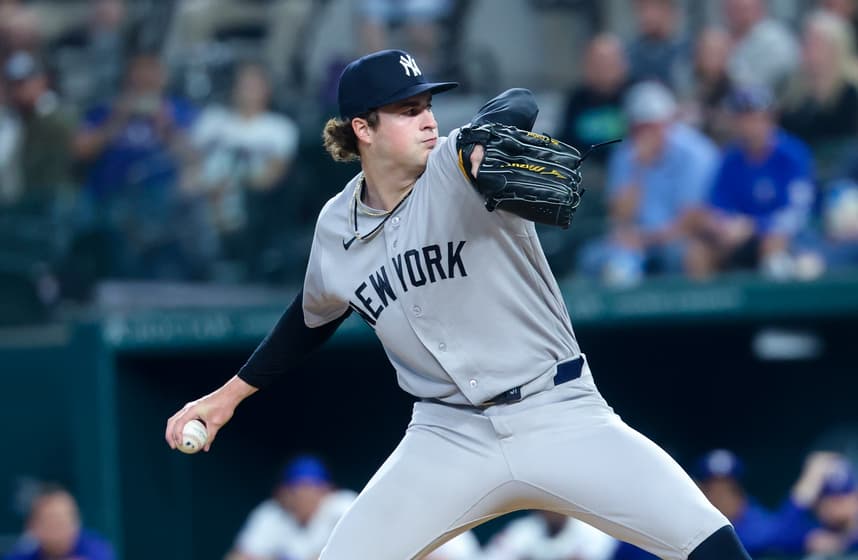
Rather than categorizing Ryan Weathers as a stuff demon who needs to just fill up the zone, the Yankees took the approach of trying to teach him how to sequence and deepen his mix.
He sits around 95-96 MPH and we’ve seen him rear back and hit 100 MPH, but his game has become keeping hitters on their toes and truly leaning into his pitchability skills.
As a result, the Yankees have a pitcher who looks like a legitimate frontline starter and has plenty of cheap club control as well.
The Mets traded Jett Williams and Brandon Sproat for Freddy Peralta and Tobias Myers, the Cubs traded Owen Caissie for Edward Cabrera, and the Rangers traded five prospects for MacKenzie Gore.
While the Yankees traded four prospects for Ryan Weathers, it was considered the weakest return among these trades, and yet he’s performed the best and presently has the most trade value.
If he can finish the season with an ERA around 3.50-3.60 while logging over 100 innings as a starter this is a pretty successful outcome considering the health issues and the uncertainty around his effectiveness.
This isn’t just about Sam Briend or Matt Blake, it isn’t even just about Brian Cashman.
It’s about their scouting, player development, and R&D department gelling together once again to find another gem on the pitching market.

More about:New York Yankees