
 Alexander Wilson
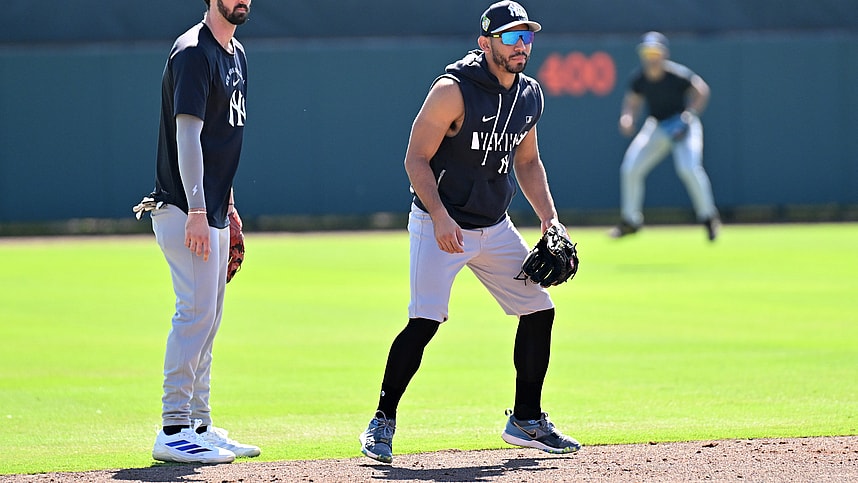
The Yankees need to drop the loyalty bit when it comes to young shortstop Anthony Volpe, who is currently rehabilitating from a partially torn labrum in his throwing arm. The injury was more serious than he led people to believe, but that doesn’t correct the previous two years, where he had a wRC+ below 100, indicating he was below average before the injury ever even happened.
“He told me that the tear in his labrum was perhaps a little bit worse than they thought once they actually got in there and started doing the surgery, and they put about six sutures in it,” YES Network’s Meredith Marakovits said in mid-February. The severity of the injury, which required six sutures to repair, raises questions about how much it affected his 2025 performance and whether the Yankees should have shut him down earlier.
The Offensive Reality
The 24-year-old hit .212/.272/.391 last season, including 19 home runs and 72 RBIs with 18 stolen bases. His 83 wRC+ suggested he was 17% below average. Offensively, he sold out for power, and while that resulted in his 19 home runs, his contact plummeted, and his strikeout rate settled in at 25.2%.
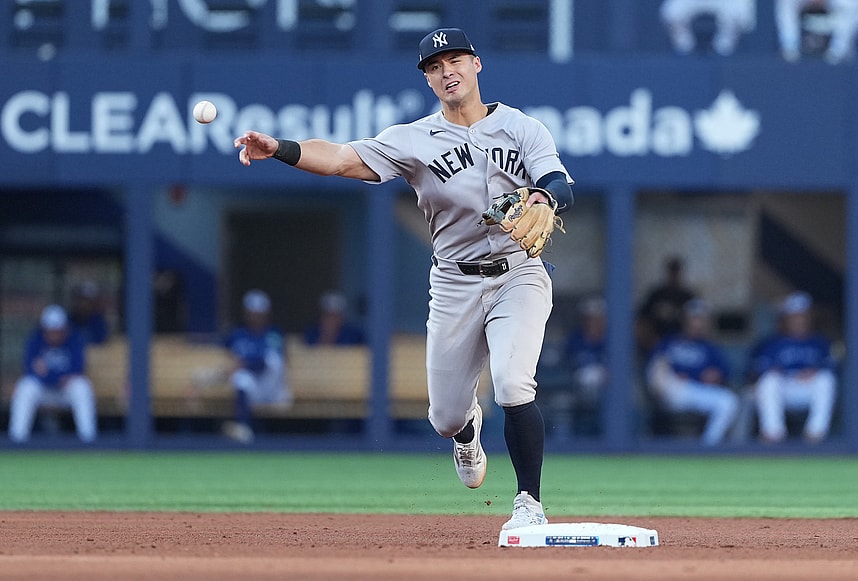
“We’ve got to get that number to go up,” manager Aaron Boone said, per MLB.com. “There’s a lot of different ways to do that, whether it’s getting on base more and hitting for a higher average, or whether it’s being more consistent on the power front.”
The problem extends beyond one disappointing season. Over his three-year career, Volpe owns a .222 batting average and .662 OPS. His 85 wRC+ ranks tied for 100th among 103 players with at least 1,500 plate appearances over the past three seasons. That’s not injury-related variance; that’s a sustained pattern of below-average offensive production.
The Defensive Decline
Defensively, his Gold Glove-caliber value plummeted as well. Over 1,303.2 innings, he posted two defensive runs saved with -7 outs above average and -5 fielding run value. If he’s not playing Gold Glove-level defense, Volpe simply isn’t a starting caliber player, and that’s concerning.
Volpe was charged with 19 errors, tied with Trevor Story for third-most among MLB shortstops, per MLB.com. Only Elly De La Cruz (26) and CJ Abrams (22) had more. His -6 outs above average in 2025 represented a catastrophic drop from his +13 OAA in 2024.
“For the noise around him this year and the struggles he went through defensively in the middle of the season,” Boone said, “I think it’s really important to know how good he was the final two months, which is more in line, defensively speaking, with who he’s been these first few years.”
But that charitable interpretation ignores the overall body of work. Even if Volpe finished strong defensively, his -7 OAA for the full season represents a player who cost the Yankees outs rather than saving them. For a shortstop whose offensive value depends entirely on elite defense to justify his roster spot, that’s unacceptable.
The Jose Caballero Alternative
That leads us to an important question: Should the Yankees be considering Jose Caballero as the starting shortstop even when Volpe returns? Caballero launched a solo homer against the New York Mets in the Yankees’ third spring training game of the season, continuing to make his case for extended playing time.
Since being acquired from the Tampa Bay Rays at the deadline last summer, he played 40 games with the Yankees during the regular season, hitting .266/.372/.456, including three homers and nine RBIs with 15 stolen bases. His ability to wreak havoc on the bases is critical to why he brings so much value, and the Yankees will want him playing frequently.
“Now with José Caballero in the mix, we have somebody that’s like, ‘Man, this guy’s a really good big league player,'” Boone said during a February 2 WFAN appearance. “I think [Caballero] showed that with us. He’s shown that the last couple of years with Tampa and Seattle, can really legit defend at a lot different places, including shortstop.”
If he can even be an average-level offensive contributor with good defense, there should be a conversation about him starting at shortstop long-term, even when Volpe returns. In his career, he has a .971 fielding percentage over 1,184.2 innings at shortstop, including five defensive runs saved, nine outs above average, and nine fielding run value. Those are good metrics that suggest he can hold down the spot if necessary.
The Performance Gap
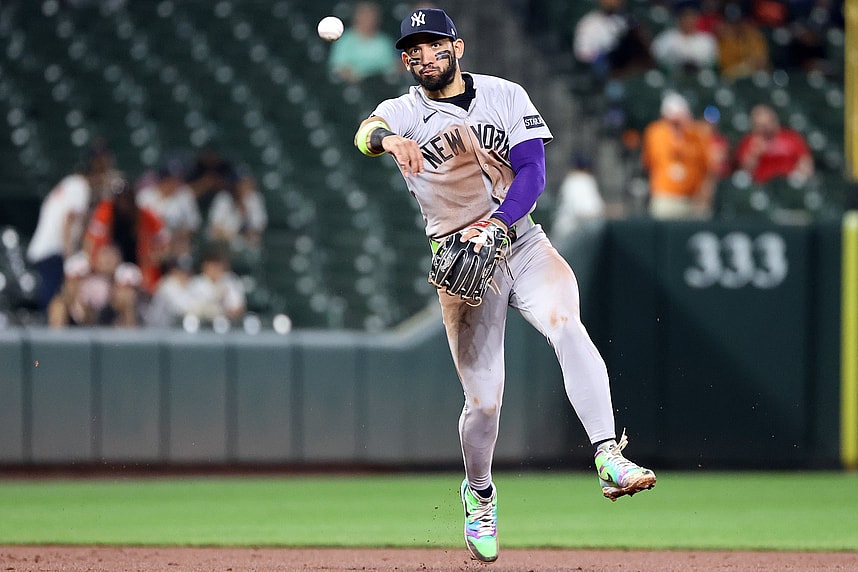
The contrast between Volpe and Caballero in their limited 2025 sample with the Yankees is stark. Caballero’s .372 OBP in 40 games dwarfs Volpe’s .272 mark. His .456 slugging percentage significantly outpaces Volpe’s .391. Most importantly, his 15 stolen bases in just 40 games projects to roughly 60 steals over a full season, compared to Volpe’s 18 in 153 games.
Caballero’s defensive metrics over his career (+9 OAA, +9 fielding run value) surpass Volpe’s 2025 numbers (-7 OAA, -5 fielding run value). While Caballero’s sample size with the Yankees is small, his track record with Tampa Bay and Seattle demonstrates he’s not a fluke. He’s a proven major league player who excels at the things the Yankees desperately need: getting on base, stealing bases, and playing solid defense.
The Loyalty Problem
“Do I believe in Anthony Volpe? The answer is yes,” general manager Brian Cashman said, per MLB.com. But belief without evidence is just hope, and hope doesn’t win championships. The Yankees’ loyalty to Volpe feels increasingly like the sunk cost fallacy, where they’re committed to justifying their first-round investment (30th overall in 2019) rather than making the best baseball decision.
“The challenge for us and for him is going to be to shore up those things to make him more consistent,” Boone said. “Everyone’s path isn’t linear. We always wanted to be here. That can be tough, especially in New York, when you’re finding your way.”
But at what point does “finding your way” become an excuse for underperformance? Volpe has had three full seasons to establish himself. His career .222 average, .662 OPS, and 85 wRC+ paint a clear picture of a below-average hitter. His 2025 defensive regression suggests the shoulder injury affected more than just his swing. And his injury timeline (likely out until May) gives Caballero a two-month audition to prove he deserves the job permanently.
The George Lombard Jr. Factor
While the Yankees wait for George Lombard Jr. to climb the ranks, having Caballero as an alternative to Volpe isn’t a bad situation to be in. Lombard, the Yankees’ top overall prospect, is still likely 18-24 months away from being MLB-ready. In the interim, the Yankees need production at shortstop, not potential.
If Caballero maintains even 80% of his production from his Yankees debut (.266/.372/.456), he’d represent a significant upgrade over Volpe’s career numbers (.222/.294/.423). Add in Caballero’s elite baserunning (15 steals in 40 games) and superior defensive metrics, and the choice becomes clear.
The Yankees should give Volpe a legitimate opportunity to win back his job when he returns healthy, likely in May. But they shouldn’t hand it to him based on pedigree or loyalty. Caballero has earned the right to keep the position if he’s outperforming Volpe offensively and defensively. In a sport where championships are decided by marginal gains, the Yankees can’t afford to sacrifice wins at the altar of player development. If Volpe wants his job back, he needs to take it. Until then, Caballero should be the Yankees’ starting shortstop, injury or no injury.

More about:New York Yankees
