
 Alexander Wilson
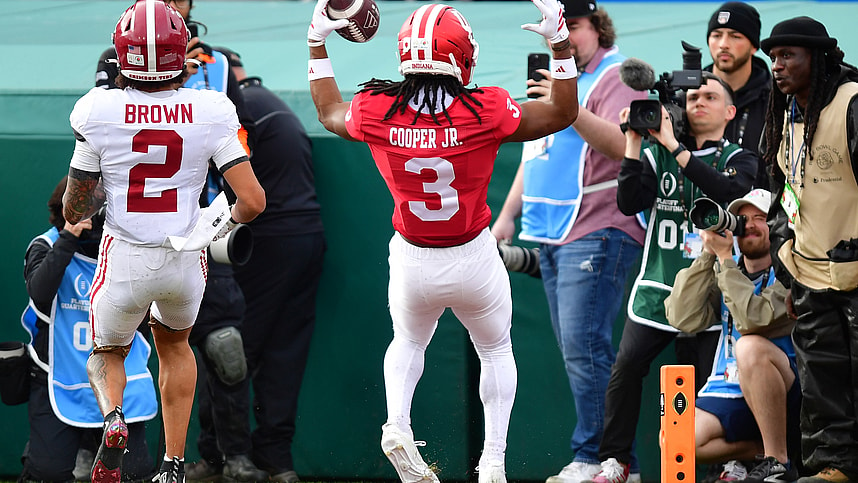
There’s a very real possibility that the New York Giants lose receiver Wan’Dale Robinson in free agency, since he’s expected to get a substantial contract as one of the better options on the market. The 25-year-old would ideally stay with New York, but coming off a season where he tallied 1,014 yards and four touchdowns with 92 receptions, it’s safe to say that some team in need of a receiver will throw him a big bag.
The Giants have to be a bit more calculated in how they spend their money, but if Robinson walks, they could target a wide receiver in the second round if they pass on Carnell Tate or Jordyn Tyson in the first. One option that stands out is Omar Cooper Jr. out of Indiana, a 22-year-old playmaker who can play inside and out.
Production Profile and Versatility
Cooper spent 591 snaps in the slot last year and 144 out wide, demonstrating the positional flexibility that Matt Nagy values in his offense. He’s essentially a replacement for Wan’Dale but has better size at 6 feet and 204 pounds. This past season, Cooper tallied 69 receptions with a 75.8% reception rate, 937 yards and a tremendous 13 touchdowns. He dropped only three passes, good for a 4.2% drop rate.
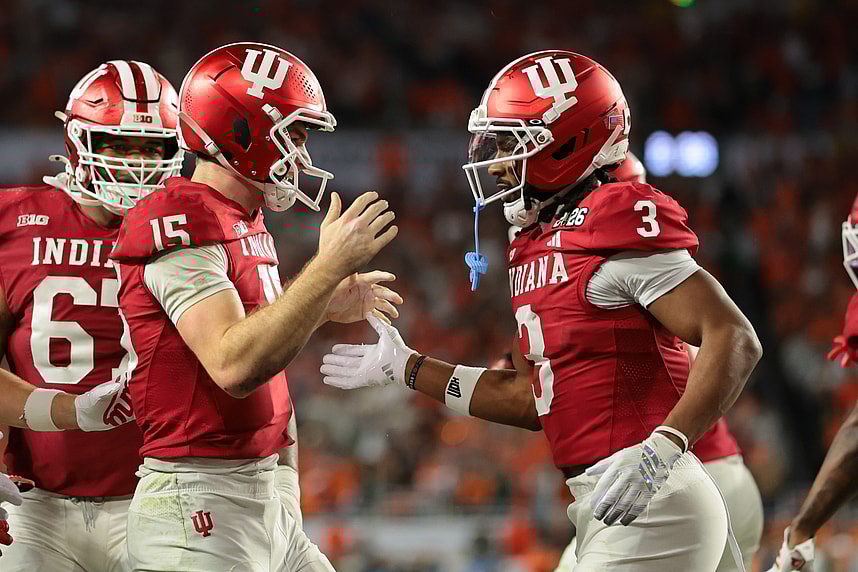
Those numbers tell only part of the story. Cooper forced 27 missed tackles in 2025, tied for fourth among all FBS receivers. That’s elite contact balance for a player his size. His 44 receptions that went for either a first down or touchdown demonstrate his ability to convert in crucial situations. The consistency is what separates him from other slot prospects, as he finished with an 82.2% catch rate over his final eight games.
Scout’s Film Breakdown: Technical Excellence
From a scouting perspective, Cooper’s route running is what immediately jumps off the tape. He doesn’t tip his stem, maintaining the same body posture whether he’s breaking inside, outside, or continuing vertical. His footwork in and out of breaks is clean, using subtle weight shifts and pacing variations to create separation against both man and zone coverage. He’s particularly effective working the horizontal plane, using crossers, digs, and slants to attack the middle of the field.
His release package needs refinement against press coverage, as he primarily faced off coverage at Indiana. However, his quick feet and leverage understanding allow him to win when corners do get physical at the line. Once into his route, he’s a cerebral operator who understands how to weave through zone coverage and find soft spots. His instincts in scramble drills are NFL-caliber, consistently uncovering for his quarterback when plays break down.
The hands are legitimate. Cooper tracks the ball naturally through the catch point, securing contested throws and maintaining focus through contact. His catch radius is impressive for his compact build because of excellent body control and ball skills. There were occasional instances where his competitiveness got the better of him, turning to run before fully securing the catch, but those were rare lapses in an otherwise technically sound season.
Run Blocking and Physical Toughness
Cooper is also known for his tremendous run-blocking qualities, and that toughness is certainly attractive for the Giants’ coaching staff. If the Giants are looking for a receiver who can block on the outside to emphasize their running game, Cooper stands out nicely. He plays with the competitive edge Nagy demands, seeking out contact away from the ball and understanding his role within blocking schemes.
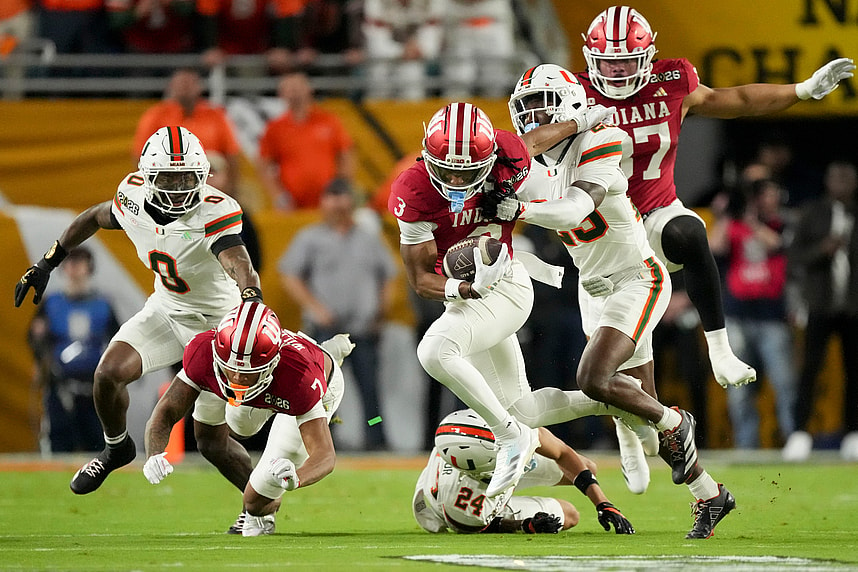
His compact, dense build gives him natural leverage against defensive backs in the run game. He’s not just willing to block, he genuinely enjoys the physical nature of it. That mentality translates to his work after the catch as well, where he runs through arm tackles and bounces off defenders to maximize yardage.
The 27 forced missed tackles weren’t empty production. Cooper runs with natural power despite his size, lowering his pad level and generating momentum through contact. He’s not going to run away from NFL safeties, as he lacks elite long speed, but he’ll consistently turn five-yard catches into 12-yard gains through contact balance and vision.
Perfect Scheme Fit in Nagy’s Offense
Matt Nagy’s offensive system is built around motion, misdirection, and creating advantageous matchups for his playmakers. Cooper’s positional versatility makes him an ideal fit. He can align in the slot, motion to the perimeter, or work from a wing alignment. His ability to threaten defenses at all three levels, despite lacking elite vertical speed, makes him valuable in Nagy’s timing-based passing concepts.
Nagy loves receivers who can win on quick-game concepts and operate efficiently in the short and intermediate areas. Cooper’s 9.7 ADOT (average depth of target) in 2025 shows he’s comfortable working underneath, which is exactly where Nagy’s offense generates the majority of its completions. His run-after-catch ability turns those short completions into explosive plays, and his blocking mentality fits perfectly with Nagy and Greg Roman’s style.
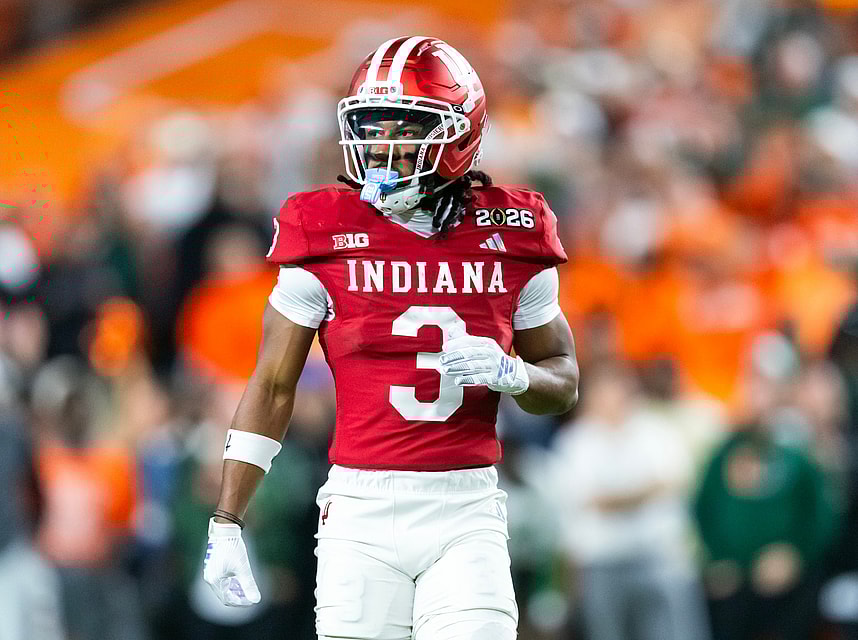
The comparison to Ladd McConkey is apt. Both are technically refined route runners with excellent hands who lack elite measurables but produce at a high level through precision and toughness. Cooper won’t run 4.3, but he accelerates quickly and possesses enough burst to threaten seams and create separation in the short area. His 13.6 yards per catch demonstrates his ability to turn intermediate routes into chunk gains.
Areas for Development
Cooper needs to expand his route tree at the NFL level. Indiana ran a lot of RPO concepts and basic route combinations that allowed him to win with leverage and quickness. He’ll need to prove he can execute the full NFL route tree with consistent stem discipline and separation techniques. His lack of top-end speed limits his effectiveness stacking corners vertically, so he’ll need to win with technique rather than pure athleticism.
His release package against press coverage requires refinement. NFL corners will challenge him more physically at the line than Big Ten defenders did. He’ll need to develop counters and hand usage to consistently create clean releases against aggressive press schemes. The injury history is also worth monitoring. He tore his ACL as a junior in high school and missed time in 2023 with a leg injury, though he played through a minor knee issue and ankle injury during Indiana’s championship run.
Draft Value and Replacement Cost
Cooper projects as a mid-Day 2 selection, likely in the 50-75 range. If the Giants are looking for a receiver who can block on the outside to emphasize that running game, Cooper stands out nicely. He has speed, suddenness, hands and toughness, not to mention plenty of capability after the catch. He seems to be a total package type of player, and if he were around in the second round for the Giants, he’d be an easy solution to replace Robinson at a fraction of the cost.
Robinson will likely command $12-15 million annually on the open market after his breakout 2025 season. Cooper, as a second-round pick, would cost approximately $1.5-2 million annually over four years. That’s massive savings that the Giants can allocate toward other positions of need while getting 80-85% of Robinson’s production from a cheaper, younger asset.
With that being said, there’s plenty of attention surrounding him right now, and it’s totally possible he ends up in the first round. His National Championship performance raised his profile significantly, and teams that value YAC ability and blocking will push him higher than expected. But if he’s available when the Giants pick in the second round, he represents excellent value as a plug-and-play slot receiver who can contribute immediately in Nagy’s system while providing the toughness and versatility the Giants covet at the position.

More about:New York Giants
