
 Alexander Wilson
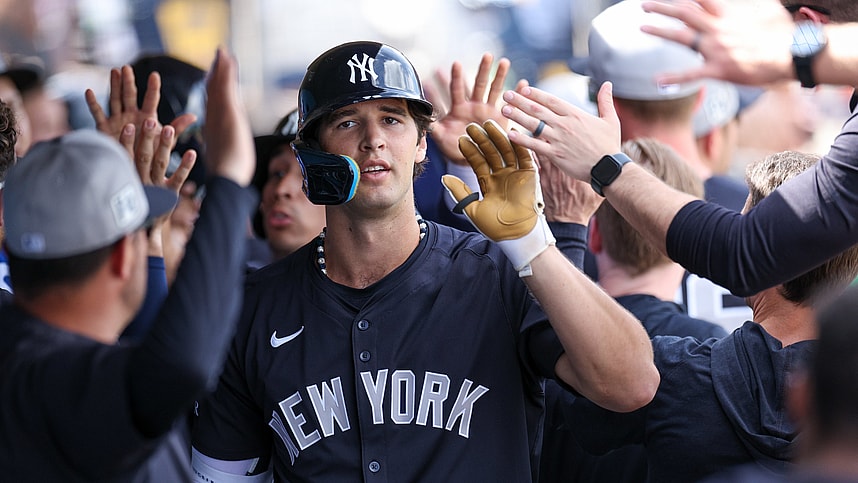
The Yankees have a position battle unfolding in the outfield outside of the starting three between Jasson Dominguez and Spencer Jones. In theory, one of them should win the fourth outfield job, even though the coaching staff believes they’re better equipped to start in Triple-A, where they can get everyday reps. However, the Yankees need a reliable fourth outfielder who can shift in and out on a daily basis.
The start of the season will likely not require the Yankees to have a high-upside hitter sitting on the bench. They want them getting everyday reps. It’s entirely possible they start the season with both Dominguez and Jones in the minors until they need to call up one of them on a moment’s notice. Even so, Dominguez and Jones are vastly different players.
Jones’ Swing Overhaul Mirrors Judge’s Approach
Jones is doing everything in his power to find a better groove, changing his swing mechanics considerably this offseason to remove a leg lift. Instead, the Yankees clearly feel he doesn’t need to load his lower body as aggressively, given his natural strength. The adjustment maintains a more stable base to increase contact, an approach that directly mirrors Aaron Judge’s setup at the plate.
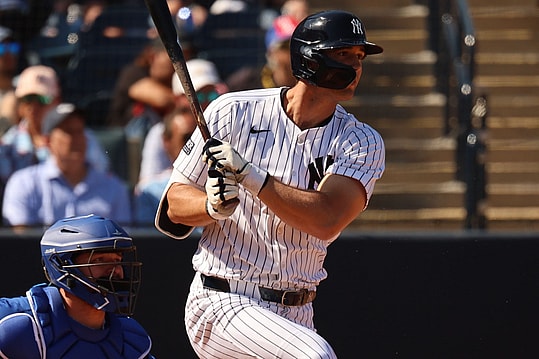
Judge’s swing is built on a quiet, balanced foundation. There’s minimal movement in his lower half before the pitch, allowing him to track the ball longer and make split-second adjustments. His hands stay back, his weight distribution remains centered, and his stride is short and controlled. This stability gives Judge elite bat-to-ball skills despite his massive frame and power output.
Jones’ new swing adopts these same principles. By eliminating the leg kick, he’s removing a timing variable that can throw off his swing when pitchers change speeds or manipulate sequencing. The simpler load keeps his head still, maintains better balance, and allows his natural 6-foot-7 frame to generate power through rotation rather than excessive lower-body movement. For a player with Jones’ raw strength, the adjustment makes perfect sense. He doesn’t need extra momentum to drive the ball.
The Numbers Tell Different Stories
| Player | Level | PA | AVG | OBP | SLG | HR | SB | wRC+ |
|---|---|---|---|---|---|---|---|---|
| Spencer Jones | 2025 MiLB | 506 | .274 | .362 | .571 | 35 | 29 | 153 |
| Jasson Dominguez | 2025 MLB | 429 | .257 | .331 | .388 | 10 | 23 | 103 |
Jones’ 2025 minor league numbers were elite. His 153 wRC+ across 506 plate appearances means he was 53% better than the average hitter at his level. The 35 home runs and 29 stolen bases showcase a legitimate five-tool ceiling, and his .274 batting average with a .362 on-base percentage demonstrate improved contact quality compared to his 2024 campaign (.259/.336/.452, 128 wRC+).
Dominguez’s 2025 MLB numbers tell a more complicated story. His .257/.331/.388 slash line across 429 plate appearances shows a player who can get on base but lacks the power production expected from a corner outfielder. Just 10 home runs in 381 at-bats is concerningly low for someone with his prospect pedigree. His .388 slugging percentage suggests he’s hitting too many singles and not enough extra-base hits to profile as an everyday corner bat.
The Defensive Divide
Jones offers elite power for the left side of the plate, but has serious concerns when it comes to strikeouts and contact rates. He offers good defense and good baserunning, though, which does give him a leg up over Dominguez, even though Dominguez has MLB experience. Jones’ defensive metrics suggest he can handle center field or either corner, and his 29 stolen bases in 2025 prove he’s a legitimate threat on the bases.
Dominguez is a horrible defensive player, a good baserunner, and a left-handed bat that hasn’t yet displayed the raw power expected. His Baseball Savant profile shows elite arm strength (92nd percentile) and elite sprint speed (84th percentile), but his defensive positioning and reads in the outfield have been consistently poor. The 80th percentile baserunning run value (2 runs above average) confirms his speed plays on the bases, but his defensive limitations make him difficult to trust in a fourth outfielder role where versatility matters.

The Platoon Problem
Dominguez is essentially a left-handed platoon bat given his right-handed splits are horrific. While his overall .257 batting average looks acceptable, the breakdown against righties versus lefties reveals significant vulnerabilities.
Jones’ left-handed bat profiles better as a full-time option, particularly if the swing adjustments improve his contact rates against left-handed pitching. His 35.4% strikeout rate in 2025 remains a concern, but the 11.5% walk rate shows improved plate discipline. The new swing mechanics should help him recognize spin better and reduce swing-and-miss on breaking balls away.
The Triple-A Solution
The Yankees’ coaching staff is right to prefer both players starting in Triple-A. Jones needs to prove the swing changes translate to game action and improve his strikeout rate. Dominguez needs to show he can hit for power and improve his defensive positioning before earning everyday MLB at-bats. Neither player is ready to sit on the bench and provide occasional spot starts.
There’s still plenty of upside left to extract from both players. The Yankees just need to be patient. Jones’ 153 wRC+ in the minors suggests he’s close to forcing a promotion if he continues hitting. Dominguez’s 85th percentile hard-hit rate (49.6%) shows the raw power exists, even if it’s not translating into home runs yet.
The Verdict
If forced to choose today, Jones has the edge. His defensive versatility, baserunning ability, and elite minor league production make him the safer bet. The swing changes removing the leg lift should improve his contact rates and reduce strikeouts, addressing his biggest weakness. The Aaron Judge comparison isn’t just about their similar 6-foot-7 frames. It’s about understanding that elite hitters don’t need excessive movement to generate power. Judge proved that a stable, balanced approach maximizes both power and contact. Jones is betting his career trajectory on the same principle.
Dominguez has the higher ceiling if everything clicks, but the defensive limitations and platoon concerns make him a riskier proposition for a fourth outfielder role. His 23 stolen bases and elite arm strength provide value, but not enough to overcome the hitting concerns and defensive struggles. The Yankees will likely start both in Triple-A, monitor their progress, and promote whichever player forces the issue first. Based on 2025 production and the swing adjustments Jones has made, he’s in the driver’s seat heading into spring training.

More about:New York Yankees
