
 Ryan Garcia
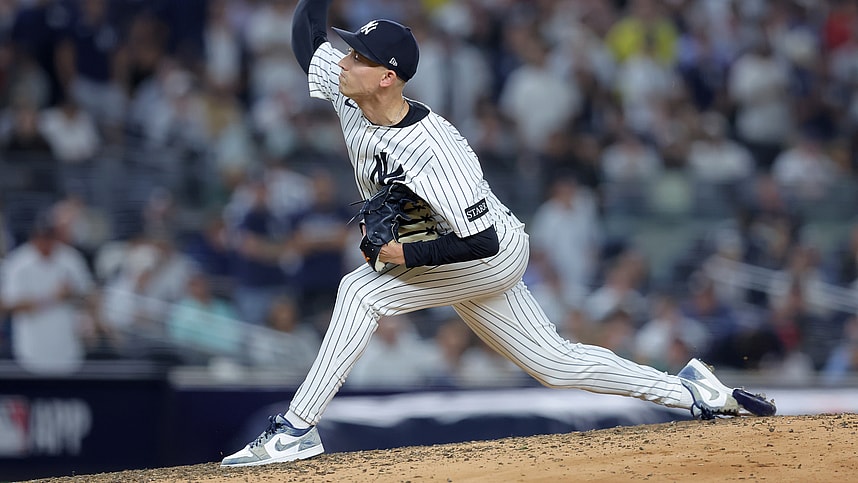
There’s been a good amount of confusion surrounding the Yankees’ desire to bring back Luke Weaver following what can only be described as an abhorrent postseason.
It’s become a trend for the Yankees in the offseason so far, they extended Trent Grisham the QO despite his poor showing in the postseason and brought back Ryan Yarbrough when he wasn’t even placed on their playoff rosters.
With that being said, we’ve discussed before the dangers of projecting future playoff results based on someone’s most recent postseason, and while fans might not agree, no smart organization takes much stock into those things.
Weaver, who did take a step back from his 2024 output, remained an effective reliever in 2025, and the reasons why teams are still into his profile are clear as day if you look at the deals handed out to pitchers so far.
READ MORE: Carlos Rodon expects to be pitching for the Yankees in Spring Training, still out for Opening Day
What Do the Yankees Care About When Signing Relievers?
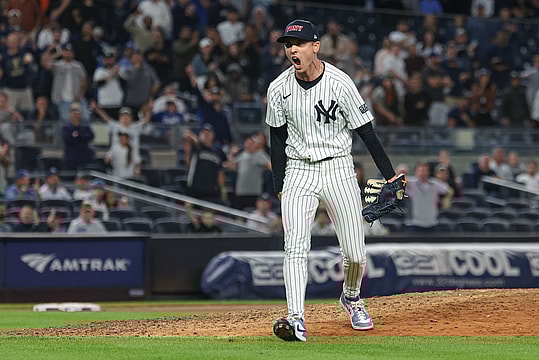
Luke Weaver is a player of interest for reasons that don’t line up with what the average MLB fan would pay attention to when it comes to free agent targets.
What’s also working against Weaver here is how well he performed in 2024; not only was his ERA below 3.00, but he was so good in high-leverage situations that it would be nearly impossible for him to replicate it again.
He finished seventh in Win Probability Added (+3.28) and allowed four hits (.078 AVG) in High Leverage situations according to FanGraphs.
The individual statline was great, but the timing on when he’d perform was impeccable, none of this of course being sticky in the slightest.
So when Luke Weaver eventually stumbled in high leverage moments and had more blow-ups than we saw the year prior, we rightfully just assumed the “tough” and “unshakeable” pitcher from 2024 regressed on multiple fronts.
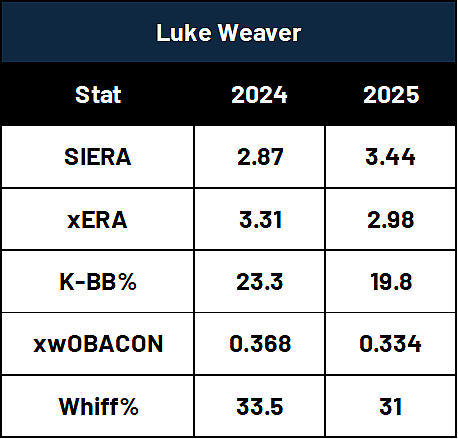
Luke Weaver’s command and polish on the mound wasn’t where it was in 2024, and despite that he still had all the makings of a strong relief pitcher.
This is not a top-10 reliever in the sport, but these are the metrics of a pretty good bullpen weapon, at least one that makes your team significantly better.
When breaking down Weaver’s repertoire, there isn’t much of a change in fastball velocity or shape that cannot be attributed to year-to-year noise.
As for the changeup, there was a notable decrease in vertical drop, but this pitch didn’t see any decrease in effectiveness, so I’m not too concerned about how it’ll perform in 2026.
Maybe there’s a long-term concern with his mechanics falling apart since his command took a step back this year, especially given that Weaver isn’t physically imposing and will spend all of 2025 as a 32-year-old.
That being said, those are hypotheticals that can be applied to any free agent pitcher, even the best relievers are volatile enough to have a down year out of nowhere (Devin Williams anybody?)
Luke Weaver Might End Up Being a Bargain On the Free Agent Market
As I mentioned earlier, I want the Yankees to take advantage of the market inefficiency of adding players who have been scorned in their final season with the team.
Gleyber Torres ($12 million), Devin Williams ($51 million), and Clay Holmes ($38 million) all signed firmly below-market value contracts and while we don’t know for Williams just yet, the other two returned on investment beautifully.
There’s a stink on these players, a stink that is created because the incumbent team doesn’t bid and drive up the price tag, and projections seem to believe Luke Weaver won’t get a ton of cash.
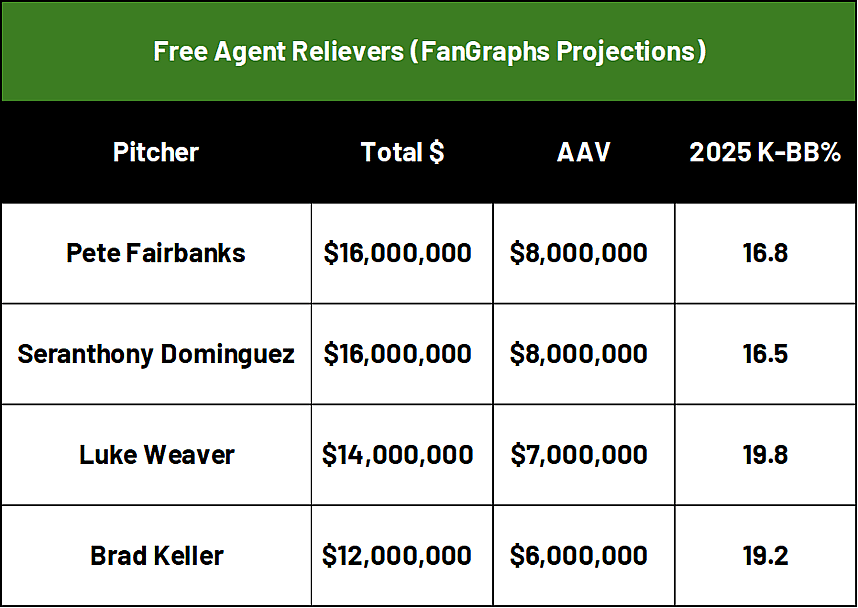
It’s been reported that Pete Fairbanks would sign for a deal closer to what Ryan Helsley got ($28 million, two years) while Brad Keller is almost certainly going to beat that $12 million for two years projection.
There’s no certainty in the slightest that Luke Weaver will beat two years $14 million given that he doesn’t have the shiny closer label that Fairbanks has or the elite-level results that come with Keller.
Weaver had the best K-BB% in 2025 of all of these relievers who FanGraphs have grouped together for contracts in this market, and it’s why he could be a steal.
Everyone laughed at the Devin Williams contract, but Robert Suarez signed for just $6 million less over the same timeframe weeks later.
Dylan Cease demonstrated this, but teams pay for strikeouts instead of ERA, and that’s why Weaver has a serious appeal for any contender looking to make a strong signing.
The Yankees shouldn’t break the bank for Luke Weaver, but if he signs at the mark FanGraphs believes he will, this could be one of their best contracts handed out this winter.

More about:New York Yankees
