
 Alexander Wilson
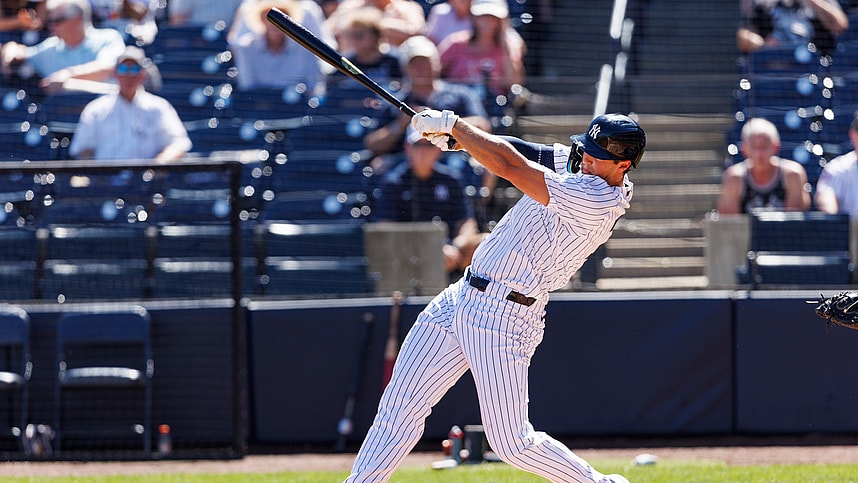
The Yankees got another example of just how polarizing a prospect Spencer Jones is in the outfield. The Yankees completely demolished the Detroit Tigers 20-3 on Saturday afternoon, and Jones enjoyed his first action of spring. In three at-bats, he struck out twice but launched a monster 408-foot bomb to right field in the second inning that left his bat at 111.7 mph.
That single swing perfectly encapsulates everything you need to know about Jones. He’s a Ferrari with no brakes, a lottery ticket that could either pay off a mortgage or end up crumpled in a trash can. There’s no middle ground with this kid, and Saturday proved it once again.
The Judge-Ohtani Hybrid Swing
Jones has been tweaking his swing mechanics all offseason, looking like a blend of Aaron Judge and Shohei Ohtani with his batting stance. The broadcast announcers immediately noticed, describing it as “almost Ohtani-like, with kind of a toe tap with his front toe instead of a kick or a hover.”
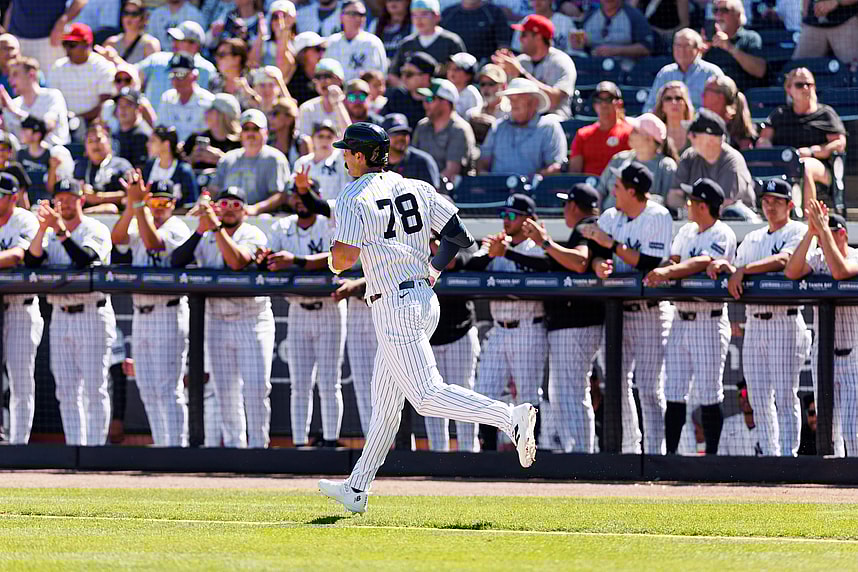
Clearly, there’s raw power that is unmatched with his upper body, which is why the Yankees have tried to limit the motion of his lower body, instead loading from his top half.
“The minute he puts that foot down with that little toe-tap, he’s ready to hit,” Judge told Bryan Hoch of MLB.com. “They might have gotten him with a lot of high heaters in the past, or even last season. I think that’s just going to help him. He doesn’t have a big leg kick and doesn’t have to worry about trying to get that down. I liked the results I saw in that first at-bat. That quickness, that readiness, it’s really going to be a game-changer for him.”
By eliminating the leg kick, Jones is removing a timing variable that plagued him throughout the minors. It’s like trying to parallel park a truck while also juggling, eventually you just need to put the juggling balls down and focus on one thing. The new approach mirrors Judge’s quiet, balanced setup that allows him to track pitches longer and make split-second adjustments without his mechanics betraying him.
The Contact Problem Remains
All they need is for him to make more frequent contact and cut down the strikeouts, and his upside is unlimited. That’s the entire equation, and it’s been the same equation since the Yankees drafted him 25th overall in 2022. Jones struck out 179 times in 438 minor league at-bats last season. That’s a 35.4% strikeout rate that would make Adam Dunn blush.
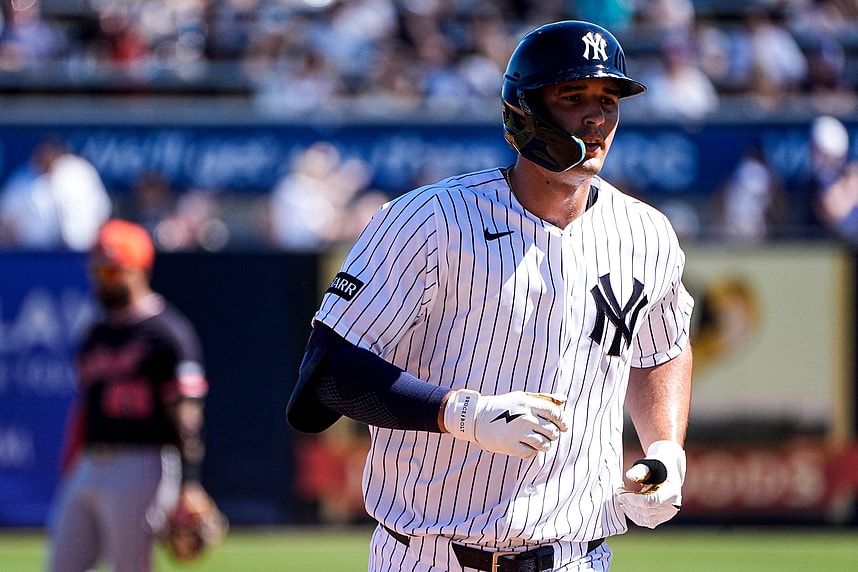
The power is undeniable. He mashed 35 home runs across Double-A Somerset and Triple-A Scranton in 2025, including 19 at the highest level. His .274 batting average and .362 on-base percentage at the MiLB level showed improved contact quality compared to 2024 (.259/.336/.452), but the strikeouts remain the elephant in every room he enters.
Saturday’s performance was Jones in miniature: one swing that makes you believe he’s the next great Yankees slugger, two swings that remind you he might never figure it out. It’s exhausting to evaluate him because the highs are stratospheric and the lows are crater-deep, with almost nothing in between.
The Complete Toolset
He represents a good defensive player with above-average athleticism to run the bases. He just has plate discipline issues, and that has been his primary issue for years. The work ethic is there, the tangible traits are there. He just needs to keep developing his pitch recognition and contact rates, which should improve with more action.
Jones’ 29 stolen bases in 2025 demonstrate legitimate speed for a 6-foot-7 outfielder. His defensive metrics suggest he can handle center field or either corner with competence. When you combine that with 111.7 mph exit velocity and 408-foot power to all fields, you’re looking at a potential five-tool player. The problem is that fifth tool, hitting for average, remains theoretical rather than actual.
The Fourth Outfielder Battle
He’s the complete definition of a boom-or-bust candidate, and he’s currently competing for the fourth outfield job alongside Jasson Dominguez. However, both need daily reps, so I wouldn’t be surprised to see both of them end up starting in Triple-A until the Yankees need to call up whoever has the hot hand in the minors.
The Yankees’ outfield is locked with Judge, Cody Bellinger, and Trent Grisham. There’s no room for Jones to get the 500-600 plate appearances he needs to develop his contact skills. Sitting on the bench and pinch-hitting twice a week won’t help him learn to recognize breaking balls or lay off high fastballs. He needs to fail, adjust, and fail again until the lightbulb turns on.
My opinion is that Jones should start the season at Triple-A Scranton regardless of how well he hits this spring. Give him 400 plate appearances against Triple-A pitching to prove the swing changes translate to sustained success. If he’s hitting .280 with 25 home runs and cutting the strikeout rate to 30% by June, promote him. If he’s still whiffing 40% of the time, you have your answer and can explore moving him in a trade.
The Make-or-Break Season
Jones acknowledged that he’s using Shohei Ohtani as a model. “He’s a great reference of a really good mover with a great swing,” Jones told Bryan Hoch of MLB.com. “He’s one of those guys that I look at with some of the stuff he does, and I try to apply it in whichever way I can.” That’s an ambitious comparison for a player who’s never faced major league pitching, but the raw tools suggest it’s not completely insane.
The 24-year-old is entering a make-or-break season. The Yankees have been unwilling to trade him even for proven MLB talent, which suggests they believe the upside is worth the volatility. But patience has limits, especially for a team with championship aspirations and Aaron Judge entering his age-34 season.
Saturday’s performance gave us everything we already knew about Spencer Jones. He can hit the ball harder and farther than almost anyone in baseball. He also strikes out more than a narcoleptic night shift worker. The swing changes are encouraging, Judge’s endorsement carries weight, and the tools are undeniable. But until he proves he can make consistent contact against quality pitching, he’ll remain baseball’s most maddening prospect, a player whose ceiling is MVP and whose floor is organizational depth piece. There’s no in-between, and that’s exactly what makes him so fascinating to watch.

More about:New York Yankees
