
 Alexander Wilson
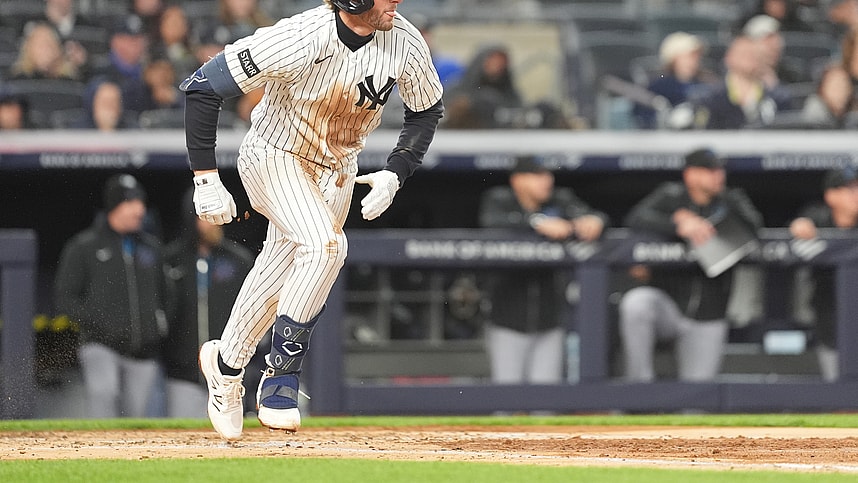
Nine games into the season, the New York Yankees sit at 7-2 and look like a legitimate American League contender. The rotation has been solid. Ben Rice has been one of the better stories in baseball. Aaron Judge and Cody Bellinger are doing exactly what you pay them to do.
Then there is the infield, where things look considerably less tidy.
Ryan McMahon is hitting .087/.276/.087 with a 31 wRC+, meaning he has been 69% worse than the average major league hitter through nine games. His strikeout rate is at 37.9%, ranking in the 6th percentile across the sport. His whiff rate sits in the 18th percentile. The one number keeping the conversation from total catastrophe is his hard-hit rate, which remains at 91% of his career level, evidence that the contact quality is still there when he does make contact. The problem, as it has always been, is that contact is not coming nearly often enough.
Jose Caballero, meanwhile, is hitting .129/.206/.129 at shortstop and has been a documented concern since the first week of the season. Two of the Yankees’ three infield spots, excluding first base, are producing at a level that would be unacceptable from a utility player on a rebuilding team, let alone a lineup built to compete for a World Series.
The McMahon Problem Is Not New
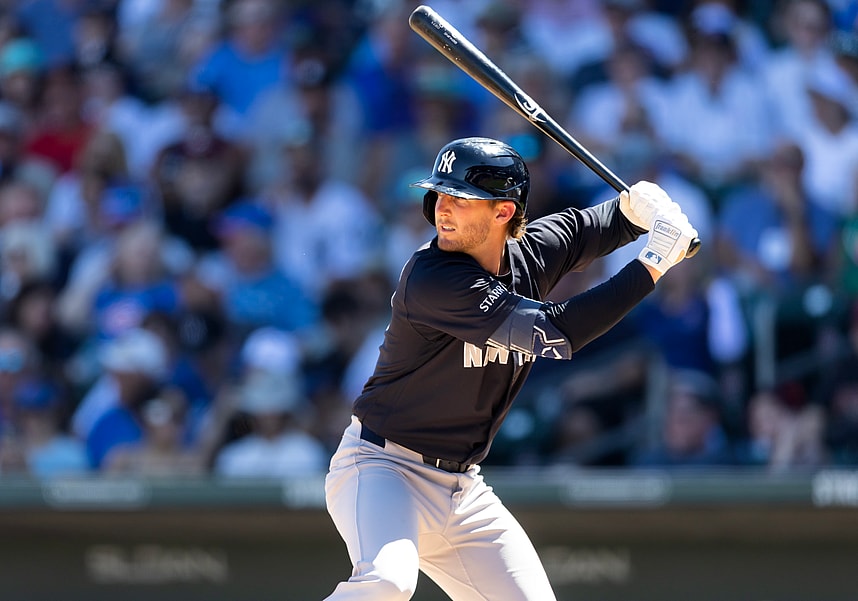
The swing mechanics got the spotlight all offseason. McMahon narrowed his stance significantly, going from the fourth-widest base in baseball to something more compact, with the goal of getting his hands higher at setup and improving his hip rotation through the ball. The theory was sound. The execution has not arrived yet.
His career numbers show a player who has never posted an above-average offensive season in nine major league years. His best came in 2022, when he managed a 97 wRC+ with 20 home runs. Since then, he has declined in three consecutive seasons. The Yankees acquired him knowing that history and believing the contact quality metrics were an argument for optimism. A hitter with 91st percentile hard-hit rate and 95th percentile exit velocity is not a hitter without ability. He is a hitter whose swing has worked against him.
The issue I keep coming back to is the sprint speed. McMahon is one of the slowest runners in baseball (11th percentile), which means when he does make contact, he cannot beat out anything that is not hit with significant authority. A ground ball that a faster hitter beats for a single is an automatic out for McMahon. That compounds the contact frequency problem in a meaningful way. He needs to barrel balls because everything else is leverage he simply does not have.
Through nine games, the barrels are not showing up regularly enough, and the walks, while encouraging at 20.7%, cannot carry a lineup spot on their own. A player who walks a fifth of the time but hits .087 is not helping the team win baseball games.
The Caballero Piece
McMahon at least has a history of producing at a passable level. Caballero’s offensive struggles feel more structurally concerning because his value was always built around speed and defense, and both have been inconsistent. An early season error on Sunday led to a run that contributed to a loss. For a player whose bat was never going to carry a lineup spot, the glove has to be reliable every night.
Anthony Volpe is targeting a return around May 1, which solves the shortstop side of this equation regardless of what Caballero does between now and then. But McMahon does not have a defined end date the way Caballero does. He is the third baseman for the foreseeable future, and if the stance adjustment does not start translating into results over the next few weeks, the questions about his long-term fit on this roster are going to intensify.
What the Trade Deadline Represents
Brian Cashman is not going to panic in April over a 7-2 team’s third baseman hitting .087 in nine games. That is not how this organization operates. But if McMahon’s numbers do not improve meaningfully by July, the trade deadline conversation will extend beyond starting pitching for the first time in years.
Third base is not a position where the Yankees have easy internal solutions. George Lombard Jr. profiles as a shortstop. There is no obvious minor league replacement at the hot corner. An external upgrade, whether via trade or available free agent, would require real capital or money the organization may not want to commit mid-season.
The Yankees have time. What they do not have is unlimited patience.

More about:New York Yankees
