
 Ryan Garcia
Our new prospect list is now HERE for the Yankees, as the upcoming 2026 season brings about excitement regarding their farm system and which names could break out.
Going from no. 30 to no. 1, here’s a full breakdown of my top 30 prospects in the Yankees’ system; over 14,000 words were needed, so we hope you enjoy!
Yankees No. 21-30 Prospects
No. 30: Brando Mayea – OF
BAT: R
THROW: R
AGE: 20
LEVEL: CPX
ACQ: Intl FA ’23
Hit: Brando Mayea has struggled to make contact in-zone at a rate that would allow him to rank higher on this list, and if he repeats another year of poor bat-to-ball abilities, then he will likely fall off of this list. The solid raw power should allow him to hit for a decent average if he makes enough contact, but Mayea has a long way to go before I would consider the hit tool viable enough to even reach the upper levels of the Minor Leagues.
Power: The ability to make loud contact still keeps Brando Mayea as a name for prospect evaluators to watch, he’s a smaller outfielder but his quick hands and powerful swing generate tons of force. He saw the home run power return, hitting three in 84 PAs when in 2024, he put up a goose egg in that category in 154 trips to the plate. The pull-side power is strong, but he doesn’t lift the ball as much as you’d like which is a result of poor barrel accuracy.
Field: Brando Mayea doesn’t have a lot of film out there in centerfield, but when I saw him last Spring Training in the backfields he moved well in the outfield and had good-enough routes to view him as a viable option out there. I think he’ll ultimately end up a corner outfielder, but if he can play a solid centerfield it would certainly boost his prospect projections.
Speed: Despite initial reports about his speed, Brando Mayea isn’t as flight of foot as you’d think for a high-bonus IFA signing who plays centerfield. It’s not that he’s slow, but I’d project him to be a slightly above-average runner as he gets older. It’s also possible that Mayea’s speed is affected by his slew of injuries which have limited the on-field production at times and cut his 2025 season short.
Summary: A powerful outfielder who keeps getting hurt and doesn’t make a ton of contact, Brando Mayea’s age and projectability keep him barely on this list. If he can make some strides in the contact department as a 20-year-old that could open the season in Single-A, then we could see him rocket up this list, but that level has been a graveyard for recent high-bonus IFA guys for the Yankees. Roderick Arias, who is not on this top 30 anymore, went from top 100 prospect to a complete non-factor in the system after arriving to Tampa.
No. 29: Harrison Cohen – RP
BAT: R
THROW: R
AGE: 26
LEVEL: AAA
ACQ: UDFA ’22
Fastball: Harrison Cohen throws a four-seam fastball that sits between 93-94 MPH with good vertical movement from a lower launch height than average. It’s more of a damage-preventing fastball than it is a high-whiff fastball, and in identifying that there’s some limitations to this heater, Cohen tends to throw it less than his changeup or cutter. The fastball he has still plays an important role in his mix especially early in counts, but I’d consider it a below-average offering.
Breaking: While I usually classify cutters in the fastball category I’m going to include it here for Cohen instead because it was the most used pitch in his mix. He throws a slider according to Baseball Savant but I’m pretty sure those are just misreads on his cutters. This pitch generates a lot of swing-and-miss and is very effective despite the shape of this pitch grading out poorly in most models.
Offspeed: Throwing the textbook definition of a good changeup, this pitch has tons of velocity and vertical separation off of the four-seam fastball. Cohen is able to miss bats and avoid barrels with this pitch, and he’s comfortable throwing it early or late in counts depending on the situation. Harrison Cohen’s feel for spinning the ball away from lefties keeps him from having platoon issues.
Command: With a sub-58% Strike%, Harrison Cohen needs to get the ball in-zone at a higher rate in order to be an above-average MLB reliever. It’s the biggest detraction in his game at the moment, he doesn’t leave the ball over the plate much for damage contact and he is one of the best swing-and-miss relievers in the organization. The ability to throw strikes is the achilles heel, and if he goes from very poor to just below-average in this department, he should be pitching in close games in the future.
Summary: Harrison Cohen has the swing-and-miss stuff to be a big-league reliever despite the underwhelming velocity, and he fits the mold of a changeup-heavy reliever that the Yankees have fallen in love with lately. That being said, the command was too erratic last year, and if he can make some improvements in that regard then we could be looking at a legitimate bullpen piece at some point in 2026.
No. 28: Wyatt Parliament – SP
BAT: R
THROW: R
AGE: 22
LEVEL: A
ACQ: 7th Rd, Draft ‘24
Fastball: Wyatt Parliament throws a fastball with some tailing action with a crossbody delivery that can create some whiffs at the top of the zone, which I love. It sits in the low-90s with the ability to get up to 95 MPH, and if he can maintain that 91-94 MPH velocity from that arm-slot after his UCL reconstruction surgery, this should be a solid pitch. His 6’4 frame does leave me wondering if there’s some more gas in the tank for the Yankees to unlock.
Breaking: A tigh gyro slider is Parliament’s breaking ball of choice, which I think works with his wide-low release point since batters often expect a slow sweeping slider from that release. Whether he ends up developing a sweeper or not remains to be seen, but that slider is able to work against righties and lefties. It fits the vertical tunnel well with his fastball.
Offspeed: Parliament throws a changeup that he gets some good two-plane movement with, as it dives down and away from lefties consistently. The feel he has for spinning the ball away from lefties and into righties as showcased by his fastball is pretty strong, and if he can continue developing his feel for this pitch then it could become a plus offering for him.
Command: While he cut the walks down at Virginia Tech, Wyatt Parliament also made a myriad of mistakes in-zone which resulted in a high HR/9. The command is erratic at times and I’m not sure how it’ll look in the initial return from TJS, which is why I’d recommend reserving judgement on how he looks until he gets 3-4 starts under his belt first. That being said, this is a clear below-average trait of his.
Summary: A UCL tear unfortunately delayed his pro debut, but I believe in Wyatt Parliament’s stuff a lot and felt the need to include him on this top 30 as a result. The fastball-slider-changeup mix provides a strong foundation if he chooses to add other pitches to his mix such as a sinker or cutter, which I think would fit his release traits well. He’s a potential MLB swingman with the ability to get healthy and rocket up this list soon.
No. 27 Luis Serna – SP
BAT: R
THROW: R
AGE: 21
LEVEL: A
ACQ: Intl FA ’21
Fastball: Luis Serna was sitting 91-92 MPH before a season-ending elbow injury in 2024, but he came out firing at 93-94 MPH in 2025, an indication that there’s been a real skill progression in that regard. Serna generates elite-level spin on his fastball, getting a lot of ride and run while releasing from a lower height than normal due to his smaller frame. This isn’t an elite fastball, but it has bumped up from below-average to above-average in most stuff models due to the improved velocity and shape.
Breaking: A gyro slider and looping curveball are the breaking pitches of choice for Luis Serna, and I believe they both fit his mix well since they’re very reliant on their vertical movement over lateral movement. The slider sits right at the zero line in terms of vertical and horizontal movement which allows it to get swings-and-misses at the bottom of the zone especially when he throws it off the fastball. His curveball generates plenty of drop and some lateral movement as well, as Serna is able to spin this pitch effectively and steal strikes because of it.
Offspeed: The best pitch in Luis Serna’s mix, this changeup is a double plus pitch as it has tons of depth and averages nearly 20 inches of arm-side movement. It’s a high spin changeup similar to the one that Devin Williams throws, and its why I included Serna on this list because this pitch is simply too good to ignore. Serna is comfortable throwing this pitch often and uses it in-zone pretty frequently.
Command: The movement that Luis Serna generates can work against him here, he often misses the zone and struggles to consistently throw strikes. This holds back a starter projection because while last year’s 20+% walk rate came in just seven innings, his 2024 Strike% (~63%) is suboptimal for someone in Single-A. Being just 21 years old does give the right-hander some time to potentially refine his mechanics more, but he might end up as a bullpen piece.
Summary: I had to include Luis Serna on this list because the stuff is really good and he was once an incredibly promising pitcher in this system who had horrific luck in 2024 and then got hurt. The elite changeup, improved fastball, and solid breaking pitches could result in a no. 5 starter outcome, but I think it’s more likely he ends up in the bullpen. In previous years that might have been a disappointing outcome since his fastball didn’t have the zip you’d like for a reliever, but if he’s sitting ~94 MPH with that changeup he could be a reliable set-up man down the road.
No. 26: Richard Matic – 3B
BAT: R
THROW: R
AGE: 18
LEVEL: DSL
ACQ: Intl FA ’24
Hit: Richard Matic had a strong sophomore season in the Dominican Summer League due to a massive increase in Contact Rate and overall bat-to-ball abilities. I think there are still issues with his swing as there’s some uppercutting going on there which leaves him vulnerable to velocity at the top of the zone. How he adjusts to better competition will be interesting to see considering how young he is and how far he is from debuting.
Power: Looking at Matic’s frame and build, he is a strong kid with the ability to generate serious power when he gets into his hips to rip his ‘A-Swing’. He takes some aggressive swings and the overall approach at the plate is centered around finding his pitch to crush and unloading. I think there’s a chance this tool could project out to a 60 in the near future as he continues to grow because he has a naturally powerful frame and some explosive movements in his swing mechanics.
Field: Already being a third baseman as a teenager isn’t exactly a ringing endorsement for one’s defensive abilities, most really good corner infielders start out playing shortstop and then move to that position. I do think given Matic’s strong legs and overall lower body that he’ll end up settling well at third base, he gets some power on these throws and should be able to play the position with some competence as he moves up the Minor Leagues.
Speed: Despite the strong build, Matic moves well and will attempt to steal bases because of that speed, even if I don’t think this remains a plus trait of his. As a he continues to grow and his game remains tailored around being a corner infielder, I think he’ll prioritizie developing his power and refining his approach more than he will on staying quick and agile. This is not to say I think he’ll be ‘out of shape’ but rather that I don’t believe he will be a speedster when he enters his 20s relative to that age range, I am admitting that this is difficult to identify for an 18-year-old in the DSL.
Summary: The Yankees saw him struggle big-time his first year in the system, but that second year was awesome and the organization should be excited about his stateside debut. Richard Matic is one of many prospects to shine in either the DSL or the Florida Complex League before fizzling out in the lower levels of the Minor Leagues. Under a new International Scouting Director and some changes in other positions in that department, the organization will have to prove that Matic is not going to become another name on a list of upsetting IFA investments.
No. 25: Brendan Beck – SP
BAT: R
THROW: R
AGE: 27
LEVEL: MLB
ACQ: 2nd Rd, Draft ’21
Fastball: Sitting between 91-92 MPH, Brendan Beck’s fastball doesn’t overpower hitters at the top of the zone but it does have elite-level vertical movement which allows it to pick up some swings and misses. His fastball as an incredibly high release point that allows him to easily throw the pitch at the top of the zone and set up secondaries later in the count that he can throw in the bottom-half of the plate for strikeouts. It’s a below-average offering due to the poor velocity, but it can be effective if Beck’s location is on-point in a start.
Breaking: Brendan Beck has a slider and curveball, with both pitches having similar horizontal movement but separating themselves in a pitch plot through their velocity and vertical movement. His slider sits around 83 MPH with elite drop from a high arm angle, creating a steeper drop that hitters often swing over for whiffs or soft contact. As for Beck’s curveball, it’s a slow looping breaking ball that can steal strikes and get some swings and misses, but if its left in-zone hitters can tee off of it.
Offspeed: A little-used splitter is in this mix, and while Brendan Beck already has tons of verticality in his repertoire, the development of a useful offspeed pitch could be very useful. The right-hander struggles to spin the ball laterally which limits his mix,whatever he can add to diversify his looks would be incredibly useful. Splitters are also platoon neutral and from his high arm angle would likely be a high-whiff pitch that can be a key fixture in his mix, but as of right now it’s a below-average pitch.
Command: Brendan Beck has excellent command and feel for moving the ball up and down the ladder, as his poor velocity creates an incredibly thin margin for error. He is able to attack the zone and get ahead with the fastball early in counts and then set up those sliders down in the zone for whiffs, although he might need to be less aggressive in-zone based on how often Triple-A hitters were able to barrel him up.
Summary: A soft-tossing right-hander with a limited pitch mix, Brendan Beck should reach the Major Leagues one day due to how his upper-levels MiLB performance has been. I don’t think he ends up as a permanent fixture on a competitive rotation due to his velocity limitations and the injury risk he comes with also throws a wrench into any starter projections.
No. 24: Blake Gillespie – SP
BAT: S
THROW: R
AGE: 22
LEVEL: A
ACQ: 9th Rd, Draft ’25
Fastball: With a low-90s fastball that can get up to 95 MPH, Blake Gillespie has that riding fastball shape that can produce swings and misses. It also plays the important role of setting up his secondary pitches such as the changeup and slider, as its a very north-south profile that comes from a rather upright delivery. The mechanics make it seem like there’s some power he’s not able to generate on the pitch due to how top-heavy he can be in his stride to the mound.
Breaking: The gyro slider with good bite sits in the low 80s and has good velocity and movement separation off of the fastball. His ability to tunnel these two pitches is impressive, and it was his primary put-away pitch during the 2025 season at UNC Charlotte. His reliance on this pitch could prove to be
Offspeed: Gillespie’s changeup lags behind the fastball and slider in usage rate and overall effectiveness. It’s a slow offspeed pitchthat is once again reliant on vertical drop over horizontal movement, giving him a mix that has excellent synergy throughout the mix.
Command: An aggressive strike thrower throughout the 2025 season, Blake Gillespie is able to locate north and south around the zone pretty consistently. He’s got good feel for this three pitches and relies more on that feel over having an overpowering mix with a particularly dominant weapon.
Summary: Blake Gillespie has three pitches that work well in tandem, but the lack of additional weapons he can mix in with horizontal movement leaves a lot to be desired. He’s got excellent college results, but the driving factors there are ones that you often find in a spot starter, not a rotation mainstay. If the Yankees help him make the right progressions, there’s a chance he’s a quality no. 5 starter in the big leagues.
No. 23: Jace Avina – OF
BAT: R
THROW: R
AGE: 22
LEVEL: AA
ACQ: Trade, MIL
Hit: Jace Avina saw his Contact% increase from 67.7% to 73.6% over the last year, with it continuing to climb after his promotion to Double-A Somerset. This did not come with a decrease in Swing% while also coming with a decrease in groundball rate. He still struck out 25.1% of the time and will need to keep making strides in that department in order to avoid having the tag of ‘strikeout risk’ next to him in future rankings. This is a hitter who likely runs high strikeout rates as he continues to climb the pro ladder.
Power: The exit velocities and overall damage for Jace Avina isn’t elite, but his ability to hit the ball in the air consistently and pull it is impressive. He hit 11 HRs and 24 2Bs in a pretty run-depressed environment as the South Atlantic League and Eastern League’s had poor OPS averages last season. Avina’s ability to make consistent quality contact will be a large determining factor in how he projects as a big-leaguer as it is currently his biggest positive trait as a hitter right now.
Field: Anyone who can play a viable centerfield is going to pique my interest as a defensive player, and Jace Avina had a balanced mix of starts in left, center, and right this past season. I view him as a capable defender in centerfield who projects to end up in a corner, but his speed should make him an option at least early in his career to play the position. His nagging injuries do create concerns with that projection since a team might look to protect him a little bit more and instead leave him in an outfield position where his body doesn’t experience so much wear-and-tear.
Speed: While not an aggressive baserunner, Jace Avina is pretty agile and an overall solid athlete, you wish there was more baserunning value to this profile but if he remains a quality defender, it shouldn’t be that big of a deal. As mentioned with his defense, the constant injuries create fair questions about how this aspect of his game will age especially if the injuries continue into his mid or late 20s.
Summary: A corner outfielder who is making more contact to go with his pull-happy swing and ability to lift the ball in the air, Jace Avina could profile as an interesting platoon fourth outfielder. His ability to hit the ball with some authority while generating the right kinds of sprays to get it out the yard could play well in a big-league role if the whiffs don’t cause him to run >30% strikeout rates. Add on the ability to play three outfield positions, and there’s some solid utility to project from Avina.
No. 22: Kyle Carr – SP
BAT: L
THROW: L
AGE: 23
LEVEL: AA
ACQ: 3rd Rd, Draft ’23
Fastball: Kyle Carr’s fastball velocity was not what we hoped it would be, instead of the guy who topped out at 97 MPH this is a low-90s fastball guy who doesn’t miss bats. He has a four-seamer with cut-ride action, a cutter, and a two-seamer which allow him to induce soft contact on the ground consistently. The velocity is just too low for me to buy into this profile right now despite the excellent results from last season, and you hope that the collegiate fastball velocity is what we see at some point in 2026.
Breaking: A sweeping slider with low velocity is not something I really like but the results he has on this pitch are solid and he’s able to mix it in with that aforementioned cutter as well. The fact that he also has a curveball helps too, the breaking pitch shapes (and even velocity!) aren’t the issue with the mix they’re just not the outlier pitches that can bail Kyle Carr out when his fastball isn’t working.
Offspeed: The changeup that Kyle Carr has falls into a similar bucket as his two offspeed pitches, it’s not a pitch that will bail out that fastball but its a solid pitch. If he ends up making it as a starter in the big leagues it will be because he throws so many pitches and can keep hitters off-balance. The Yankees are hoping to keep evolving this changeup since they saw first-hand with Nestor Cortes how impactful a quality offspeed pitch can be for a soft-tossing southpaw.
Command: I think Kyle Carr’s command has improved from 2024 to 2025, there were outings when he first debuted that were just flat-out uncompetitive that would scare you off of even ranking him in a top-30. I was more encouraged with what I saw on that front this past season but I still find the overall profile underwhelming because the command is maybe average when the stuff is firmly below-average.
Summary: Kyle Carr is two years removed from throwing hard enough to overcome his mediocre command and shapes, I’ve seriously dropped him from his initial ranking on this list ahead of the 2024 season. I’m not sure if there’s enough in this profile for me to really justify a much higher ranking, but I do think the proximity in the big leagues is important here. If Carr has a solid season in Double-A then he’s suddenly on the radar of a big-league promotion, but I don’t think that’ll be in the Bronx if he doesn’t make a serious skill improvement.
No. 21: Brock Selvidge – SP
BAT: R
THROW: L
AGE: 23
LEVEL: AA
ACQ: Rd 3, Draft ’21
Fastball: Brock Selvidge’s fastball has lost some shine, he was sitting around 94 MPH compared to the ~92 he’s at right now when he peaked in 2023 and that Spring Breakout Game in 2024. It felt like there was a true middle-of-the-rotation arm blossoming, but the stuff has gone down the drain and its why he’s way down on this list. Selvidge’s cutter is an interesting pitch that could help limit some of the damage you’d expect in-zone for a pitcher who doesn’t have good power on his fastball, but this is a limited ceiling without that 93-95 MPH zip.
Breaking: One area of his game that has remained pretty strong is the ability to throw good breaking pitches with quality stuff grades and whiff rates. I’m not a big fan of the slow slider archatype especially for lefties, but Selvidge’s shape has elite-level drop from a steep angle which creates some dificult looks for hitters to handle. There’s excellent tunnelling off the fastball, which makes that fastball degradation so much more disappointing because this is what had analysts sipping the juice that Selvidge would eventually become a starting pitcher in the Bronx.
Offspeed: The changeup shape that Brock Selvidge has is pretty mediocre as is the velocity separation, the fact that he has an offspeed pitch he can throw is pretty important though. I’m a believer that pitchers who can’t move the ball arm-side should be willing to throw a pretty bleh changeup just to change eye levels, and if they end up finding a good feel for the pitch or develop a better grip, then they’ve got a really well-rounded arsenal. In this case, I think Selvidge’s command has regressed to the point where the two outcomes I just described are unlikely for him as things stand right now.
Command: This past season the Strike% for Brock Selvidge had dipped to 61%, and without the high whiff rates he previously had there are a lot of long counts that result in walks as well. His walk rate is a reflection of a more conservative pitching philosophy centered around misses out of zone to protect a weak fastball. A home run is worse than a walk, and in that sense Selvidge is essentially trying to survive on the mound because his stuff no longer allows him to thrive. This is below-average for him, a trait that could hopefully rebound nicely without the early-season rehab.
Summary: In 2023 Brock Selvidge was a 20-year-old who had a 65% Strike%, had a 50-grade fastball, threw a plus breaking ball, and the feel for the cutter had reached a point where he could throw it reliably in games. The foundation for a pitcher that could take a Game 3 start for a competitive Yankees’ team was there with a couple of adjustments, but injuries and inconsistency have derailed that. Maybe Selvidge can move to the bullpen and they can squeeze out some more value that way, but I think he’s trending towards floating around the league as a depth arm.
Yankees No. 11-20 Prospects
No. 20: Andrew Landry – SP
BAT: R
THROW: R
AGE: 23
LEVEL: A+
ACQ: 16th Rd, ’23 Draft
Fastball: Andrew Landry’s fastball shot up in fastball velocity down the stretch, he began pumping 97-98 MPH fastballs with plus vertical movement from a low release height. This pitch could be a double plus if he ends up sitting around 95 MPH because of the 18.4 inches of IVB while having a 5.4 foot release height and a 33-degree arm angle. As of right now I would look at that ~92-94 MPH fastball in High-A with elite ride as a plus pitch, andwhile he does have some two-seamers and cutters that he’s thrown in there, I think Landry will end up as a one-fastball guy.
Breaking: The slider Landry throws has low-80s velocity with good two-plane movement, he is able to get swings and misses off of it while also having a wider release which creates some sharp release angles. His ability to miss bats will hinge on his feel for the slider which can wane from start to start, there are some reported curveballs here but based on his pitch plot they just seem to be mistagged sliders. It’s a plus pitch alongside his four-seamer.
Offspeed: Pairing with the fastball-slider combination is a splitter that I view as a plus pitch as well due to how much vertical separation he gets off of the fastball. It had a 34% Whiff% in Single-A this season and batters found themselves helplessly swinging away at this pitch at the bottom of the zone. Sitting between 81-83 MPH, there’s a healthy amount of velocity separation as well to really fit this pitch in with his four-seamer on that pitch plot well.
Command: You’re looking at three write-ups that label Andrew Landry’s mix as firmly above-average, and even Baseball America had strong Stuff+ score for him this season. The issue? He has no idea where the ball is going at times and the misses are flat-out uncompetitive, causing him to underperform the strikeout numbers you’d expect for someone with his kind of mix. There is significant reliever risk here, honestly there’s a real chance that he can’t even throw strikes in a reliever role because if you look at the pitch plot there are a ton of complete misfires due to inconsistent deliveries.
Summary: I am a big Andrew Landry believer relative to the public, I think the command is putrid but the stuff is electric and the Yankees could unlock something even if its as a reliever. The upside here is a potential no. 3 starter, but the downside is he cannot execute consistently enough to get the most out of his mix. I might recommend a more aggressive usage of that splitter in a reliever role because these pitches are platoon neutral, but as a starter he just needs to find some more consistency with his delivery and maybe add a second fastball shape.
No. 19: Cade Smith – SP
BAT: L
THROW: R
AGE: 22
LEVEL: A
ACQ: 6th Rd, Draft ’25
Fastball: Cade Smith has a low release point that helps his four-seamer seriously overperform its seemingly average vertical movement, but his velocity is underwhelming. There isn’t a lot of whiff potential here as a 91-93 MPH fastball from the right-handed side because the release height is abnormal, but not a complete outlier. He should be able to throw this pitch for strikes and get some weak flyballs on it, I just don’t expect it to perform like a high-end offering without a massive velocity jump.
Breaking: The tight deathball slider and big curveball are both huge whiff pitches that are above-average offerings and play well off of the fastball. Smith should likely boost the usage of these breaking balls to eat into his fastball usage since there’s not much of a future for him as a starter who throws a lot of mediocre fastballs. He has started trying to throw a sweeper, and while I’m not sure he’ll throw a good one, I’m curious to see if he’ll become a mix-it-up guy on the mound.
Offspeed: I haven’t seen many impressive changeups from Cade Smith and continue to believe that he won’t end up throwing a productive one. This isn’t to say that he doesn’t need one or definitely needs one, the jury is still out on whether he can rebound from his injury-riddled 2025 season to put a year similar to what we saw in 2024. Maybe he finds something this winter he can use, even if its sparingly, but the odds of him finding it aren’t high.
Command: Cade Smith does have some walk issues and there are real questions to be had about whether he can stick as a starter or not. Last year he walked 12% of batters faced in High-A and isn’t getting pushed super deep into games either, so I wonder if he can hold up over a 5-6 inning workload every fifth day. This is a clear-and-obvious below average skill of his as things stand right now.
Summary: I’m not as high on Cade Smith as I was earlier in his pro career, but there’s some real upside for him as a reliever if the Yankees slide him into that role. You can’t fake the whiffs he can get on those breaking balls and perhaps a bullpen setting can squeeze some more velocity out of that fastball to make it an above-average offering. If he does make some strides in the strike throwing department there’s some backend starter upside.
No. 18: Jack Cebert – SP
BAT: R
THROW: R
AGE: 23
LEVEL: A+
ACQ: 6th Rd, Draft ’25
Fastball: Jack Cebert has gotten up to 96 MPH on his fastball while sitting in the low-90s, the vertical life he gets on this heater is pretty exciting and there’s positive reviews on where the velocity is trending. The right-hander is also able to throw a sinker and there’s some good run on that pitch, giving him a second fastball shape coming out of college. Baseball America reported that he added a new cutter to his mix which would give him a third fastball shape, and if he can get the tri-force down this could make him a pretty exciting starter in their system.
Breaking: A sweeping slider serves as the lone notable breaking pitch in his repertoire, and while the Yankees are pushing more towards the fastball-changeup side of things, they still love a good lateral whirly. Cebert is able to miss bats with this pitch, but without a curveball I do wonder if there’s enough verticality in this mix, even with how many fastball shapes he has.
Offspeed: By having a changeup, I’m pretty encouraged by the floor we’re working with here, but there aren’t many standout traits here. I do wonder if the fastball can help him disguise a mediocre changeup shape because of the vertical movement on the four-seamer, vertical separation is a key part of offspeed success. The Yankees might need to help him find that offspeed pitch if he wants to truly end up a backend starting pitcher.
Command: As a reliever I would have no questions about Jack Cebert’s ability to throw strikes and execute pitches at the rate you would expect for one. That being said, as a starter I’m not exactly sure if he’ll be able to attack the zone and this is not me saying he won’t, it is a literal admission of uncertainty. Texas Tech has had developmental oversights before on the pitching side, which leads me to wonder if they just bailed on Cebert as a starter too early.
Summary: We cannot guarantee that the Yankees will use Jack Cebert as a starter and we also don’t know if his stuff can even hold up in that role, but he can definitely do it as a reliever. The stuff in a bullpen role should make him a fast riser in the system if they decide against seeing if he can do it in a rotation spot or not. He was dominant in his brief MiLB debut as a reliever, I think you should look at that and give him some run as a starter because you can bank on the bullpen outcome being pretty solid if the rotation idea is a flop.
No. 17: Allen Facundo – SP
BAT: L
THROW: L
AGE: 23
LEVEL: A
ACQ: Intl FA ’21
Fastball: Allen Facundo has a four-seam fastball and a two-seam fastball, sitting around 95 MPH and getting up to 99 MPH and using these two pitches depending on the count. Neither shape is pretty exciting to me, but the velocity he gets on these pitches make them effective out pitches when he is able to locate them well. I would hope for the high spin on his four-seamer to translate into more efficient spin and vertical movement eventually but it has not to this point and I’m not sure if I should see a reason for it to happen. These are average-at-best offerings in my opinion, but the fact that he has two of them that have some separation in movement should make them useful pitches.
Breaking: The best pitch in Allen Facundo’s mix at this point in time is his slider which is a wipeout pitch that has good velocity and tons of vertical depth. I really like his slider and I think there’s a world where he ends up being a quality reliever because he throws kind of hard and has an excellent secondary. I think perhaps the biggest plus here is that he has a high arm angle which allows him to generate a steep approach angle that hitters struggle with.
Offspeed: While he only threw it 6% of the time last season, Allen Facundo’s changeup shape is pretty encouraging and I think there’s some upside here if he can get some more velocity separation here. He threw it more in August and September, and hitters were not performing well against it which I think is tied to what we referenced earlier with the steep angle that he releases from. I’m not sure this ever becomes a plus pitch, but having that movement profile is rather important given how limited Allen Facundo’s mix is currently.
Command: Allen Facundo does issue some walks more than you’d like, which could lead to him being pushed out of the rotation and into a bullpen role as he climbs up the prospect ladder. He did recover from a UCL injury that ended his 2024 season early, but I’m not of the belief that he will suddenly develop a full grade improvement in command as a result of just having a healthy offseason given how the walk rates got worse as the year got on.
Summary: The Yankees have a really talented arm in Allen Facundo who saw a nice boost in fastball velocity following UCL surgery, but I believe he’s limited in what pitches the Yankees can give him. He doesn’t spin the ball laterally away from lefties that well and that’s why I don’t think we’re going to see him add much more to the mix outside of maybe fixing his changeup up a little bit. There’s a backend starter outcome here somewhere, but the below-average command leads me to believe he’s an eventual reliever down the road.
No. 16: Henry Lalane – SP
BAT: L
THROW: L
AGE: 21
LEVEL: A
ACQ: Intl FA ’21
Fastball: Henry Lalane’s fastball has truly tanked in terms of shine, instead of having a 93-94 MPH fastball that tops out at 97 MPH from the left-handed side as a teenager, he’s a 21-year-old sitting 92 MPH. His fastball movement isn’t particularly special here either and the release height isn’t helping here, and you’re hoping there’s a better health track record to help him *finally* have that healthy season and bring the velocity back. The good thing is that this fastball plays a role with the changeup being as good as it is, so if it’s going to get anything back there’s hope for it.
Breaking: I don’t love the slider at all, there’s not much for me to buy into given that it’s a slow left-handed sweeper when it’s not a pitch that works well in the big leagues. He needs to either throw a curveball or re-work the slider to be more of a dropper with more velocity even if it does lose the lateral movement it currently has. Righties crush it, there’s not enough speed for lefties to be fooled by it, and it seriously limits his pitch mix. This is a firmly a 30-grade pitch at best in my opinion.
Offspeed: If you ever want to revisit the good ol’ days of Henry Lalane for fellow prospect sickos, just look at Henry Lalane’s still excellent changeup. There’s a lot of vertical drop and the pitch fades so well off of the four-seamer which is why he gets elite-level whiff rates on it. I’m not entirely sure how much this pitch can anchor his mix, such as in a reliever role, but it’s always going to get a shiny grade from me until I get reason to see otherwise.
Command: Henry Lalane’s command is below-average and there isn’t that polish or feel for his mix that you would hope for at this point in his Minor League career. I’m not sure he can throw enough strikes to be a starter even in the upper-levels of the Minor Leagues and I think the injuries have only continued to eat away at his command. When you have injuries this frequently and you spend a lot of time rehabbing, it’s hard to stay consistent mechanically and that leaves me concerned that his body won’t allow any potential improvements to occur.
Summary: The Yankees once hoped that Henry Lalane would become one of their top pitching prospects, but I instead have to sit here and tell you that he is my no. 16 prospect in a system that has poor depth. It’s pretty unfortunate how his career has turned out to this point and my faith in a healthy turn around has seriously waned from the pre-season of 2025 to the pre-season of 2026.
No. 15: Xavier Rivas – SP
BAT: L
THROW: L
AGE: 23
LEVEL: A+
ACQ: 16th Rd, Draft ’24
Fastball: Xavier Rivas sits at 90 MPH with his fastball and while he gets a good amount of ride on it, there isn’t much deception here and as a result its a below-average pitch. His above-average extension does help him a little but there’s a reason that hitters had zero issue obliterating it to the tune of a .305 AVG and .561 SLG% in Single-A. There was a slight uptick in velocity down the stretch, and given his tall and strong frame I have to believe there’s some more juice in the fastball to get around 92 MPH in average velocity.
Breaking: The gyro slider that Xavier Rivas throws is disgusting, it has perfect bullet-like spin which creates a sharp dropping action that reminds me a lot of what Jordan Montgomery’s curveball became in Texas. His feel for this pitch is questionable but he’ll throw enough of them in the bottom-half of the zone to miss bats against less-experienced hitters, but more on that later. He has a really strong breaking ball-fastball synergy that often gets overlooked when doing data-based scouting because pitches are interactive and that reflects in game footage and your overall results.
Offspeed: Rivas’ best pitch is his splitter which gets a ridiculous amount of vertical separation off of his four-seam fastball, as it ripped through lineups with ease last year. This pitch helped spearhead an incredible late-season surge and it’s the kind of weapon that can at least help a prospect land in the upper Minors at some point in their career. I can’t really tell if he has a good or bad feel for the pitch because he will somehow get whiffs on splitters that are nowhere close to the zone and I’ll need to see it against better hitters before I give it the Fernando Cruz treatment.
Command: Xavier Rivas has really good secondaries that allow him to get away with some misses in-zone on them, but his command is pretty unpolished here. The left-hander needs to get some more work under his belt in High-A despite the great results barring an incredible leap in pitch quality because he makes too many mistakes in-zone that will get punished when he faces better hitters. The walk rates are high, but my concern is more that he’ll end up allowing loud contact again because teams can better prepare their hitters for his deceptive mix.
Summary: An often erratic pitcher due to the nature of throwing a splitter, Xavier Rivas has to refine his mechanics to get more out of his tall and built frame. This is not a pitcher who should be throwing 90 MPH nor is he one who should have erratic misses as often as he does, but there’s some grace that needs to be provided here. He missed all of 2024 with a UCL tear and did not pitch until May of 2025 in Minor League games, so I do hope a more normal offseason can produce a more polished version of the southpaw.
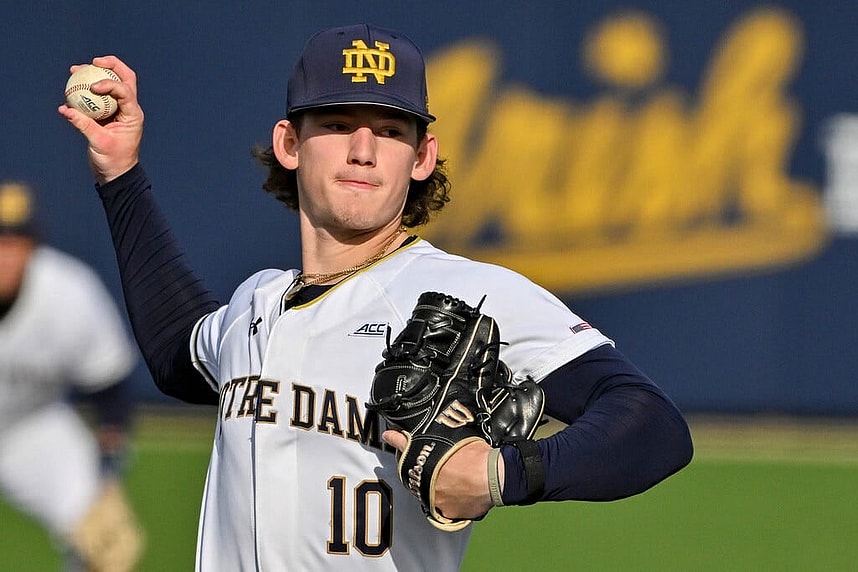
No. 14: Rory Fox – SP
BAT: L
THROW: R
AGE: 22
LEVEL: A
ACQ: 6th Rd, Draft ’25
Fastball: Rory Fox has a four-seam fastball that sits around 91-93 MPH, and while he’s topped out at 96 MPH previously, he tends to sit further away from his max velocity than you’d expect. The shape of this pitch coupled with a lower release height results in some swings and misses when he can get that heater to the toprail of the zone. Fox does have pretty strong quads and I wonder if there’s some more punch the Yankees could unlock in that fastball, even if its mostly just pushing him a little closer to that max velo.
Breaking: Displaying a feel for a big 12-6 curveball and a tight gyro slider, Rory Fox has the existing weapons in his bag to get righties and lefties out with spin. The downward action on these pitches create a good tunnel with his fastball, and when he can keep these pitches down he tends to get some ugly chases out of zone. These are the right kinds of breaking balls to throw when you have a fastball with good vertical movement, and it adds some verticality that the Yankees have been targeting in their recent pitching acquisitions.
Offspeed: The limited cases in which Rory Fox has used his changeup have flashed more of a floater than anything that has serious tail, and I think there’s potential for him to build that into a quality offering. The right-hander seems to pronate well which means he gets inside the baseball well, a good sign for someone trying to spin the ball away from lefties. As of right now though it’s not a viable weapon and if it does not develop, Fox will be limited in the options he can go to as a fourth pitch and may never end up as an MLB starter.
Command: I don’t expect Rory Fox to have issues repeating his mechanics especially after a winter working on the pro side with the Yankees, but I will address his elevated walk rates from 2024 to 2025. Notre Dame fans will rave about how much of a bulldog Fox was for them last year, and the limitation in home runs seems to stem from a calculated change in his approach. He does not have the overpowering stuff to keep runs off the board in a metal bat league and I suspect is an intentional decision to miss out of zone instead of in-zone to avoid damage. Very long-winded way of saying “he’s got solid command, nothing special”.
Summary: The Yankees’ track record with mid-round pitchers means you should keep your eyes on Rory Fox, who has the fastball release traits I covet in a sleeper prospect. Fox’s already-existing slider/curveball package coupled with his athleticsm as a former shortstop have me excited about how he could progress, but I forecast a depth starter outcome with the current skillset.
No. 13: Kaeden Kent – IF/OF
BAT: L
THROW: R
AGE: 22
LEVEL: A+
ACQ: 3rd Rd, ’25 Draft
Hit: Kaeden Kent has a pretty flat swing which allows him to make a good amount of contact in-zone, something that should translate over to the pros. I expect him to put balls in play and do so with some solid raw power which is why I think he’ll have quality batting averages as well. Sometimes that swing and ability to make contact around the zone hurts him, he made a lot of contact on pitches out of zone in High-A which resulted in a low SLG% and walk rate in his first 25 games in Hudson Valley.
Power: I don’t think there’s much raw power here, Kaeden Kent doesn’t display excellent exit velocities which is a bit of a departure from their usual selections in the higher rounds of a draft. He does pull the ball in the air a lot to right field which should allow him to hit some home runs with that short porch in right field. Kent’s ability to drop the bat head and drive the ball in the air with some authority is a big plus in this power category, I expect his game power to outproduce what these raw power grades would suggest for him.
Field: The ability to play multiple positions, including shortstop, will make Kaeden Kent a valuable piece to have on a big-league roster depending on where the bat is at. He’s a good athlete and I think he’ll be able to consistently move around the diamond and play wherever the team needs him on that day. Kent can play first, second, third, shortstop, and the corner outfield and I’m excited to see how much of that versatility is used on the pro side.
Speed: I don’t think Kaeden Kent is an excellent runner and its why I don’t think we’re going to see many stolen bases on a year-to-year basis. His ability to play shortstop pretty well at the college level and the film of those reps would indicate he can move pretty well laterally and that should keep him in the infield even if doesn’t stick at shortstop. The lack of serious power and speed do create a pretty clear ceiling here.
Summary: Kaeden Kent is a player who goes against the Yankees draft philosophy of big speed and power, he doesn’t have standout physical traits and that should seem like a reason to fade his prospect stock. With that being said, he has a lot of soft skills that the Yankees tend to struggle developing such as bat-to-ball quantity and bat control and there’s room to project some bat speed improvements which the organization does do well. I project a utilityman who can play as a strong-side option against righties and fill holes wherever the Yankees need him on the diamond.
No. 12: Mac Heuer – SP
BAT: R
THROW: R
AGE: 21
LEVEL: A
ACQ: 8th Rd, ’25 Draft
Fastball: Mac Heuer has a riding fastball he can throw at the top of the zone for whiffs, sitting in the 93-94 MPH range, reaching 98 MPH in the past. The frame he has suggests there’s room for some more velocity and I could see the Yankees getting that 93-94 into that 94-95 MPH range, which does a lot more for a fastball than you think. This pitch is another one of the many quality four-seamers near or at the top of these prospect rankings in the Yankees’ organization and for Heuer, it sets up his secondaries nicely.
Breaking: There is a lot of movement deviation in his slider which is something the Yankees will have to fix in order for him to consistently get outs with it in the Major Leagues. Sometimes it’s a bullet gyro slider, other times it’s a baby sweeper, he might benefit from just separating the two pitch shapes instead of using the current grip he has. The ability to spin the ball as tightly as he does while also being able to move it laterally creates the ceiling for him to not just own one plus slider, but potentially two. It also creates some collapse risk where he ends up with middling shapes on the pitch.
Offspeed: I don’t think Mac Heuer’s changeup is very good right now, the Yankees tend to work well with changeups and there’s projectability with his arm motion that allow me to see the world where he throws a quality one. This pitch is an important one for Heuer finding the consistency needed on the mound to be a starting pitcher even in the upper-levels of the Minor Leagues.
Command: Strike-throwing hindered Mac Heuer at college which is why he boasted such a poor K% and ERA, and the Yankees will need to work with him to clean up those mechanics. The Yankees had a similar situation occur with Ben Hess who also has that tall/husky body type but couldn’t consistently locate even after being drafted. It took some time for Hess to find it, I would expect growing pains for Heuer as well considering how difficult it is for taller pitchers to consistently repeat their mechanics.
Summary: Mac Heuer has risen up prospect boards because the upside is excellent and the initial readings inside the organization are positive. The offseason he has had indicates the Yankees believe he’ll come out firing in 2026, but that will require a good bill of health to see it come to fruition. I think there’s a backend starter or potential bullpen piece here, but if he makes some real strides with a changeup and refine his slider shapes then he could end up as a mid-rotation piece.
No. 11: Cade Winquest – RP
BAT: R
THROW:R
AGE: 25
LEVEL: MLB
ACQ: Trade, STL
Fastball: Cade Winquest’s fastball sits in the ~95 MPH range with the top-end velocity getting up to 100 MPH, which should allow him to sit closer to the max velocity now that he’s a reliever. He generates around 13-14 inches of ride with some cut on the fastball, a result of Winquest’s tendency to get outside of the ball rather than behind it. His low release height allows this pitch to play up at the top of the zone, but his high-spin rates would serve him better if it was more efficient. There’s some rumblings that he’s been working on another fastball shape over the offseason, the Yankees are good with these right-handed pronator types who want better sinkers/two-seamers.
Breaking: If you go on Baseball Savant and look for his pitches you’ll see a slider but it’s definitely a mistag, this is a curveball shape and there are some sliders/sweepers mixed in here as well. The spin rates and movement profiles are great, his curveball helped him hold lefties to a mere .258 SLG% with a 29% K%. Here’s the thing though; righties tagged Winquest more than you’d think for someone who should have a solid slider, but for some reason it has yet to click. His slider is not a reliable out pitch right now, but with how well he spins the ball, I expect this to change in 2026.
Offspeed: Despite my initial belief that Cade Winquest had been throwing something different in a bullpen session, he actually does already have a quality offspeed pitch in his mix. It’s a high velocity changeup that has good swing-and-miss potential, and it’s such a reliable offering that he had a near .200-point OPS gap in his splits (but in reverse!). I think there’s a lot of verticality to Winquest’s profile and that’s a good match for what the Yankees like in their relievers as of late.
Command: The strike-throwing abilities were firmly below-average in the Minor Leagues especially early in his pro career, but when he got to Double-A his in-zone rates improved. This could be tied to some tweaks in his mechanics or repertoire, as a new regime was installed for the Cardinals to help modernize their archaic player development system. I do think this command improvement would only grow if he went from a starter to a reliever role, but trying to project how a Double-A starter would fare in an MLB reliever role is pretty difficult.
Summary: Cade Winquest was a target for the Yankees in that 2022 MLB Draft where they landed Cam Schlittler, but the Cardinals took him in the eighth round. He started out as someone who threw too many fastballs and didn’t have that much upside as a starter, but the Yankees will now get their hands on him with a chance to dial back that heater usage and incorporate more secondaries. If he can nail the sinker down, we could see an improvement against righties as he could be more sinker-slider in those matchups and be a set-up man for this team.
Yankees Prospects No. 1-10
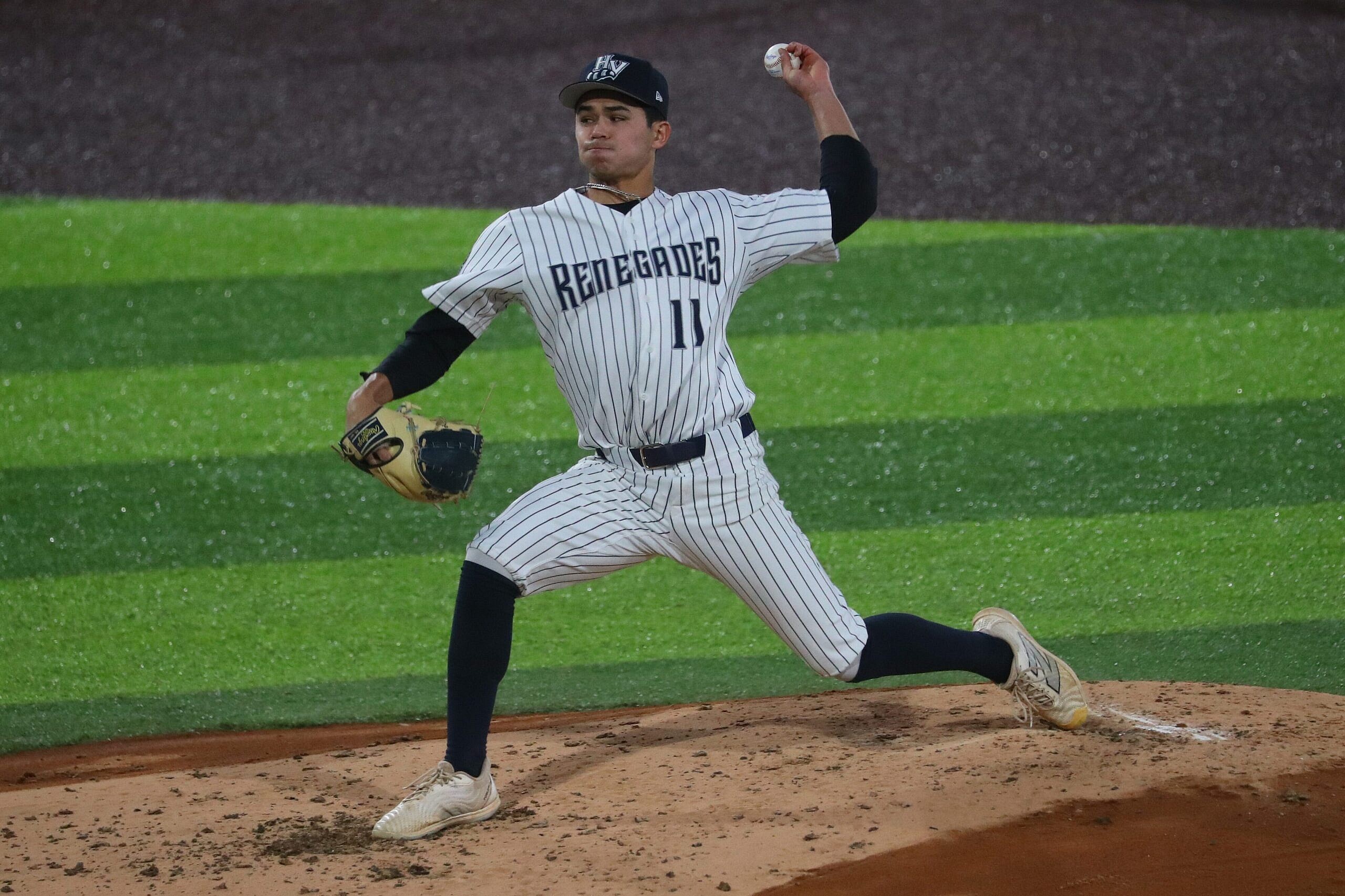
No. 10: Pico Kohn – SP
BAT: L
THROW: L
AGE: 23
LEVEL: A
ACQ: 4th Rd, Draft ’25
Fastball: Pico Kohn sits in the lower 90s with his fastball, but this pitch still grades out as a plus pitch to me because of his funky arm angle which creates difficult looks at the top of the zone for hitters. This pitch gets up to 95 MPH and the frame Kohn has leads me to believe there’s some more power in this heater for the Yankees to unlock. I think there’s a lot to like with this heater if you’re someone like me who cares a lot about approach angle and the importance it plays in whether a fastball will or will not perform well in the big leagues.
Breaking: The slider that Kohn throws has some good two-plane movement and sits in the low-80s which works really well from that aforementioned release point. His slider has a wide approach angle which can lead to ugly chases when he throws it across the zone whether it’s away to lefties or into the backfoot of righties. He also features a curveball every now and then but I wonder if we see the Yankees either tweak the shape of the pitch or just up the usage of it, I’m not sure how necessary this pitch is given how nasty the slider is.
Offspeed: A sharp circle changeup that needs plenty of refinement, this pitch is the one the Yankees should be doing the most work with. Pico Kohn lacks anything he can reliably throw away from righties, but he does have the arm action and release traits to throw a usable offspeed pitch. It’s got some vertical and velocity separation off the fastball, but the consistency he has locating the pitch is not good enough to take it out of the below-average tier for me right now.
Command: You won’t see Pico Kohn get a 70 next to his command grade, but he throws enough strikes where his overall location abilities aren’t a red flag. The left-hander is able to consistently get the fastball up in the zone and keep the slider down in the zone, which is why he’s able to miss so many bats while only really being able to use two pitches effectively in a given count.
Summary: As of right now, Pico Kohn is a two-pitch pitcher who has flashed the ability to throw some other weapons that would help him against righties. That lack of pitch diversity creates real reliever risk, but I believe his release traits and the Yankees’ pitching development are a good match for his potential development. There should be some excitement around his pro debut especially as their top left-handed pitching prospect in my opinion entering 2026.
No. 9: Thatcher Hurd – SP
BAT: R
THROW: R
AGE: 23
LEVEL: A
ACQ: 3rd Rd, Draft ’25
Fastball: Thatcher Hurd has a power fastball with good velocity and vertical movement that allows him to miss bats at the top of the zone. It’s your stereotypical power pitch that can be thrown toprail repeatedly to set up secondaries or just put away hitters who can’t consistently handle velocity. He can get the fastball up to 98 MPH and it pairs well with his breaking balls which really give me a lot of confidence that this pitch will be a staple in his mix for years to come. I think we could see this pitch become a double-plus in a bullpen role, but as a starter it’s still a firm plus weapon to me.
Breaking: Having a slider and curveball covers the necessary movement boxes for Thatcher Hurd, his slider specifically has good two-plane movement with lots of spin around 85 MPH. His curveball has a lot more depth and is much slower, and since he can throw it down in the zone it plays very well off of the four-seamer against lefties. The feel Hurd has for spin makes him a reliable swing-and-miss arm in whatever role he’s in, and both of these pitchers are plus weapons for him right now.
Offspeed: There isn’t a changeup right now in Thatcher Hurd’s profile even though I believe he would benefit greatly from throwing something that moves away from lefties. That could be something we see him tackle as he rehabs from UCL reconstruction surgery, but I’d also understand if the Yankees delayed adding another pitch until after he fully recovers and gets his feet wet in the pros.
Command: A very favorable scouting report on his fastball, slider, and curveball are underscored by some awful command and strike-throwing abilities. Not only did this cause an 11.2% walk rate last year, but it also resulted in some damage in-zone as he didn’t consistently execute pitches he needed to in order to get outs. I also think it reflects in the strikeout rate (26.2%) which feels lower than where he should be given the high-octane fastball and high-spin breaking balls. Cleaning up the mechanics could do him wonders, but TJS threw a wrench in those plans early-on.
Summary: When the Yankees drafted him, he might have been my favorite arm from their deep pitching class and I think I was justified to believe so. The UCL tear put the hype train on pause, but he is still a top 10 prospect in the system because his stuff is electric when he’s on, and I see at least a future reliever role for him in the big leagues. If he adds a changeup and cleans up the command issues he could be a nice no. 3 starter, but there’s a long road ahead of him and an injury hurdle he’ll need to overcome still.
No. 8: Chase Hampton – SP
BAT: R
THROW: R
AGE: 24
LEVEL: AA
ACQ: 6th Rd, Draft ‘22
Fastball: Chase Hampton’s fastball has a combination of excellent vertical movement and a low release height, sitting around 93-94 MPH when he’s fully healthy. The velocity was more ~92 MPH when he returned from injury in 2024, so we won’t know what it’s going to look like following TJS until after he returns. This fastball was a high-whiff pitch and its complimented by a solid cutter which he can throw for strikes and some whiffs as well. If Hampton’s arm is in a good place following UCL reconstruction, then the four-seamer is a solid 60-65 for me and the cutter is a 45-50.
Breaking: Coming out of college, Hampton had a nice curveball and that remained the case in the Minor Leagues, being able to throw this pitch reliably against lefties for strikes. It’s a large breaking ball that’s much slower than the fastball, but his feel for spinning the ball away from righties prompted the development of his sweeper. This sweeping slider has tons of lateral movement and good depth, but these two pitches don’t overlap much on a pitch plot which is an encouraging sign for his ability to pitch to both lefties and righties.
Offspeed: There isn’t much of a changeup shape to speak of with Chase Hampton, he could develop one since the Yankees have had some success getting these right-handed supinators to throw changeups but that’s not a lock. I think the recovery back from TJS and the need to regain some of the lost velocity he had from 2023 to 2024 are greater priorities than a changeup at the moment.
Command: When he got drafted in 2022 there was some worry about his ability to throw strikes, but Chase Hampton refined some of those mechanical deficiencies and looked much more comfortable in 2023. I’m unsure how that will change following a slew of serious injuries especially since it’s been this long since we’ve seen Hampton pitch a full season.
Summary: There’s a lot of uncertainty about Chase Hampton but I loved what I saw in 2023 so much that the idea he could return to that form is enough to remain inside the top 10. There just aren’t many prospects in the system with his ceiling, and I think the Yankees could still squeeze out some value here by using him as a reliever in the big league because his pitch shapes are just so divine. Insanely high injury risk and tons of questions about what Chase Hampton looks like in 2025 cannot be ignored here.
No. 7: Spencer Jones – OF
BAT: L
THROW: L
AGE: 25
LEVEL: AAA
ACQ: 1st Rd, Draft ’22
Hit: There is no sugar-coating how bad the contact rates are, Spencer Jones had a 73.2% Zone Contact% across two levels of Minor League Baseball last year which is among the worst marks you’ll see for a prominent prospect. Among MLB hitters with at least 200 PAs since 2023, only Sam Hillard, Joey Gallo, and Jose Siri have recorded a worse Z-Contact% than that. That’s some ugly company to be in, and while I would expect Jones to run a higher AVG than those three because he’s a line-drive hitter who crushes the ball on contact (high BABIPs!), but he doesn’t have Gallo’s selectiveness which is why that comparison doesn’t really work for me.
Power: For as bad as Spencer Jones’ hit tool is, his power tool is as good if not better than hyped up to be as the left-handed hitting outfielder can take the ball out any part of the park. His pull-side power improved and he started lifting the ball a lot more in 2026, crushing 35 home runs which was the second-most for any Minor League hitter despite missing time with a core injury earlier in the season. This is an easy 30+ HR threat with enough playing time and there lies the reason scouts and analysts won’t just scrub him off their prospect watchlists.
Field: As a centerfielder I have settled on an above-average grade here, Jones is a great athlete in the outfield and moves well, but I think his routerunning abilities could use some work. He has a much larger room for error since his long limbs allow him to flag down balls that would fly over the head of most centerfielders, and while that’s not exactly a ‘skill’, it definitely impacts his defensive abilities. I do think he would settle in really well at left field for the Yankees since he’s still a very tall outfielder and I’d be a little worried about the wear-and-tear on his body covering that much ground, especially with the back issues he had last year.
Speed: Spencer Jones is a great runner and an aggressive basestealer, he could end up being a 30-30 guy in the big leagues if he actually gets on-base enough to attempt that many steals. The decisions on the bases are pretty strong and he’ll take an extra base when he sees fit, there’s a reason people were touting him as an outlier athlete with ridiculous upside.
Summary: I find myself on the less-excited side of the Spencer Jones conversation because he does not make enough contact for me to believe he’ll get everyday reps in the Bronx. He is better-suited developing in an organization that doesn’t have plans to immediately contend in 2026 because the learning curve is going to be rough. If he can play solid defense in centerfield or really good defense in a corner spot then he can end up as a power-hitting corner outfielder who has an Adam Duvall-like slashline if things go right.
No. 6: Bryce Cunningham – SP
BAT: R
THROW: R
AGE: 23
LEVEL: A+
ACQ: 2nd Rd, Draft’ 24
Fastball: Bryce Cunningham gets downhill well with his fastball creating plus extension and a ~94-96 MPH sitting velocity, as he spins the ball well for plus vertical movement. It’s a pretty normal release height for the shape he gets on it, and his feel for the pitch is strong although I think there’s more velocity ceiling due to his frame and max veloicity, which is closer to 100 MPH. The pitch won’t win any awards especially when compared to some of the fastballs thrown by the pitchers ranked ahead of him, but this is a quality offering.
Breaking: The gyro slider that Cunningham has disappointed me a bit, there’s a good amount of vertical drop but the velocity of 83-85 MPH isn’t enough in my opinion. Throwing this slider harder, even at the expense of some desirable movement traits, would give him a more reliable swing-and-miss pitch he can push against lefties and righties. Cunningham has also flirted with a curveball shape that could be a promising addition to his mix given his release traits and overall feel for spin.
Offspeed: Out of Vanderbilt this power changeup was arguably the highest-rated pitch in Cunningham’s mix because its a power offspeed pitch that plays off of his fastball well. The movement on this pitch hasn’t translated from college to the pros perfectly, but I do think he can throw this pitch to both righties and lefties effectively. I’d like to see him perhaps make some tweaks with his grip and seam orientation to see if there’s something they can unlock because his
Command: I’m not sure that throwing strikes is as big of an issue for Bryce Cunningham as we saw in the second half, injuries and time off the mound definitely played a role in his less-than-polished look at times in the summer. He doesn’t strike me as someone who manuevers the ball extremely well in-zone but I also don’t view that as an issue either. You could argue that he has the best location abilities of any of the Yankees’ top five pitching prospects entering 2026, and it’s part of why I still have him as a top 10 prospect.
Summary: Part of what makes Bryce Cunningham’s 2025 season so underwhelming is that he started out looking like their best or second-best pitching prospect in May. The injuries piled up and his stuff didn’t look as sharp when he made attempts at returning to the rotation, and it’s why he finished the year in High-A instead of joining the other HV starters in Double-A. There’s still tons of upside and I still think he’s got the prototypical starting pitcher mold, I’m hoping we still see him fufill the backend starter projections while keeping an eye on his odds of take a leap in 2026.
No. 5: Ben Hess – SP
BAT: R
THROW: R
AGE: 23
LEVEL: AA
ACQ: 1st Rd, Draft ’24
Fastball: This pitch has a ton of vertical ride and some tailing action as well, a result of Ben Hess’ low release height and high spin rates. It’s a big swing-and-miss pitch when located at the top of the zone and if he can be more consistent with the velocity of this pitch, it might be one of the better heaters in the Minor Leagues this season. There’s a lot to like in the shape and the angles Hess is able to create with his deceptive release points, but there are days where he’s more 91-93 instead of 93-96, which creates some unease with which version of him you’ll get every sixth day.
Breaking: Ben Hess’ primary breaking ball is a big curveball, but we’ve seen him throw some sweepers as well which bump up the overall mix. The curveball has all of the visual traits you want for a big breaking pitch, and it plays well off of his fastball by establishing that vertical tunnel especially to lefties. Hess’ feel for the pitch is there, but the fastball-curveball righty has essentially gone extinct in today’s game. The development of his sweeper down the stretch helped him miss some more bats because he spins the ball well, but its around 78-79 MPH and that’s a bit too slow for me.
Offspeed: At first I thought Ben Hess’ changeup would take off, but the feel he had for this pitch hasn’t quite matched the excellent movement data. We saw more fastball-curveball mixes to lefties, and I think this offseason should be centered around getting that offspeed pitch back in the fold. It’s a nice weapon to have especially because he got so much separation off of his four-seamer on it, and it would certainly mitigate some of his current reliever risk.
Command: Entering the month of June, Ben Hess’ command issues had gotten so bad that his season began spiraling out of control, walking nearly 14% of High-A batters faced before missing a month of action. He was not placed on the IL nor did a reason ever get released for this absence, but from that point forward he kept the walk rate under 9%. You will still see some rather uncompetitive misses, as is true with all pitchers, however you can’t ignore the massive leaps in strike-throwing and the absence of in-zone misses that get hammered.
Summary: There was a point in time where you could have reasonably asked the question of whether the Yankees’ top 10 should even include Ben Hess, but he corrected course and looks like a potential top-100 prospect. The right-hander has plus traits in his pitch shapes and the release height creates angles for those already-excellent shapes that make it harder for hitters to track as they approach the plate. If his velocity is more consistent on a start-to-start basis, Ben Hess could end up being a middle-of-the-rotation arm for a contender with frontline upside.
No. 4: Carlos Lagrange – SP
BAT: R
THROW: R
AGE: 22
LEVEL: AA
ACQ: Intl FA ’22
Fastball: Carlos Lagrange has the best fastball inside the Yankees’ organization and might have the best fastball in all of Minor League Baseball, sitting around 98 MPH with plus vertical movement. He gets it up to 103 MPH, and it’s important to note that Lagrange is averaging high-90s velocity while being a starter, who knows what this pitch would look like in a reliever role. He misses a ton of bats with this pitch and the work he put in to make the shape of this pitch firmly above-average is astounding; hats off to the athlete first and foremost and the player development system as a whole.
Breaking: The tall right-hander features a sweeping slider and a gyro slider, with the former being a new weapon he developed in the Arizona Fall League. Neither pitch is thrown quite as hard as you’d expect for someone with explosive fastball velocity which does raise some questions about how these pitches will fair in the big leagues. I would encourage him to be more behind his gyro slider even if it creates more of a cutter shape instead of a downer shape because it might make it a pitch he can throw in-zone more while not leaving himself exposed to damage contact. As for the sweeper, it’s only something he should throw to righties and it can be nasty when he executes it down and away.
Offspeed: While the fastball is clearly the best pitch in Carlos Lagrange’s mix, I think his changeup is the second best pitch he has due to the velocity and improved feel throughout the year. He can repeatedly land this pitch close enough to the zone for swings and it plays well off the fastball, but the velocity makes it more palatable when he misses in-zone with it. This differs from the slider/sweeper which will get crushed by any skilled MLB hitter if left hanging, the changeup can get up to 94 MPH and has elite whiff rates.
Command: Easily the biggest question mark in Carlos Lagrange’s game, this is what hurts his breaking balls a bit and leaves him vulnerable to damage contact at times. I think the Yankees will be faced with a serious conversation this year about whether Lagrange can be a big-league starter or not, and it’s why I ultimately view him as more of a reliever at least early in his career. The Yankees have done this before; Clarke Schmidt and Michael King came up as relievers before moving into the rotation and the fact that Carlos Lagrange has 70-grade stuff as a starter might make them think there’s a Jhoan Duran/Mason Miller ceiling here as a reliever.
Summary: The Yankees signed Carlos Lagrange for just $10,000 as an International Free Agent in 2022, his placement on this list alone is beyond unlikely. He made strides in the strike-throwing department from 2024 to 2025 to become a universal top-five prospect in the system and he has the stuff of a Game 1 starter. That being said, Lagrange is very raw and has serious command issues, often losing his feel for the zone in-game and spiraling from that point forward. Injury risk does matter here as well, which combined with the previously-stated factors creates a high reliever risk, but this is a universal top-five prospect in the system for a reason
No. 3: Elmer Rodriguez – SP
BAT: L
THROW: R
AGE: 22
LEVEL: AAA
ACQ: Trade, BOS
Fastball: Elmer Rodriguez has a four-seamer, sinker, and cutter which allow him to vary his looks and keep hitters off-balance. His sinker is the best of this trio of pitches, having plus sink and tail while sitting around 95-96 MPH, as it’s a called strike and groundball machine. The command he has his sinker is incredibly impressive, and it leads the way in both usage and overall pitch grades. As for his four-seamer, it has tail but lacks the vertical movement to make it an outstanding pitch. Velocity and command help it play up as a set-up pitch, but his cutter lags behind as more of a show pitch that can get him out of a long drawn out at-bat.
Breaking: The sweeping slider that Rodriguez has is nasty, generating tons of lateral and vertical movement which allow the right-hander to miss bats at a high clip with it. While Elmer Rodriguez will spin a sweeper to righties, he leans more on the curveball against lefties which has a ton of depth and ran a high SwStr% against in 2025. He has a natural feel for spinning the ball to the gloveside and its illustrated in his reliable and excellent pair of breaking pitches.
Offspeed: I did not think Elmer Rodriguez’s changeup would look as good as it did in Double-A, but I was pleasantly surprised to see that split-change dominate. He has really grown comfortable throwing that pitch and it adds a nice layer of verticality to his mix, making his four-seamer a more important pitch to lefties as a result. This is a big reason why his OPS against lefties was actually better than it was against righties in 2025.
Command: At a first glance the 9% walk rate and 63% Strike% are a tick worse than you’d like, and I do think Rodriguez tends to have more misses than you’d like, but his ability to steal strikes is more important than people think. He is consistently able to locate sinkers on the outer-half of the plate to righties, as they appear like a ball out of hand before the late tail and sink drop it right into the zone for count leverage. He misses out of zone more than he does in-zone which is better than the alternative in my opinion, and for that I do actually view him as an average or above-average locator.
Summary: Elmer Rodriguez is another low arm angle right-handed pitcher who cuts the ball, the Yankees have been excellent with this prorotype and I expect this to be no different. If the right-hander stays healthy I think he could be a Michael King regen, the stuff is sharp and the deep mix should make him a high-probability MLB starter. This is a mid-rotation starter with the upside to potentially slot into the top half of a contender’s rotation.
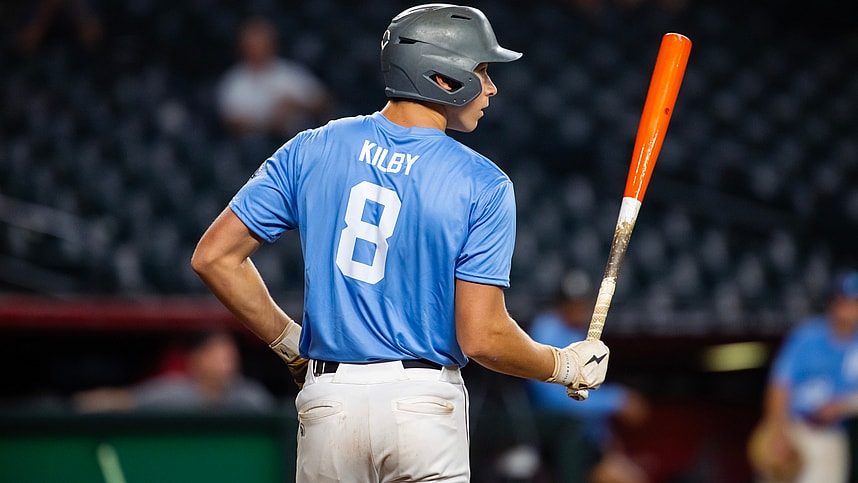
No. 2: Dax Kilby – SS
B/T: L/R
Age: 19
Level: A
ACQ: 1st Rd, Draft ’25
School: Newnan High School
Hit: Dax Kilby has the best bat-to-ball abilities in the Yankees’ organization already, his feel for contact in the zone paired with how he can generate hard contact to all fields is unmatched in this farm system. It feels early to say some of these things, but the film backs up the data, and Kilby swung enough at pitches in-zone for me to believe this is a real skill he carries. It’s not enough to just make contact, you have to also hit the ball with some authority to have a good AVG, and I expect Kilby to have a plus K% and AVG for years to come.
Power: Instead of being firmly below-average in the raw power category as some believed he would be, Kilby displayed some solid exit velocities last year. The tight groupings to his pedestrian Max EV alongside the feel he has for swinging the bat hard while being a 19-year-old fresh out of high school is exciting. I do not expect him to ever maximize his raw power since his approach doesn’t seem like it’ll shift towards pulling everything in the air and I also don’t think we’re going to see him become a high Flyball% guy either, so maybe he hits 10-15 HRs annually when he’s a big leaguer.
Field: To me this is not a prospect who sticks at shortstop, I think Dax Kilby can make it work in centerfield even and that would change the way I view him as a defender but I’ll remain skeptical for now. It keeps him from being the top prospect in the organization in my eyes, it’s not that he can’t find a defensive home but I don’t know if he’ll end up playing a premium position or not. My guess? Second base or third base end up being his home.
Speed: Dax Kilby moves very well, he had the fourth-best 30-yard dash time of any participating players at the 2025 MLB Draft Combine. He put that speed to the test early, stealing 16 bases in 17 attempts in just 18 Minor League games, and while we’ll need a larger sample size to judge how aggressive he truly ends up being, you can pencil Kilby in as a true plus runner who might steal 30+ bases one day in a big-league season.
Summary: The best hitter in the system, Dax Kilby has all the upside and potential to end up being a top-of-the-lineup hitter. I think he’s got a real chance to overtake George Lombard Jr. even if our current no. 1 prospect in the system has a good year, and that’s because of how hard it is to find a young hitter with this feel for contact and some power upside. When I spoke to Kilby last summer he talked about looking up to Christian Yelich and his swing, and ironically enough the teenage infielder reminds me a lot of the former MVP when he was in Miami.
No. 1: George Lombard Jr. – SS
B/T: R/R
Age: 20
Level: AA
ACQ: 1st Rd, Draft ’24
School: Gulliver Prep School
Hit: George Lombard Jr. is passive and doesn’t make a ton of contact in-zone, which is why I think he’ll have a higher strikeout rate than average in the big leagues. Some of those struggles to require the asterisk of knowing that he is oftentimes being promoted before he can truly put up gaudy numbers at a level, playing in Double-A as a 19 and 20 years old. His feel for lifting the ball and hitting on a line are there, and I expect this to be a ~25% K% hitter with a .240-.250 AVG in the Major Leagues.
Power: The leap in Isolated Power (ISO) from .104 to .146 is not insignificant, George Lombard Jr. played in two incredibly run depressed environments in High-A’s South Atlantic League and Double-A’s Eastern League. I also think it’s notable that he can hit a baseball above 110 MPH, and with just how young he is, the nine HRs and 32 2Bs this past MiLB season could translate into 15-20 HR power by the time he debuts. If the Yankees can get some more pulled flyballs from Lombard, they could get a hitter who ends up surpassing the 20 HR threshold multiple times in his career.
Field: I would have previously referred to Alexander Vargas as the best defensive shortstop prospect I’ve seen in the Yankees’ system over the last five years, but George Lombard Jr. takes the cake now. His range and athleticsm are ridiculous, making off-platform throws across the diamond with precision and serious velocity. Watching the 20-year-old play the position is a joy, and I believe he will contend for numerous Gold Gloves in his career which is why I still have him as the no. 1 prospect in the system.
Speed: While not the only reason he’s an excellent defensive shortstop, George Lombard Jr. has excellent mobility, creating more range laterally and making him a threat on the basepaths. His background as a star high school futbol player shine through when you watch him move around the bases or play the infield, and I think it’ll allow him to swipe 25+ bases in the Major Leagues with good efficiency, maybe we see a 40+ stolen base season at his very peak.
Summary: If the skills we’ve seen at the Minor League levels progress well, I could see a 105 OPS+ shortstop with elite-level defense, which is a ~4 WAR player and maybe even more with his baserunning abilities. George Lombard Jr. is still very young, and it’s possible we’re overjudging him on his unpolished skillset at the plate because of how much the Yankees have challenged him with promotions. Lombard did not have much time to accumulate impressive statistics in High-A this year before being promoted, and over his final 23 games at Double-A to finish the year, he had a 147 wRC+.

More about:New York Yankees
