
 Ryan Garcia
The Yankees are taking a gamble on their ability to develop pitching, as three of their projected five starters for the upcoming season are homegrown arms.
Ryan Weathers was their lone external addition to the rotation and he’s a project arm with some serious ups-and-downs in his career, but all of these arms have real reasons to believe in them.
You could reasonably argue that the improvements Sam Briend and Matt Blake are able to make will define this season for the Yankees, as if they can mold these enticing lumps of clay into reliable starters, this team could be deadly.
We’re going to break down three of the staff’s young pitchers and delve into how the Yankees could tinker with their mix or usage rates to get more out of them in 2026.
READ MORE: The Yankees should be all over a potential trade for JoJo Romero
Can Will Warren Be the Yankees’ Rotation Rock Again?
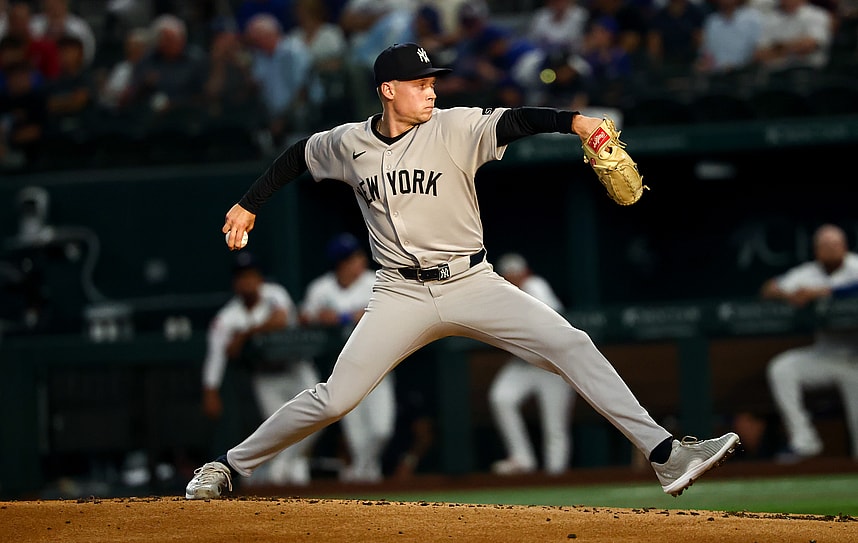
Seasons like the one we saw from Will Warren are important for multiple reasons, as the right-hander was able to boost his career-high in innings and show the Yankees he can be a workhorse for the staff.
Furthermore, it put some of his weaknesses on display and forced Warren to show how he could adapt to adversity, which he handled really well.
Through his first 13 MLB appearances he had a 7.71 ERA and a 4.49 FIP, over his last 26 he’s been down to a 4.17 ERA and 4.05 FIP, which are both above-average for a starting pitcher.
It was a sizable improvement for the 26-year-old, and now the question becomes whether the Yankees could get another step forward in 2026.
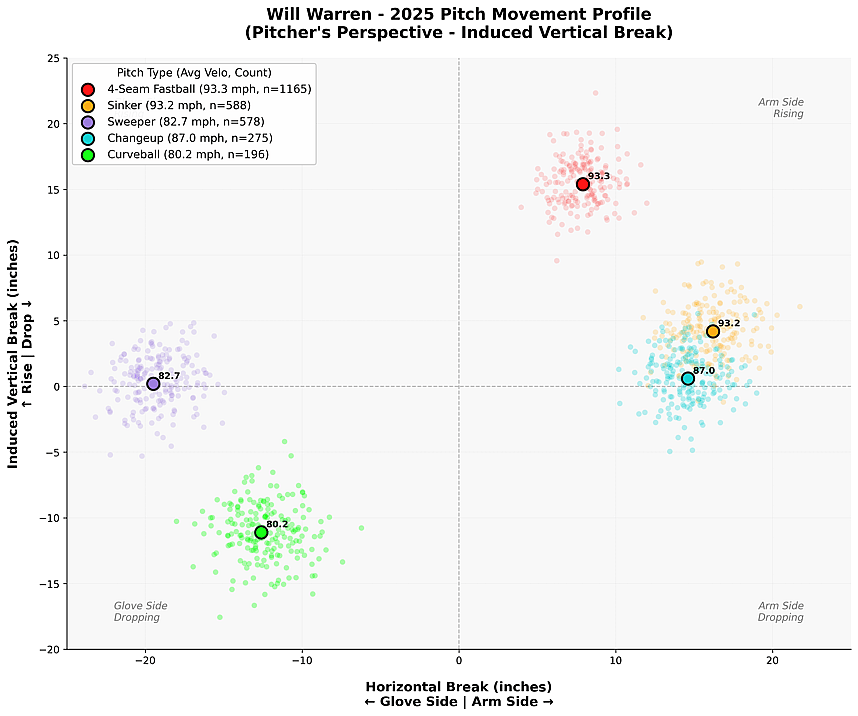
One of the biggest issues that Will Warren has is in matchups against lefties, and this pitch plot shows an issue with his mix that is making it easier for lefties to hit him.
The massive gaps in horizontal movement in all of his pitches creates an easier read for lefties, as opposite-handed batters are less deceived by horizontal movement than they are vertical movement.
His changeup and four-seamer are the combination to focus on here, they don’t have a ton of horizontal separation between each other but do have the desired gap in vertical movement that illicits bad swings from lefties.
17% of the pitches he threw to lefties were changeups, the same percentage as his sweeper which is a pitch type that tends to perform poorly against opposite-handed hitters.
Warren’s changeup produced a 31.6% Whiff% with a high groundball rate in these right-on-left matchups last season, and if he can push the usage of that pitch more we could see more even platoon splits in 2026.
The feel he has for this pitch is growing, but it has not gotten to the point where he trusts himself not to have it miss in-zone and get crushed.
It’s the most boring fix on the list, but the Yankees need Will Warren to get more comfortable throwing his changeup (and curveball) to lefties with more consistent execution.
Having big platoon splits also means he’s pretty much got it nailed down against righties; now it’s time for him to improve his feel for spinning the ball up-and-down against lefties.
Will the Yankees Unleash Ryan Weathers’ Potential?
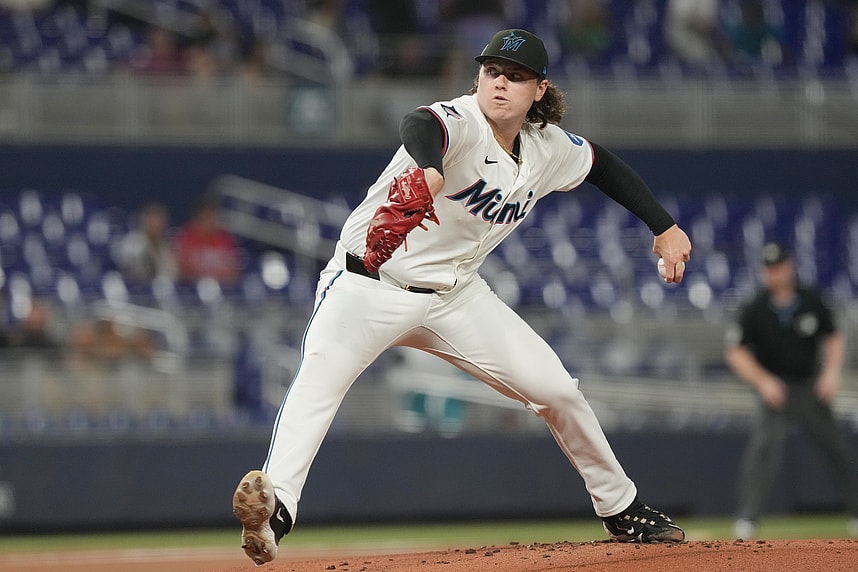
Ryan Weathers has nasty stuff, the left-hander’s fastball sits in the upper-90s with good vertical movement and he has both a changeup and sweeper with plus swing-and-miss rates as well.
Despite a career 4.93 ERA and 5.03 FIP, the Yankees view Weathers as a piece they could unlock for their rotation, as some people in baseball view a playoff starter outcome for him if he can stayh on the mound.
Health is one of the biggest issues here and there’s not a fix I can conjur up to reduce injuries, but I can try and figure out how the Yankees could make him better.
Spoiler alert: Weathers hopped on Foul Territory and already leaked the things the Yankees are having him tinker which is a two-seam fastball and a bullet slider to compliment his already-existing arsenal.
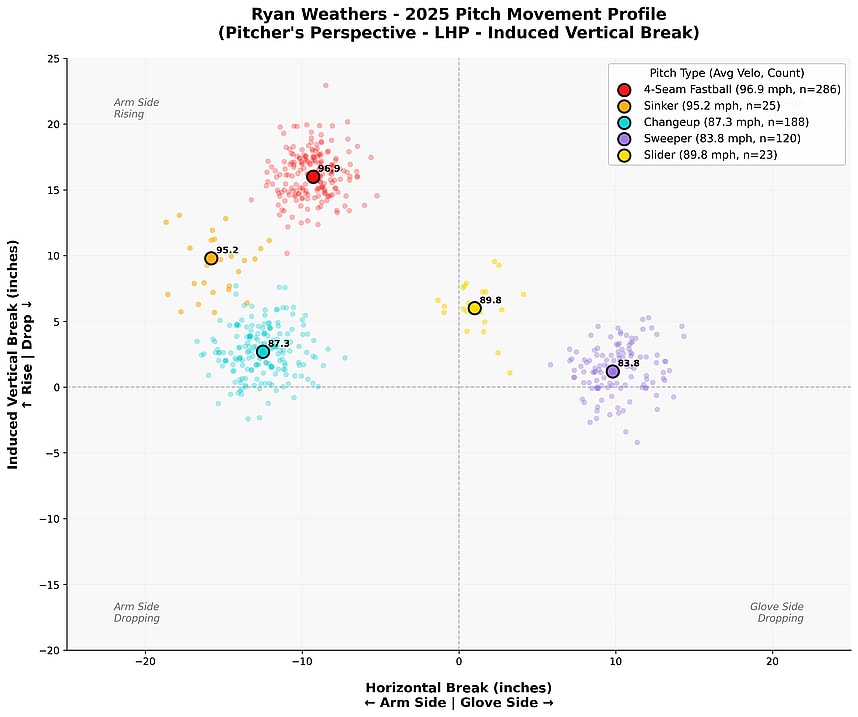
The pitches that balance out the fastball-changeup-sweeper mix are little-used in that sinker and slider, but Ryan Weathers is trying to push the usage of those pitches while improving their shape.
I wrote about Weathers potentially adding a one-seam sinker but he mentioned that it wouldn’t separate enough from his changeup, so he wants to prioritize arm-side movement with a ‘runner’ rather than chasing more depth.
He struggled more against same-handed batters than opposite-handed batters last year so this makes sense, his four-seamer got rocked by LHB and being a sinker-sweeper guy with his wide release point could be gross in those matchups.
As for the tight bullet slider, this pitch would be a better option against righties than his sweeping slider would in some instances especially given how rare it is for someone with his release point to get that tight bullet-like spin.
The fastball-changeup mix works because of the north-south deception it creates against righties, a tight bullet slider would have a similar effect and would force hitters to respect that pitch.
A shallow pitch pool has left Ryan Weathers exposed against quality hitters because he has only been able to throw three pitches with very distinct movement profiles reliably.
With a sinker and bullet slider, you add some bridges between his three pitches that can help him against lefties and righties, and by adding some new toys to his mix you make him even more deceptive.
There’s more to Weathers than his power fastball, he has an abnormal release point due to his long arms that create a sharp approach angle horizontally while also creating that flatter approach angle vertically due to a lower release height.
He has the traits of a Game 2 starting pitcher, and I am cautiously optimistic that a healthy version of Weathers could be an excellent starter for this team.
Is Cam Schlittler Trending Towards Stardom?
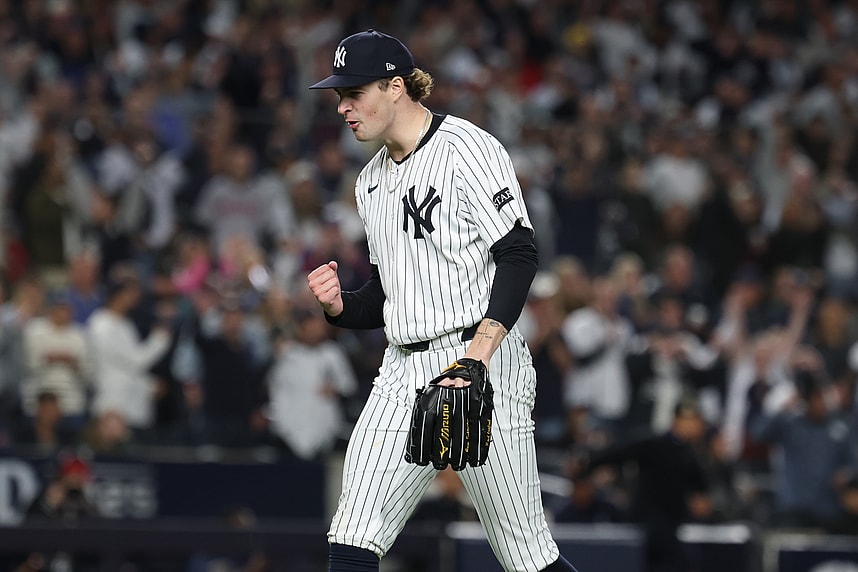
Cam Schlittler has the most helium going into the upcoming 2026 season as the right-hander was incredible down the stretch and parlayed it into a great postseason.
His 2.23 ERA and 2.62 FIP over his final nine starts of the regular season were a result of improving command as the right-hander executed more consistently and found a two-seamer that made the mix even better.
As a power pitcher who can attack the zone when he’s on, Schlittler has had some issues getting into long counts as hitters would foul off pitch after pitch, and there seems to be an obvious reason for that when looking at his repertoire.
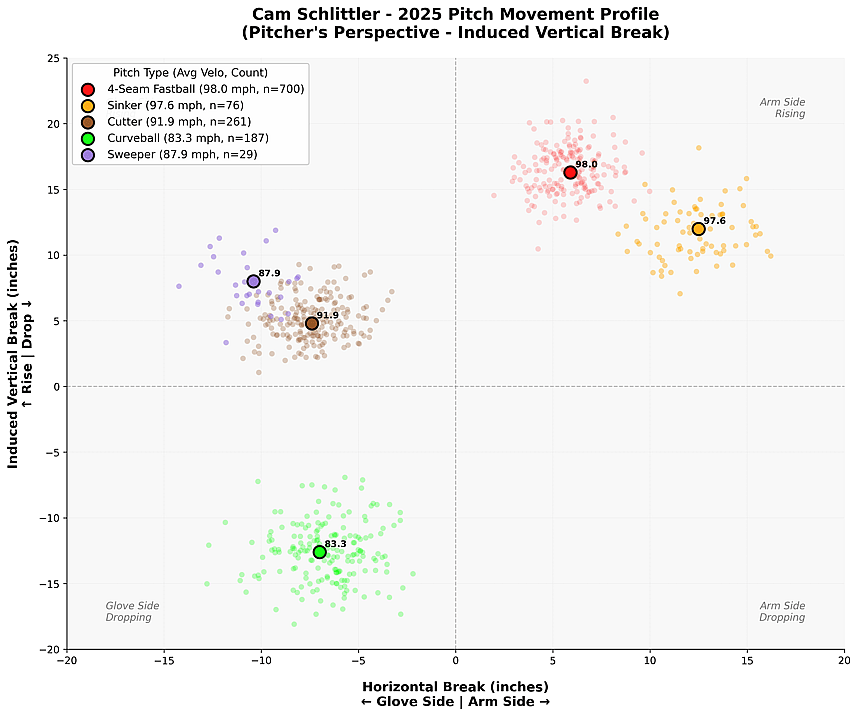
Cam Schlittler does not have anything arm-side that drops, his two-seamer is more of a running fastball than it is a sinker with some depth.
Adding a changeup would help a lot for this, Matt Blake has mentioned they want to avoid him throwing a changeup that isn’t very good just to check a box and I would be foolish to disagree with his assessments.
The ability to throw a quality changeup could elevate his mix to the next level and provide him with all of the movement quadrants needed to have success.
I would also tinker with that sweeper instead of abandoning it, perhaps there’s a better slider grip he can use to spin something laterally away from righties for some more whiffs.
As a four-pitch pitcher (fastball-sinker-cutter-curveball) I would expect Schlittler to be an above-average starter, but if he can add a quality fifth pitch then I do think there’s real ace upside.
Being a power pitcher is great and it provides tons of margin for error when you’re attacking the zone, but even the hardest throwers in the sport are diversifying their mix to keep hitters off-balance.
Tarik Skubal and Paul Skenes have insane fastball velocity and are the two best pitchers in the game, but they registered four-seam usage rates of 29% and 39% respectively.
Cam Schlittler used his four-seamer a whopping 56% of the time; finding a way to siphon some of that usage into his sinker and a fifth pitch could be revolutionary for the right-hander.
In his two postseason starts he used his four-seamer just 43.1% of the time and increased his sinker usage to 21.5%, I wonder if there lies the recipe to some success.

More about:New York Yankees
