
 Alexander Wilson
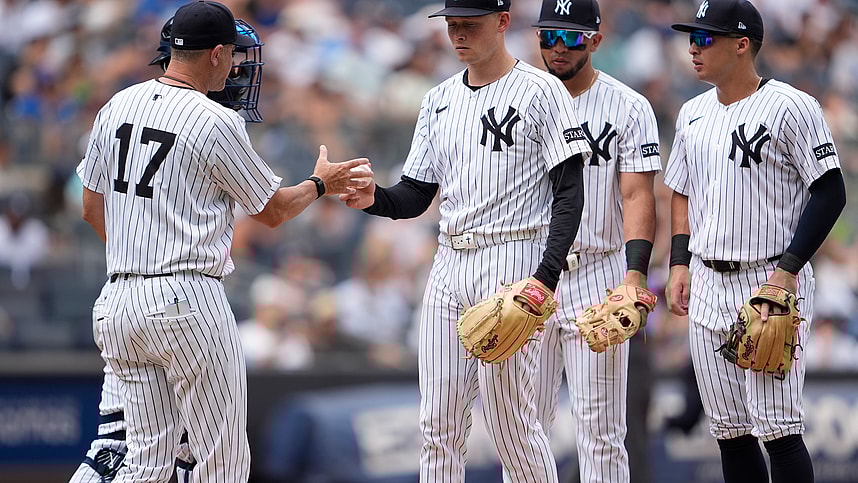
The Yankees are currently operating at a pace that can only be described as “glacial,” and quite frankly, it is testing the sanity of every fan in the Bronx.
While the crosstown rival Mets have been ruthlessly aggressive, poaching elite bullpen arms like Devin Williams and Luke Weaver directly from the Yankees’ grasp, General Manager Brian Cashman has seemingly been content to sit on his hands.
The only notable moves thus far have been extending Trent Grisham on a hefty $22 million qualifying offer, bringing back utility man Amed Rosario, and taking a flier on pitcher Paul Blackburn. To be blunt, the Yankees are worse today than they were when their season ended a few months ago, and the gap is widening by the day.
This inactivity is baffling because the Yankees cannot leave their roster incomplete this offseason if they genuinely intend to compete for a championship in 2026.
The rotation has question marks, the bullpen has been stripped of its high-leverage safety nets, and the lineup still feels top-heavy. However, if you squint hard enough through the fog of frustration, you can see the outline of Cashman’s strategy. He is hoarding pitching depth, likely preparing to trade from a surplus of arms to acquire a legitimate difference-maker. Whether he targets a frontline starter or a versatile bat like St. Louis’s Brenden Donovan, the Yankees have three specific pitchers who have quietly become the keys to unlocking this offseason.
The algorithm hides the best New York Yankees news; make sure you pin Empire Sports Media on Google News so you don’t miss a beat.
Will Warren Is the Perfect Mid-Rotation Trade Chip
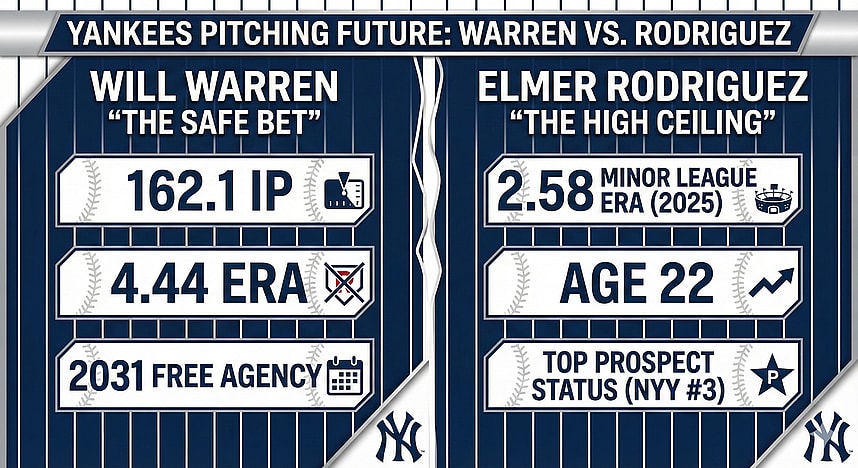
The first name that opposing GMs are undoubtedly circling is Will Warren. At 26 years old, Warren represents the ideal trade commodity: a controllable, durable arm who just proved he can handle a full major league workload. He tossed 162.1 innings in his first full season, posting a 4.44 ERA and accumulating 2.1 WAR, numbers that scream “reliable mid-rotation starter.” In an era where pitchers break down constantly, a guy who takes the ball every fifth day and keeps his team in the game is worth his weight in gold.
However, Warren is not without his flaws, which might make him more expendable to New York than he appears. While he struck out a respectable 9.48 batters per nine innings, he struggled mightily with the long ball, surrendering 1.22 home runs per nine. His fastball was actually his most effective weapon, holding hitters to a .216 batting average despite averaging a modest 93.3 mph, but his secondary stuff raised major red flags.
His sweeper, which was projected to be his primary out-pitch, was absolutely hammered last season. Opposing batters hit .336 with a staggering .569 slugging percentage against it, suggesting that hitters were sitting on the pitch and crushing it when it hung.
If he stays in pinstripes, the Yankees might need to scrap the sweeper dominance in favor of developing his change-up to keep lefties off balance. But with team control until 2031, Warren offers immense value to a rebuilding team that believes they can tweak his pitch mix, making him a prime candidate to headline a blockbuster package.
The Luis Gil Dilemma: Selling Low or Holding Hope?
If Warren is the “safe” trade chip, Luis Gil is the volatile wild card that creates a massive headache for the front office. The 27-year-old is a free agent in 2029, giving him plenty of team control, but his stock has plummeted following a worrying 2025 campaign. Gil threw only 57 innings due to injury, and while his 3.32 ERA looks pretty on the back of a baseball card, the underlying metrics are nothing short of terrifying.
Post-injury, Gil was a shell of his former explosive self. His fastball velocity dropped by a full 1.4 mph, a dip that often signals structural issues or lingering fatigue.
Consequently, his strikeout rate cratered to just 6.47 per nine innings, while his command completely evaporated, leading to 5.21 walks per nine. When you rank in the 1st percentile for chase rate and the 2nd percentile for walk rate, you are essentially daring hitters to do damage, and usually, they oblige.
Trading Gil right now would undeniably be selling low. Opposing teams see the velocity dip and the inability to generate ground balls as major warning signs. Unless a trade partner believes their pitching lab can fix his mechanics and restore his heat, the Yankees might be forced to hold onto him. They likely have to hope he rebuilds his value in the first half of 2026, or perhaps transitions into a high-leverage bullpen role where his stuff might play up in shorter bursts.
Elmer Rodriguez Is the Crown Jewel Everyone Wants
While Warren and Gil have warts, Elmer Rodriguez is the shiny new toy that every general manager dreams on. The 22-year-old prospect has skyrocketed up rankings after a dominant season across three levels of the minors. Posting a cumulative 2.58 ERA between High-A, Double-A, and Triple-A is impressive, but his consistency is what truly stands out. He didn’t just survive as he climbed the ladder; he thrived, posting a 2.64 ERA over 61.1 innings in Double-A Somerset, historically the hardest jump for young pitchers to make.
Rodriguez possesses a pitch mix that scouts drool over, with the ability to dial up velocity when he needs it and a feel for pitching that belies his age. For a team like the Yankees, he represents a fascinating duality. On one hand, he is the perfect centerpiece for a trade to acquire a star.
On the other, he might be the internal solution they desperately need. We have already seen how the Yankees may have unearthed a new ace in Cam Schlittler, and Rodriguez follows that same lineage of homegrown talent ready to contribute.
If the Yankees keep him, Rodriguez essentially serves as a high-upside insurance policy for the 2026 rotation. If injuries strike—and they always do—having a 22-year-old with front line potential waiting in Scranton is a luxury few teams possess. However, if Cashman decides to go “all-in,” Rodriguez is the chip that gets the deal done.
Targeting Aces: Freddy Peralta and Joe Ryan
So, who exactly should Cashman be targeting with these assets? If the goal is to fortify the rotation for a World Series run, two names stand out: Freddy Peralta of the Brewers and Joe Ryan of the Twins. Peralta would be a seamless fit for New York, bringing an electric “stuff-over-command” profile that plays beautifully in the postseason. He is a strikeout artist who can shut down elite lineups single-handedly, providing the kind of swing-and-miss capability that Will Warren currently lacks.
Joe Ryan offers a different, but equally valuable, skillset. He is an extreme fly-ball pitcher, which can be dangerous in Yankee Stadium, but his ability to limit walks and pound the zone is exactly what the Yankees need to stabilize the staff. Ryan is a bulldog who eats innings and saves the bullpen, allowing the high-leverage arms to stay fresh for October. Acquiring either of these arms would likely cost a package headlined by Rodriguez or Warren, but it would instantly transform the rotation from “good enough” to “dominant.”
Cashman has the pieces to make a splash. He has the depth to absorb the loss of a Warren or a Gil, and he has the prospect capital in Rodriguez to land a big fish. But waiting for the perfect deal is a risky strategy when the rest of the league is getting better. Predicting the Yankees’ 2026 starting outfield is fun, but without the pitching to support it, it’s just a fantasy. It is time for the Yankees to stop hoarding assets and start acquiring championships.

More about:New York Yankees
