

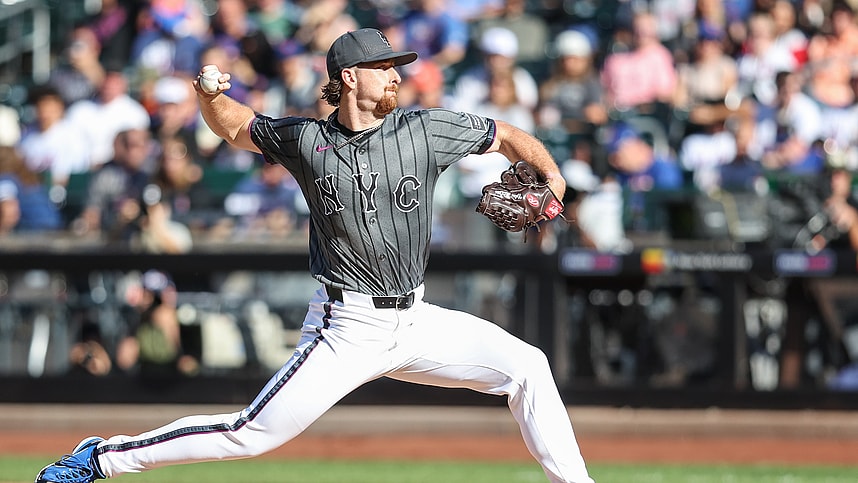
Every organization has that one pitching prospect whose name starts circulating early, whose stuff and upside draw whispers long before the debut. For the Mets, that pitcher was Jonah Tong. His talent is real, his ceiling remains high, and the organization still believes in him. But if the conversation is about the pitcher Mets fans should be most excited about heading into 2026, it’s not Tong anymore.
It’s Nolan McLean — and the numbers make that case louder than any scouting report.

McLean’s debut wasn’t just promising — it was dominant
McLean didn’t sneak into the league quietly. He stormed through his first taste of MLB action, posting a 2.06 ERA across 48 innings and flashing the kind of pitch mix that overwhelms hitters on both sides of the plate. His strikeout rate (10.69 per nine) underscored how much swing-and-miss potential he already possesses, and his 84.1 percent left-on-base rate showed maturity in high-pressure situations.
Even more impressive was his 61.1 percent ground-ball rate. Very few pitchers can combine elite strikeout stuff with heavy ground-ball contact — those profiles usually belong to perennial top-of-the-rotation arms. McLean’s rookie sample size didn’t just hint at that type of upside; it rivaled some of the league’s best in those specific categories.
For a 24-year-old pitcher making his first big-league run, it was the kind of debut that changes organizational timelines.
A pitch mix built for long-term success
McLean’s arsenal played a huge role in his breakout. He features four primary pitches: a sinker, sweeper, curveball, and four-seam fastball. But each pitch brings something different to the table.
His sinker was his calling card in his debut season. Opponents hit just .193 against it with a .316 slugging percentage, a remarkable profile for a pitch designed to induce contact rather than avoid it. Its late movement and hard velocity made it a nightmare to elevate, feeding directly into his elite ground-ball rate.

His curveball quietly might be his best pitch. Used just 15.8 percent of the time, it still produced 19 strikeouts and allowed a microscopic .074 batting average. When young pitchers show the ability to land a true out pitch — one that plays both early in the count and in put-away situations — teams take notice.
The one pitch still lagging behind is the sweeper. He used it 25.7 percent of the time, but hitters tagged it for a .361 average, and it produced just six strikeouts. It’s not unusual for sweepers to require refinement, especially for pitchers transitioning into full MLB workloads. If he can sharpen the shape or simply reduce its usage relative to his curveball, the entire arsenal becomes even more dangerous.
A path toward ace-level upside
Pitchers with McLean’s early numbers don’t come around often. Elite whiff rates, elite ground-ball rates, and the ability to pair a swing-and-miss breaking ball with a heavy, late-moving sinker create a foundation few young starters ever achieve. And he’s already doing this at 24, in the toughest pitching environment in the league.
McLean doesn’t need massive change to take a leap. He needs incremental refinement. Improving the sweeper. Potentially adding another secondary pitch into the repertoire. More MLB reps to deepen his command.
If those things fall into place — even modestly — the upside is enormous. This is the type of pitcher who can rise quickly from promising rookie to legitimate front-line starter.
The Mets may have found a foundational arm sooner than expected
For all the attention Tong received leading into last season, McLean is the one who has forced his way into the Mets’ rotation and never looked back. His combination of stuff, composure, and early performance gives the team something it desperately needs: a young, controllable arm with ace potential.
The Mets envisioned Tong carving out that path. But as 2026 approaches, it’s McLean who looks ready to make that kind of impact. Tong will have his chances, but this is the best possible surprise the Mets could’ve asked for.
More about:New York Mets
