
 Alexander Wilson
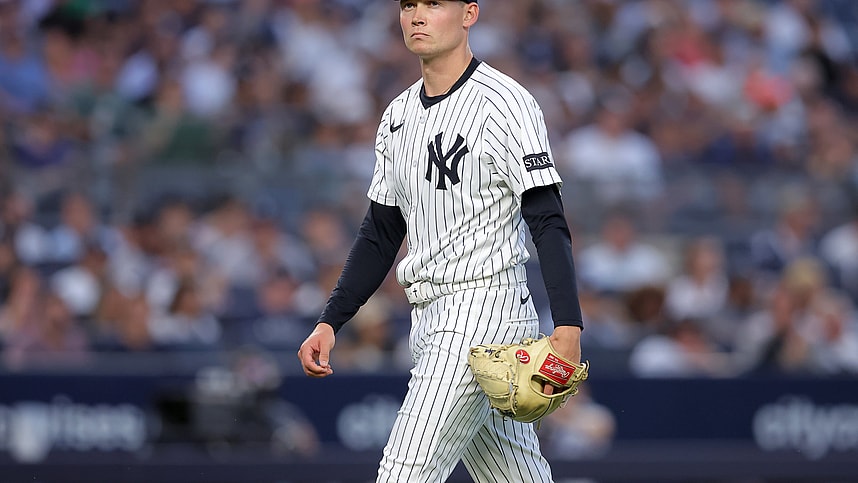
Will Warren isn’t getting the headlines that Gerrit Cole and Carlos Rodon command, but here’s the reality: the Yankees‘ 2026 season might hinge more on Warren’s development than either veteran ace’s health. I’m convinced that the 26-year-old right-hander is sitting on a breakout, and the advanced metrics tell me exactly why—even if his 4.44 ERA and playoff benching last fall suggest otherwise.
The Stuff Is Elite—The Surface Stats Lie
Let’s start with what the surface stats miss. Warren’s fastball run value ranked in the 95th percentile in 2025, a number that screams elite when you’re sitting 93.3 mph with extension in the 81st percentile (6.8 feet). That’s not a guy who succeeds on velocity alone—that’s a pitcher who generates late life and deception by releasing the ball closer to home plate than 81% of the league. The problem wasn’t his stuff. The problem was his head.
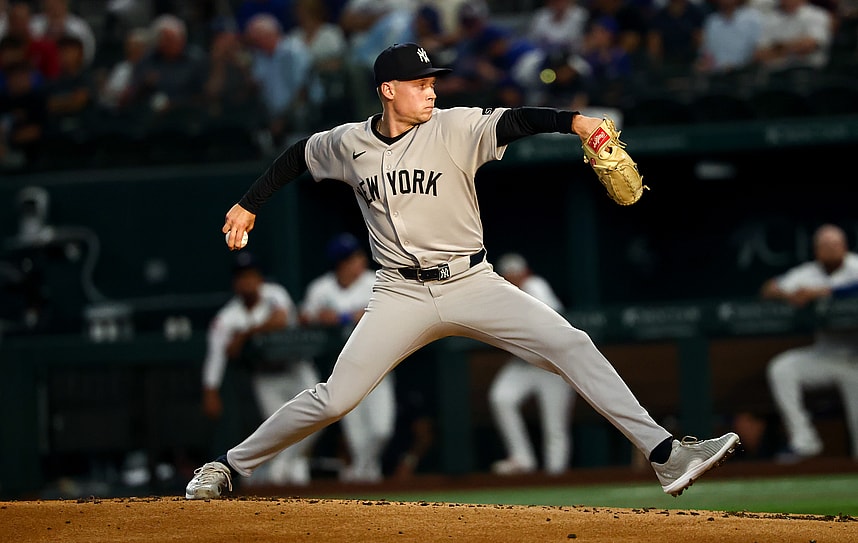
Aaron Boone confirmed the Opening Day rotation pecking order on Tuesday: “We’re talking about probably [Max] Fried, [Cam] Schlittler, [Will] Warren, [Ryan] Weathers and [Luis] Gil to start the season in the rotation. And you always have [Ryan] Yarbrough and [Paul] Blackburn there that can fill that role very capably.” Warren slots in at number three, which means the Yankees are betting on consistency from a pitcher who was mentally compromised down the stretch. That’s a calculated gamble, but it’s one the data supports.
The Three-Pitch Arsenal That Changes Things For Will Warren
Here’s where it gets interesting. Warren’s four-seamer generated a .236 xBA against in 2025 (his actual .216 BA was even better), making it one of the most effective fastballs in baseball when he commanded it. He threw it 41.6% of the time, primarily to set up his sinker (21%) and sweeper (20.6%), creating a three-pitch ecosystem that keeps hitters off-balance. The sweeper is the real weapon—a .291 xBA with a .478 xSLG that ranks as plus-plus against both righties and lefties. When Warren trusts his breaking ball, he’s borderline unhittable. When he doesn’t, he leaks 87 mph changeups (9.8% usage) that get crushed.
The Command Fix Is Simpler Than You Think
The command issues are real, but they’re fixable. Warren’s chase rate sits at 24.5% (8th percentile), which tells you hitters aren’t expanding the zone against him. His walk rate (9.1%) isn’t disastrous, but it’s not efficient for a pitcher who relies on weak contact rather than swing-and-miss. The solution? Attacking the zone early. His hard-hit rate (45.3%) is manageable, but his barrel rate (10.9%) suggests he’s leaving pitches in the heart of the plate when he falls behind in counts. If Warren can push his first-pitch strike rate above 65%—it currently hovers around 60%—the rest of his profile clicks into place.
I also love what his batted ball data suggests about his floor. A ground ball rate of 42.8% (55th percentile) combined with elite extension means Warren can survive even on mediocre command nights. He’s not going to implode like a flyball pitcher who loses his command; he’s going to grind through five or six innings, lean on his infield defense, and give you a chance to win. That’s exactly what the Yankees need from a number three starter behind Fried and Schlittler.
Year Three Is When Pitchers Figure It Out
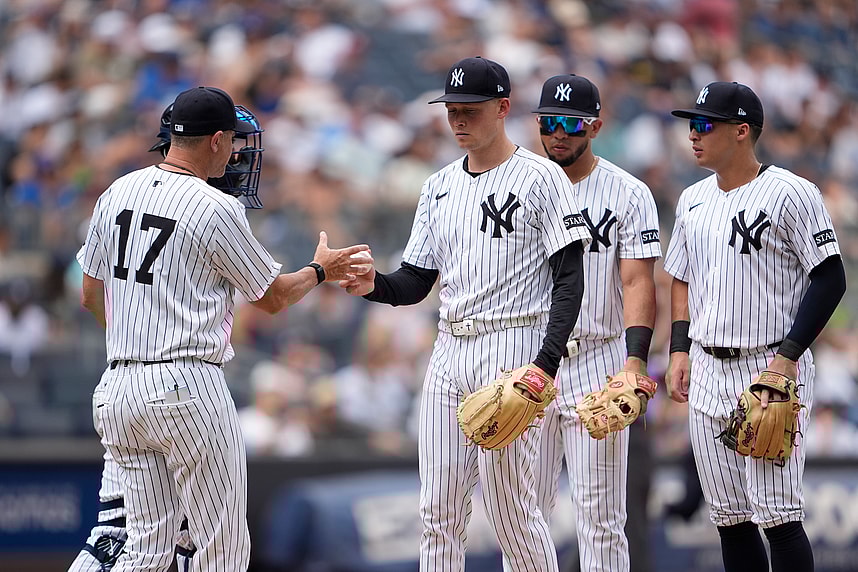
The mental side is where year three becomes make-or-break. Warren was visibly shaken in his final regular-season starts, nibbling at corners instead of attacking hitters with his best pitch. That hesitation cost him his playoff rotation spot, and it exposed the one thing advanced metrics can’t measure: confidence. But here’s the thing—Warren now has 184.3 innings of big-league experience, a full offseason to refine his secondary offerings, and the security of knowing Cole and Rodon are coming back to take pressure off the staff. If he can trust his fastball-sweeper combination the way the Savant data says he should, he’s a legitimate mid-rotation arm with back-end ace upside.
The Rotation Depth Changes Warren’s Ceiling
The Yankees’ rotation health is already trending better than expected. Cole and Rodon are both progressing ahead of schedule, which means Warren won’t be asked to carry the staff through April and May like he was a year ago. That’s the difference between a 10.32 ERA in limited 2024 action and a respectable 4.44 in 2025. Now imagine what happens when he’s the third option instead of the first.
Here’s my projection: Warren goes 14-9 with a 3.65 ERA and establishes himself as the Yankees’ most tradeable asset by July. His strikeout rate won’t spike—the 24.1 K% is what it is with his pitch mix—but his ability to limit hard contact and generate ground balls makes him exactly the kind of innings-eater that contenders covet at the deadline. If Cashman holds onto him, great. If he flips Warren for a bat, even better. Either way, this is the year Warren proves he belongs.
The front office is betting on development. The advanced metrics are screaming upside. And the rotation depth finally gives Warren the runway to prove both right. This isn’t a story about surviving inconsistency—it’s about a pitcher who’s one mental adjustment and an improved slider away from legitimacy. The Yankees need him to make that leap. I think he will.

More about:New York Yankees
