
 Alexander Wilson
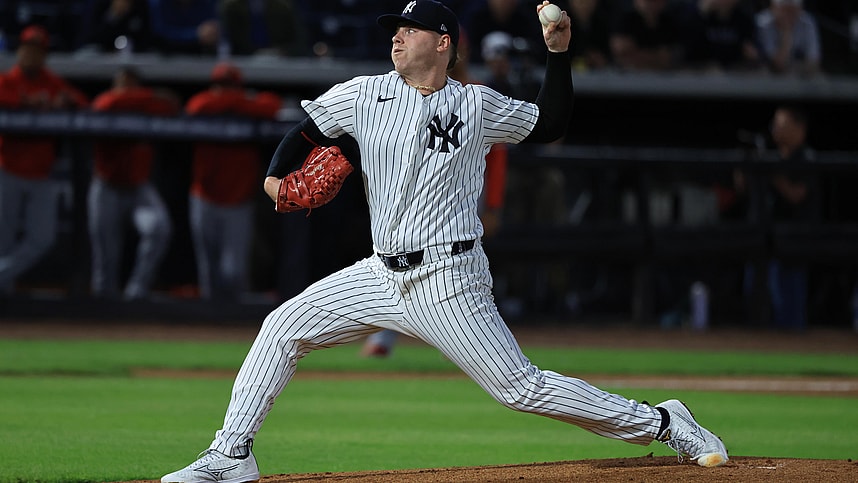
The Yankees haven’t had to wait long to see the upside they traded for in Ryan Weathers. Wednesday’s performance against the Nationals was everything Brian Cashman envisioned when he sent four prospects to Miami in January: a revamped left-hander attacking hitters with premium stuff and a confidence he’s rarely shown in his five-year career.
Weathers carved up Washington over 3.2 innings, surrendering just one hit while striking out five batters. The whiff numbers were staggering. Twelve total whiffs. A 52% whiff rate. But the real story was the velocity. Weathers touched 99 mph with his fastball, a career high by a significant margin, and showed the kind of arm strength that made him the seventh overall pick in 2018.
Somehow, pitching coach Matt Blake has already unlocked another level in Weathers’ game. The revised fundamentals and new pitch mix are producing results that the Marlins never consistently saw, and it’s happening in February. If this is what Weathers looks like in spring training, the regular season version could be a genuine weapon for a rotation that desperately needs healthy arms.
The Career Arc Shows Why Yankees Took the Gamble
Weathers’ career has been defined by flashes of brilliance interrupted by injuries. His 2021 rookie season with San Diego ended with a 5.32 ERA across 94.2 innings, the result of rushing a teenager through the minors and throwing him into big-league competition before he was ready. The Padres realized their mistake and sent him back to Triple-A in 2022, where he spent nearly the entire season refining his craft. He made one spot start that year, throwing just 3.2 innings before heading back down.
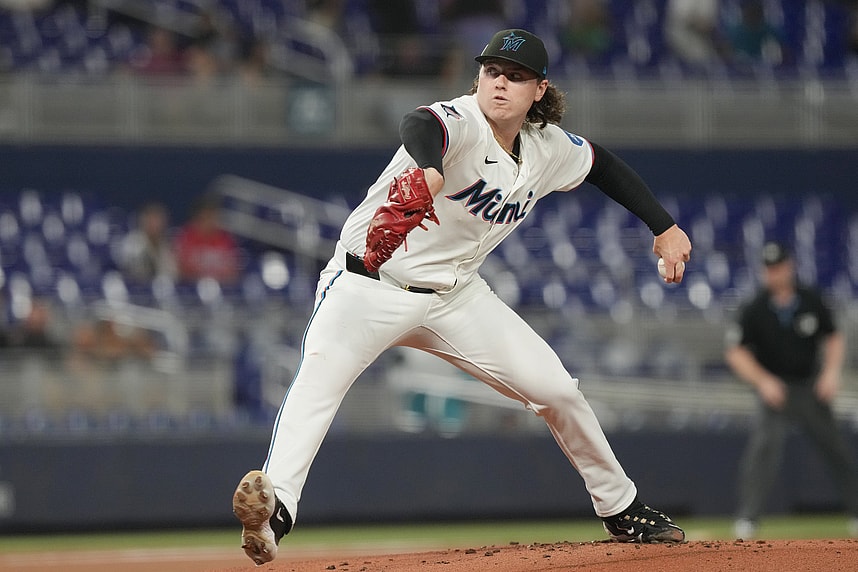
The 2023 campaign split between San Diego and Miami showed a pitcher still searching for consistency. He posted a 6.55 ERA over 57.2 innings across 15 starts, walking 4.53 batters per nine while striking out 6.71. The strikeout-to-walk ratio was ugly, and teams had a .326 BABIP (Batting Average on Balls In Play) against him with a troubling 66.5% LOB rate that suggested he couldn’t escape trouble when it arrived.
Then something clicked in 2024. Weathers posted a 3.63 ERA across 86.2 innings, cutting his walk rate to 2.49 per nine while upping his strikeout rate to 8.31 per nine. The BABIP normalized to .276, and his ground ball rate jumped to 46.6%. He looked like a completely different pitcher, someone who could actually miss bats and limit hard contact. But a strained left index finger limited him to just 16 starts, and the durability questions persisted.
Last season brought more of the same injury frustration. Weathers made his debut on May 14 after missing time with a strained left flexor, then disappeared from June 7 to September 11 with a left lat strain. He finished with a 3.99 ERA over 38.1 innings across eight starts, striking out 8.69 batters per nine while maintaining solid command with just 2.82 walks per nine. The underlying metrics showed a pitcher capable of sustained success if he could just stay on the mound.
Why Cashman Pulled the Trigger
The Yankees needed pitching depth with Gerrit Cole and Carlos Rodon both recovering from surgeries. Weathers offered something few mid-tier prospects could: immediate upside with three years of team control at a bargain price. Cashman sent outfielders Dillon Lewis and Brendan Jones along with infielders Dylan Jasso and Juan Matheus to Miami, none of whom ranked higher than 16th in the Yankees’ system according to MLB Pipeline.
When Weathers spoke with Cashman and Aaron Boone after the trade, he was in shock. “I just couldn’t believe that the New York Yankees were a team that I could ever have a chance to play for,” he said in his introductory comments. The son of former Yankee David Weathers, Ryan grew up around big-league clubhouses and understood what pitching in the Bronx meant.
Cashman defended the move as part of a broader strategy. “I’ve been openly willing to challenge anybody that we don’t have a championship caliber roster,” he said when discussing the Yankees’ relatively quiet offseason. Weathers fit the profile of a high-reward acquisition without sacrificing top prospects, the kind of calculated risk championship contenders make when injuries create rotation holes.
Blake’s Impact Already Showing Through
Wednesday’s outing revealed a pitcher who looks completely different from the version Miami employed. The fastball velocity jumped nearly three mph from his 2025 average of 96.8 mph, and Weathers was throwing it with conviction. He attacked the zone early, getting ahead of hitters and then expanding with secondary offerings that generated swings and misses.
Blake’s adjustments appear to focus on two areas: release point consistency and pitch sequencing. Weathers mentioned in his introductory press conference that the Yankees wanted him to incorporate his two-seam fastball more frequently, a pitch he threw just 4% of the time in Miami despite it grading out favorably. That addition gives him another weapon to keep hitters off balance, especially against left-handed batters who have given him trouble throughout his career.
The whiff rate suggests Weathers is getting more deception in his delivery. A 52% whiff rate in any sample size is ridiculous, and while spring training numbers come with caveats, the underlying mechanics driving those results are sustainable. Blake has a track record of maximizing velocity and movement from pitchers with similar profiles, and Weathers is clearly buying into the program.
“This is the best I’ve probably felt in a year-and-a-half,” Weathers said after arriving in camp. That health baseline matters more than anything else. If he can stay on the mound for 120-140 innings, the Yankees will get exactly what they need from the back end of their rotation. Add in the velocity spike and improved command, and you’re looking at a potential steal.
The Rotation Fit Makes Sense
Boone has already outlined his Opening Day rotation: Max Fried, Cam Schlittler, Will Warren, Weathers, and Luis Gil. “We’re talking about probably [Max] Fried, [Cam] Schlittler, [Will] Warren, [Ryan] Weathers and [Luis] Gil to start the season in the rotation,” Boone said on MLB Network Radio. “And you always have [Ryan] Yarbrough and [Paul] Blackburn there that can fill that role very capably.”
Weathers slots in perfectly as the fourth or fifth starter while the Yankees wait for Cole and Rodon to return. His ability to miss bats and induce ground balls gives the defense a chance to work behind him, and his improved command means he won’t beat himself with walks. If the velocity holds and Blake continues refining his pitch mix, Weathers could force his way into a more prominent role even after the veterans return.
Cashman made this trade knowing the injury history, knowing the career 4.93 ERA, and knowing the inconsistency. But he also saw the 2024 version who posted a 3.63 ERA with strong peripherals when healthy. Wednesday’s performance validated that belief. The Yankees didn’t just acquire a depth piece. They might have found a legitimate contributor who can eat innings and keep them competitive while their rotation sorts itself out.

More about:New York Yankees
