
 Alexander Wilson

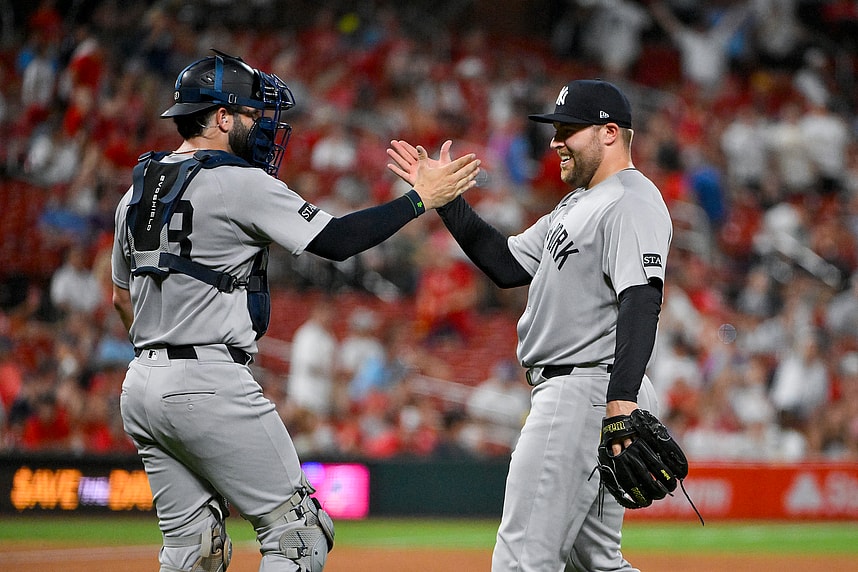
The Yankees lost two high-leverage bullpen arms this offseason to the New York Mets, Devin Williams and Luke Weaver. Both played significant roles for the team in 2025 but struggled with volatility and inconsistency. Nonetheless, the Mets feel they can help both pitchers turn things around, and the Yankees are turning to their new high-leverage tandem that includes David Bednar and Camilo Doval.
Bednar Brings Stability and Contract Year Motivation
Bednar is a sturdy and reliable veteran closer who is heading into a contract year, so he has every reason to perform at a high level. The 31-year-old right-hander posted a 2.30 ERA across 62.2 innings in 2025, striking out 86 batters while maintaining a 1.04 WHIP. Those numbers represent a significant bounce-back from his disastrous 2024 campaign (5.77 ERA, 1.42 WHIP), proving he still has elite closer stuff when healthy and locked in.
His four-seam fastball remains one of the nastiest pitches in baseball. In 2025, he threw it 451 times (44.0% of his total pitches), averaging 97.1 mph with excellent rise. The pitch generated 78 strikeouts with a 20.6% putaway rate while holding batters to a .229 average. When Bednar commands the fastball, he’s virtually unhittable in the ninth inning.
| Pitcher | W-L | ERA | IP | SO | WHIP | K% | BB% |
|---|---|---|---|---|---|---|---|
| David Bednar | 6-5 | 2.30 | 62.2 | 86 | 1.04 | 34.3% | 7.6% |
| Camilo Doval | 4-3 | 3.58 | 65.1 | 72 | 1.32 | 25.9% | 12.6% |
His curveball and split-finger fastball provide excellent secondary options to keep hitters off balance. The curveball (371 pitches, 36.2%) generated 27 strikeouts with a devastating 43.1% whiff rate and held batters to a .172 average. The splitter (202 pitches, 19.7%) averaged 92.3 mph with 36.2% whiff rate, creating a devastating speed differential off his 97 mph fastball. Bednar’s 97th percentile strikeout rate (34.3%) and elite 92nd percentile xERA (2.84) suggest his 2025 performance was legitimate, not a fluke.
The contract year motivation cannot be overstated. Bednar will be 32 years old when he hits free agency after 2026. This is his last chance to secure a multi-year deal worth significant money. A dominant season as the Yankees’ closer could earn him a three-year, $50+ million contract. That financial incentive should keep him locked in mentally and physically throughout the grind of a 162-game season.
Doval’s Elite Stuff Comes With Maddening Control Issues
Doval has elite velocity and a nasty pitch combination. His slider is where his upside lives. He threw it 529 times (48.0% of pitches) in 2025, generating 59 strikeouts with a staggering 41.1% whiff rate. Opponents hit just .190 against it with a .279 slugging percentage. The pitch averaged 89.1 mph and created devastating lateral movement. The problem is that he walks batters at an astronomical rate and can lose command at a moment’s notice. His 12.6% walk rate in 2025 ranked in just the 3rd percentile among all pitchers, meaning 97% of MLB pitchers had better control.
His cutter (439 pitches, 39.8%) provides a second elite weapon. It generated 64 strikeouts and held batters to a .236 average with a .347 slugging percentage. The pitch averaged 98.2 mph with late cutting action that freezes hitters or induces weak contact. When Doval sequences slider-cutter-slider effectively, he’s as unhittable as any closer in baseball.
His sinker (135 pitches, 12.2%) provides a third weapon that keeps hitters guessing. It averaged 96.6 mph with downward movement, holding batters to a .231 average and .308 slugging. The sinker gives him three pitches that can attack different zones and generate different swing profiles in any count.
The Yankees are trying to reel in Doval’s wildness without sacrificing his aggressiveness. His 3.58 ERA in 2025 was actually solid considering his control issues, suggesting the stuff is good enough to overcome occasional walks. The 68th percentile xERA (3.64) and 76th percentile xBA (.219) indicate his metrics supported the results. He wasn’t getting lucky, just living dangerously with baserunners.
Ryan Weathers Provides Left-Handed Depth
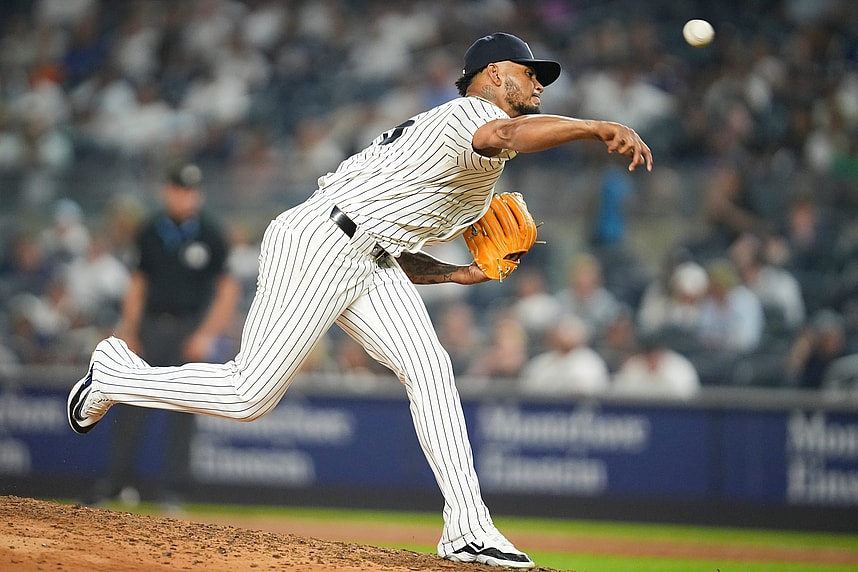
The Yankees also acquired Ryan Weathers this offseason, and he could end up supporting the bullpen as a left-handed power arm later in the season and in the playoffs, if the Yankees make it. Weathers has shown flashes of dominance as both a starter and reliever, and his ability to miss bats from the left side gives the Yankees flexibility in high-leverage situations.
Weathers’ sinker-changeup combination plays up in shorter bursts, and his 95-98 mph velocity gives him enough heat to challenge right-handed hitters inside. The Yankees envision him as a potential seventh or eighth-inning weapon who can get crucial outs against left-handed mashers in October. His presence allows manager Aaron Boone to deploy Bednar and Doval exclusively in the eighth and ninth innings without worrying about lefty-heavy lineups.
High-Risk, High-Reward Strategy
Replacing Williams and Weaver with Bednar and Doval is a gamble. Williams is one of the most reliable relievers in baseball when confident, and Weaver provided consistent high-leverage outs despite occasional blowups. Both struggled with inconsistency in 2025, but their track records suggested they could bounce back.
The Yankees are betting that Bednar’s contract year motivation and Doval’s elite arsenal will outweigh the volatility concerns. Bednar’s 97th percentile strikeout rate and Doval’s triple-threat pitch mix give the Yankees two legitimate ninth-inning options. If Bednar stays healthy and Doval tightens his command even slightly, this could be one of the most dominant back-end bullpen duos in baseball.
But if Bednar regresses to his 2024 form or Doval’s walks spiral out of control, the Yankees will be scrambling for bullpen help by the trade deadline. The upside is sky-high. The downside is very real. That’s the tightrope the Yankees are walking as they try to replace two Mets-bound relievers with a new high-leverage tandem.

More about:New York Yankees
