
 Alexander Wilson
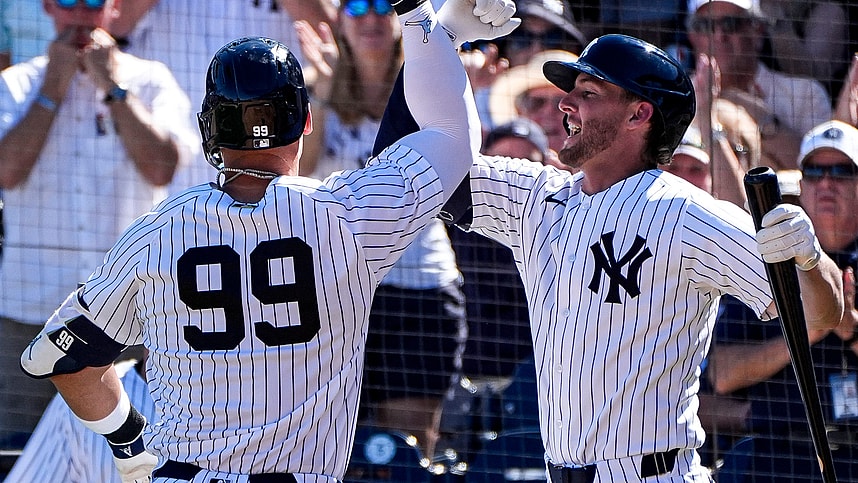
If there’s anything the Yankees love to do, it’s acquire players from other teams, then try to tweak their pitch mix and throwing mechanics or change their batting stance to further align with their style. One of the players they are working on right now is veteran third baseman Ryan McMahon, who they acquired from the Colorado Rockies at the trade deadline this past season.
McMahon has very interesting metrics. He ranks among the best in baseball when it comes to his power metrics, but he’s also one of the worst when it comes to plate discipline. McMahon was acquired to elevate the defensive floor on the hot corner, which he did with ease. He’s known to be one of the best defensive infielders in baseball, so the Yankees immediately improved in that category. Now they’re trying to unlock a new offensive side, which improves his pitch recognition and allows him to hit the ball more frequently while leveraging his power.
The Stance That’s 4th-Widest in Baseball
McMahon played in Saturday’s 20-3 demolition of the Detroit Tigers at George M. Steinbrenner Field, showing off his narrowed stance for the first time in game action. The change is significant. Last season, McMahon averaged 42.7 inches between his feet, the fourth-widest stance in Major League Baseball. The Yankees’ hitting coaches immediately identified this as a culprit for his offensive struggles.
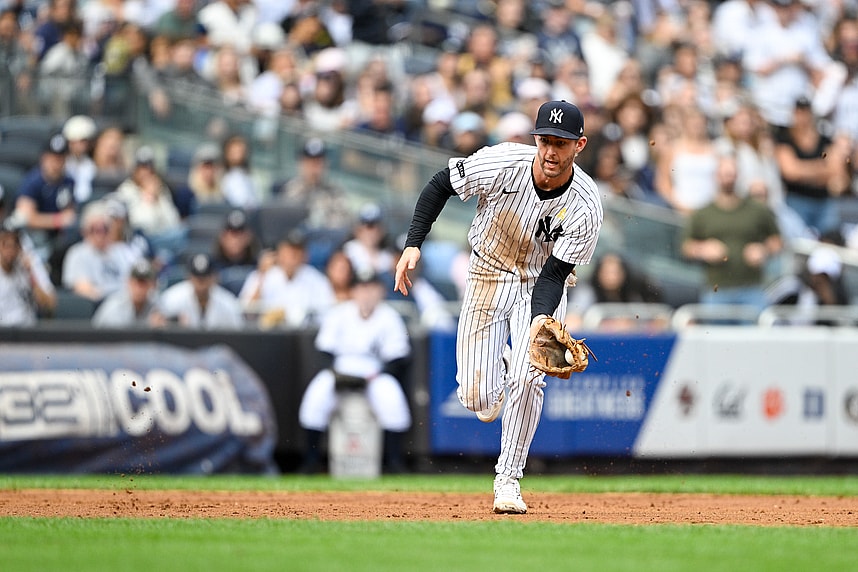
“There’s plenty of video of me in the past where I’m not nearly that wide, and a lot of better things are happening in my swing,” McMahon told Gary Phillips of the New York Daily News. “He and his hitting coaches believe that his hip rotation suffered by having his feet so wide.”
“Just things I’ve done in the past and things I kind of got away from. They pointed them out, and we worked on them,” McMahon told Greg Joyce of the New York Post. “Trying to find a way to give myself the best chance every single time and be consistent with it.”
The Plate Discipline Problem
The numbers tell a damning story. McMahon placed among the league’s worst in strikeout rate (32.3%), whiff rate (35.2%), and in-zone contact rate (77.8%) in 2025. His 2nd percentile K% and 2nd percentile whiff rate ranked him near the bottom of baseball in making contact. When you’re in the 2nd percentile for both categories, you’re essentially gifting opposing pitchers free outs.
Over 586 plate appearances, McMahon hit just .214/.312/.381 with 20 home runs and a .693 OPS. His expected batting average (xBA) of .219 (8th percentile) and expected wOBA of .322 (47th percentile) suggest he wasn’t even getting particularly unlucky. The underlying metrics confirm he was genuinely struggling to make consistent contact.
His chase rate ranked in the 69th percentile at 25.0%, which is actually decent, meaning he wasn’t swinging at pitches outside the zone at an alarming rate. The problem was what happened when he did swing at pitches in the zone. His squared-up percentage ranked in just the 10th percentile at 21.0%, revealing a player who was rarely centering the baseball even on pitches he should handle.
The Power Is Real
Here’s what makes McMahon’s offensive struggles so frustrating for the Yankees: the power metrics are elite. His 95th percentile average exit velocity (93.3 mph), 76th percentile barrel rate (12.1%), and 89th percentile hard-hit rate (50.5%) prove he hits the ball as hard as almost anyone in baseball when he makes contact.
His 77th percentile bat speed (74.0 mph) demonstrates above-average swing mechanics and strength. The tools are clearly there for McMahon to be a 30-home run threat if he can just make contact more frequently. His 60th percentile launch angle sweet-spot percentage (35.3%) shows he’s getting the ball in the air at an ideal rate when he connects.
The disconnect between his elite power metrics and his brutal contact metrics is exactly why the Yankees targeted him at the trade deadline. They believe the stance adjustment can bridge that gap, allowing McMahon to leverage his 95th percentile exit velocity and 89th percentile hard-hit rate while cutting down on the whiffs that plagued him in 2025.

Elite Defense Justifies the Gamble
McMahon’s 87th percentile fielding run value (7 runs saved) and 92nd percentile range at third base made him one of the best defensive third basemen in baseball last season. His 20th percentile batting run value (-7 runs) and 66th percentile baserunning run value (1 run) meant his value came almost entirely from his glove.
The Yankees acquired McMahon knowing they were getting elite defense at third base, a position where they desperately needed improvement. His defensive value alone justified the trade. If the stance change unlocks even league-average offense, McMahon becomes a genuinely valuable player rather than a defensive specialist.
Career Progression Shows the Blueprint
McMahon’s career numbers reveal he’s been a better hitter before. From 2023 to 2025, his batting average dropped from .240 to .242 to .214, while his OBP fell from .322 to .325 to .312, and his slugging plummeted from .431 to .397 to .381. His OPS cratered from .753 to .722 to .693 over that three-year span.
The Yankees believe returning to a narrower stance, similar to what McMahon used earlier in his career when he hit .240 with a .753 OPS in 2023, can restore his offensive production.
McMahon hit just .214 with a .693 OPS in 2025, hitting 20 home runs but also struggling with swing-and-miss. The Yankees are running back mostly the same roster from their 2025 playoff run, but if McMahon takes a step forward with his adjusted stance, it could be a key upgrade simply by fixing something that had gone awry. The power metrics prove the potential is there. The stance change could be the key to unlocking it.

More about:New York Yankees
