Alexander Wilson

“We can talk before [Cashman] goes into [the] winter meetings about a range, but because it’s a fluid situation, that range can go bye-bye in two seconds if there’s a deal that arises that I feel would be very beneficial to some area of need that we have.”
That admission from Hal Steinbrenner tells you everything you need to know about the chaos awaiting the New York Yankees as free agency heats up. The checkbook is open, but the margins are tighter than fans might realize. We are looking at a team gearing up for the winter meetings with a clear mandate to improve, yet they are navigating a payroll minefield that requires precision rather than reckless spending.
Analyzing the New York Yankees Payroll Reality
Let’s evaluate the actual numbers on the books right now. At the moment, the Yankees have $255.8 million in projected total allocations. That is a massive number, but it includes some painful dead weight. specifically $15 million in retained payroll for departed infielder DJ LeMahieu. Paying guys to not play for you is the quickest way to handicap a front office.
The active roster is top-heavy with massive commitments. The Yankees are dishing out $36 million for Gerrit Cole, $29 million for Giancarlo Stanton, and $27.8 million for Carlos Rodon. Then you have the recently extended Trent Grisham, costing $22 million. These expensive pieces anchor the roster, but they also eat up the vast majority of the financial flexibility.
Youth Movement Saves the Bronx Budget
Fortunately, the organization has a ton of young talent bringing costs down to balance the scales. If the Yankees didn’t have these pre-arbitration and early arbitration contracts, they would be paralyzed. Anthony Volpe is only earning a projected $3.25 million in his first year of arbitration. The savings get even better from there.
Austin Wells is sitting at a bargain $820K. Will Warren is at the same price. You can list Cam Schlittler, Ben Rice, and Jasson Dominguez at that same projected $820K figure. This “stars and savings” financial model is the only reason Cashman can even think about shopping for big fish this winter.
Hal Steinbrenner Signals Financial Flexibility
The Yankees have tried to hover around $300 million in total payroll the past few years. If they stick to that hard deck, it gives them about $45 million left until they hit that threshold. That buys you one nice player and maybe a reliever. However, reports have indicated that the Yankees may be willing to push $20 million over that soft limit. That adjustment would give them $65 million to spend.
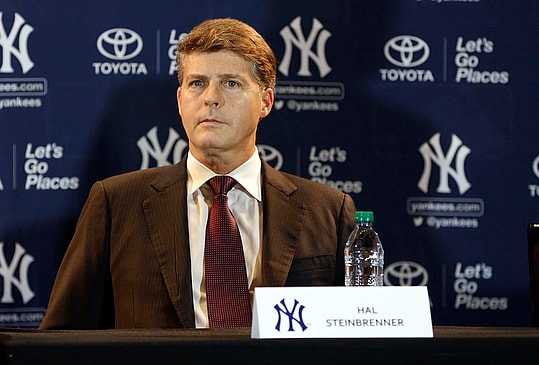
Steinbrenner knows the stakes.
“Would it be ideal if I went down [with the payroll]? Of course,” Steinbrenner said last week on a video call with reporters. “But does that mean that’s going to happen? Of course not. We want to field a team we know could win a championship — or we believe could win a championship.”
Spending on Outfield Stars and Pitching
With $65 million potentially in the war chest, the targets become clear. If they extend Cody Bellinger or sign Kyle Tucker, you’re already looking at about half of that number being cut down immediately. It is a steep price, but it solves the last vacancy in the outfield.
The Yankees have also been linked to Japanese star pitcher Tatsuya Imai among other pieces. The math works out where they have enough money to extend two big-name players and allocate the leftovers towards solving simple pen problems and reinforcing their depth. The pipeline offers insurance too. They have some young pieces ready to make a promotion next year, including Spencer Jones and possibly Elmer Rodriguez at some point in 2026.
The Yankees are structured well to compete right now. They just need to turn that financial flexibility into pitching reassurances and a definitive answer in the outfield before the market dries up.

More about:New York Yankees