
 Quinton Fesq
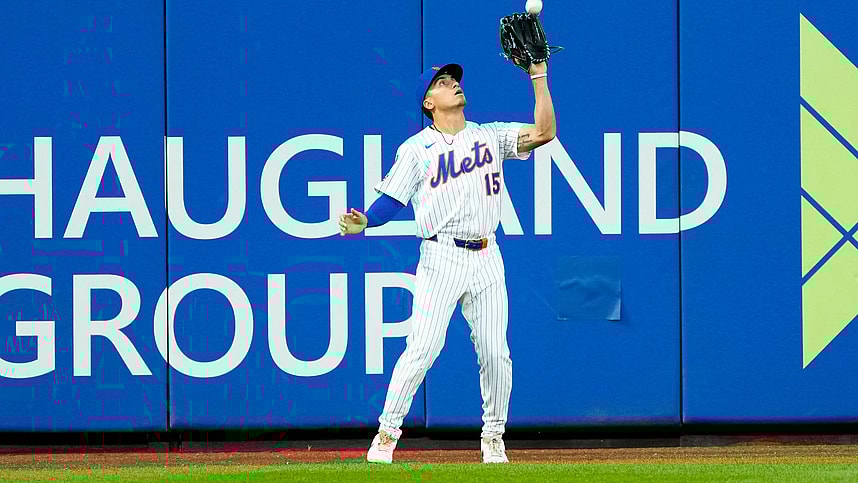
Tyrone Taylor is entering the 2026 season after an offseason where he saw the Mets completely transform this roster into a juggernaut. This offseason we saw David Stearns shift the narrative by acquiring Bo Bichette, Marcus Semien, Jorge Polanco, Luis Robert Jr, Devin Williams, and Luke Weaver, now it’s officially “World Series or bust” in Queens. In a lineup stacked with MVP-caliber talent and heavily paid superstars, the margins of the roster, the 25th and 26th men, often get overlooked.
However, for a championship team, such depth pieces may be the difference between a World Series ring and an early exit. Tyrone Taylor is sitting right in that role. Coming off a down year in 2025, Taylor enters this season not as a starter, but as a luxury defensive replacement who needs to prove he can still handle the bat. It will not be whether Taylor breaks out or not, but whether he can give this “Super Team” the sturdy floor that it requires in 2026.
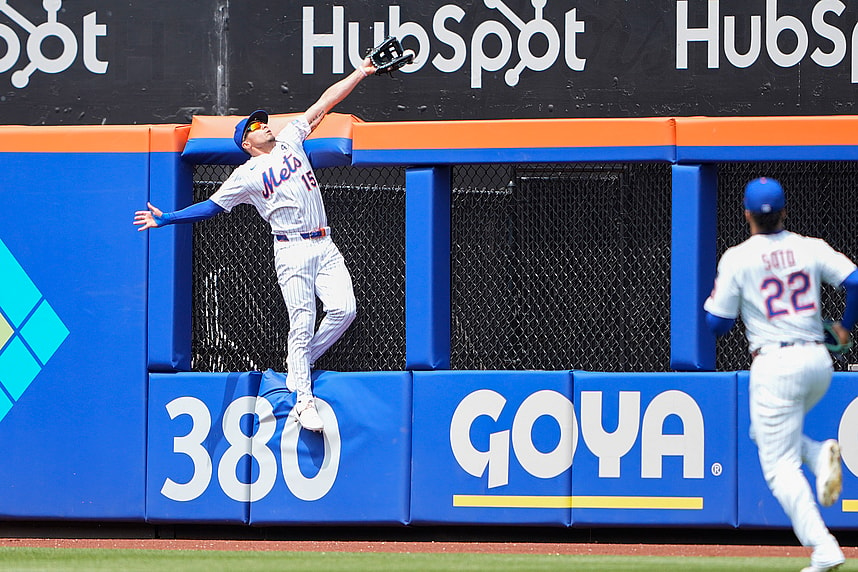
2025 Review: Elite Glove, Vanishing Bat
To be blunt, Tyrone Taylor’s 2025 season was a tale of two players: a defensive wizard and an offensive liability. In his second year in Queens, Taylor saw his offensive production fall off a cliff. Through 113 games and 341 plate appearances, he slashed a mere .223/.279/.319, resulting in a .598 OPS. That production led to a 70 wRC+, meaning he was 30% worse than the league-average hitter. It was a sharp decline from the serviceable 97 wRC+ he posted in 2024, and his lack of power, with only 2 home runs, made it hard for Carlos Mendoza to see him in the lineup on any given day.
However, if you look away from the batter’s box, Taylor was arguably one of the most valuable defenders on the roster. He was a stabilizing force in the outfield when injuries or rest days shuffled the deck. His surface level stats showed a player who was struggling to get on base, but his value didn’t come from his bat. It came from his ability to prevent runs. For a team that occasionally sacrificed defense for offense with other players, Taylor’s glove was a safety net that Stearns clearly valued enough to keep around.
The Underlying Metrics: A Defensive Clinic
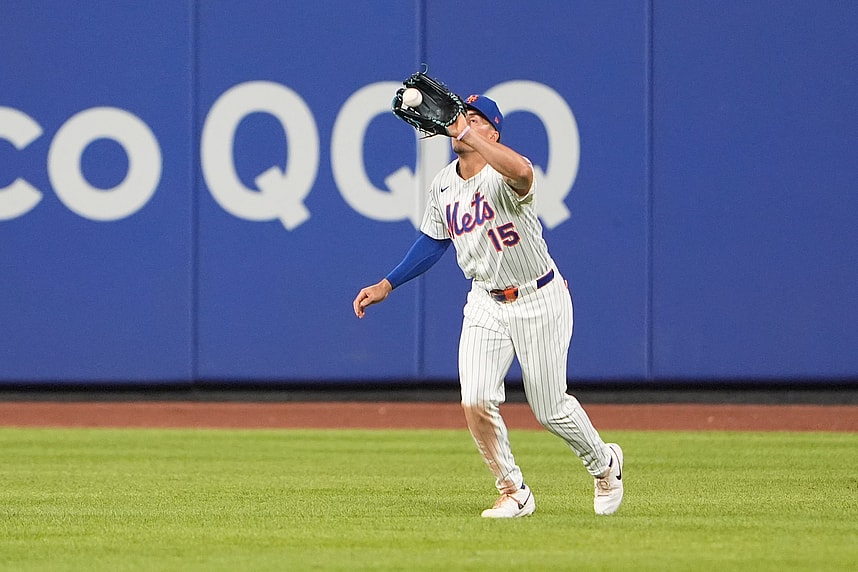
His Baseball Savant page shows a player who is clearly elite in the field but still trying to figure it out at the plate. Defensively, Taylor was absolutely amazing. He ranked in the 98th percentile in Arm Value and the 89th percentile in Fielding Run Value. He wasn’t just catching what was hit to him, he was patrolling the gaps, taking away hits in the gap. His Sprint Speed also sat in the 94th percentile, as he remained one of the fastest players on the team, a tool that made him an incredible asset to this team.
On the offensive side, his underlying measures are a sea of blue though, showing that his 2025 struggles weren’t just bad luck. Taylor posted an Expected Weighted On Base Average (xwOBA) in the 18th percentile and a Barrel rate in the 12th percentile. But the most concerning issue was his plate discipline, as he chased pitches out of the zone at a 30.4% clip placing him in the 34th percentile, while also whiffing 22.7% of the time.
Yet somehow Taylor managed to rank in the 95th percentile in Launch Angle Sweet-Spot Rate, hitting the ball at the ideal launch angle 40.6% of the time. This suggests that when he did make contact, he was technically doing a great job, but his lack of exit velocity (Hard-Hit Rate of 35.1%) meant those balls were dying in gloves rather than finding gaps.
Tyrone Taylor’s 2026 Projections and Role
For 2026, the projections are expecting a slight bounce back for Taylor, as they realistically expect him as a bench piece for this team. The FanGraphs Depth Chart (FGDC) projects him to play in roughly 66 games with a slash line of .232/.284/.372 and 6 home runs, which is good for an 85 wRC+. But Steamer is even more conservative, projecting him in just 57 games with a .233 average. These projections are essentially telling us that Taylor will be a replacement-level hitter at this stage of his career. But for this Mets team, that might just be enough.
Taylor doesn’t need to be a 100 wRC+ hitter. He would perfectly fit into the role of the 4th/5th outfielder for this team. David Stearns loves depth pieces, and Taylor can offer a specific skill set with his elite defense and speed, that can complement the heavy hitters in the lineup. If he is able to cut down his chase rate marginally, and get his wRC+ back into the 85-90 range, he will be able to become a valuable asset. Tyrone Taylor won’t be the headline of this team, but his ability to lock down the outfield in the 9th inning of a playoff game could be exactly what this team needs.
More about:New York Mets
