Alexander Wilson
Four miles per hour.
That is the difference between a heater that blows past a bat and a meatball that lands in the second deck, yet the New York Mets bet millions that gravity matters more than gas last offseason. It has become abundantly clear that the Mets are no longer just sharing a city with the Yankees; they are actively raiding the Bronx pantry for ingredients.
This trend started with the massive acquisition of Juan Soto last offseason, but it has accelerated into a full-blown strategy of poaching pinstriped pitching.
They also signed Clay Holmes to start in 2025 and just brought in Devin Williams to lock down the late innings. The front office in Queens is clearly operating under a specific philosophy: if you can survive the pressure cooker of Yankee Stadium, Citi Field should be a walk in the park.
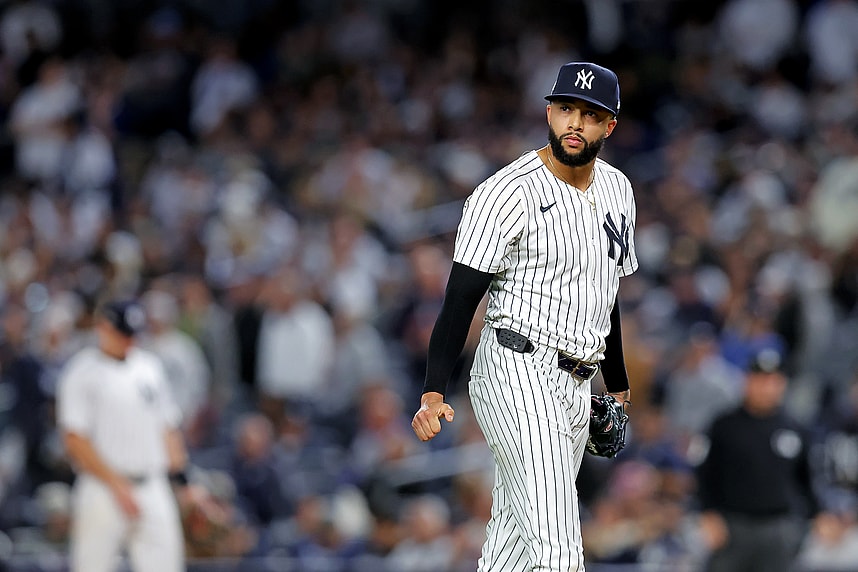
Clay Holmes and the $38 Million Gamble
The decision to sign Clay Holmes to a three-year, $38 million deal to be a starting pitcher was quite the experiment. Holmes is 32 years old and fresh off tossing 165.2 innings last season.
That workload is more than double his previous career high. While he posted a respectable 3.53 ERA, the strain of that transition is flashing bright red warning lights on the dashboard. You cannot drastically increase innings without expecting a physical toll, and we saw it in the radar gun readings.
Holmes watched his fastball velocity fall off a cliff, dropping from 97.5 mph in 2024 to just 93.5 mph in 2025.
That is a significant dip for a guy who needs to overpower hitters to set up his slider. However, the Mets are banking on his elite ground ball ability to mitigate the velocity loss. Holmes posted an upper-echelon 55.8% ground ball rate and a 74% left-on-base rate. If he can keep the ball on the ground, the lack of velocity might not kill him, but his decline in strikeouts to 7.01 per 9 innings suggests his margin for error is razor-thin.
Mets Bet Big on Devin Williams’ Underlying Metrics
On Monday night, the Mets backed up the Brinks truck again, signing former Yankees closer Devin Williams to a three-year, $45 million deal.
At first glance, paying $15 million per season for a reliever who just posted a 4.79 ERA over 62 innings looks like insanity. But this is where the Mets are flexing their analytical muscles. They are looking past the surface-level damage and seeing a pitcher who is still arguably the most unhittable man in baseball when he is right.
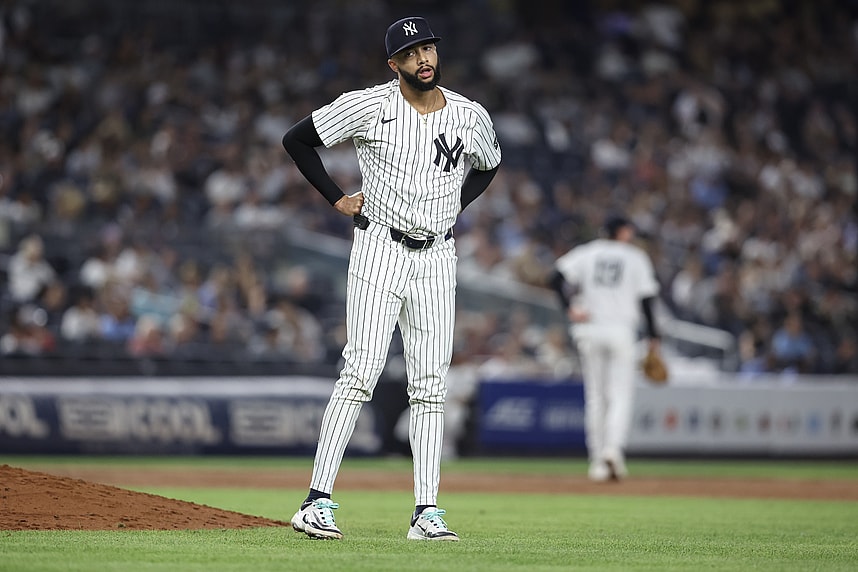
Williams still ranked in the 99th percentile in whiff rate. That is not a typo.
Despite the inflated ERA, he sat in the 97th percentile in both chase rate and strikeout rate. He is a massive bounce-back candidate, and the Mets are poised to capitalize on a market that may have overreacted to his bad luck. This is a savvy purchase of a distressed asset that still possesses elite traits.
Insurance Policy for an Uncertain Future
There is a strategic layer to this signing that goes beyond just piling up arms. Williams serves as a high-end insurance policy if Edwin Diaz ends up leaving in free agency.
You cannot go into a season with a hole in the ninth inning, and securing Williams gives the Mets flexibility and leverage. It’s not a crazy cost for a player who clearly has better days ahead.
Ultimately, poaching from the Yankees is a smart play. The Mets are acquiring known commodities who have already proven they can handle the New York media market. They are betting nearly $83 million combined on Holmes and Williams that the Bronx’s trash is Queens’ treasure.

More about:New York Mets