
 Quinton Fesq
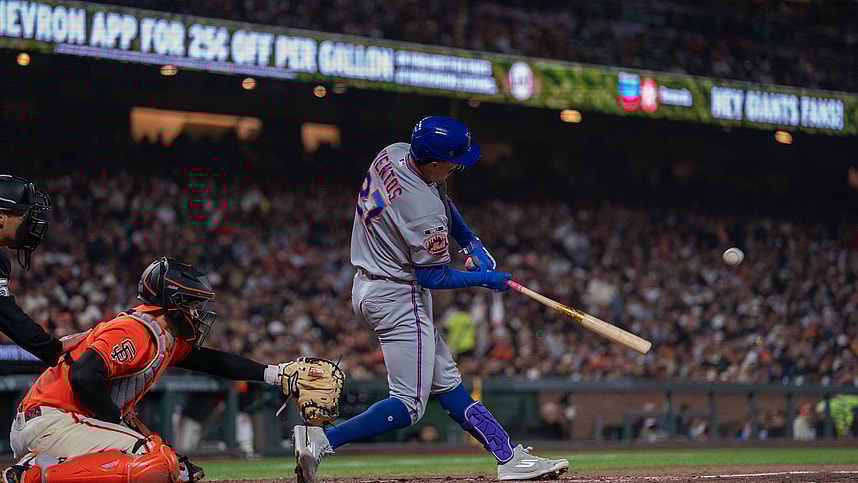
Mark Vientos spent 2025 being one of the more confusing players in baseball.
He hit the ball hard. He hit it often. He posted an 89th-percentile hard-hit rate, an 82nd-percentile average exit velocity, a 72nd-percentile barrel rate. By raw contact quality, he looked like a middle-of-the-order force. Then the results came in: a .233/.289/.413 line, a 97 wRC+, and 17 home runs in 121 games. The New York Mets got a league-average hitter wearing the production profile of a much better one.
Something had to give. In 2026, two things changed at once.
The Bat Speed Went Up. The Whiff Rate Went Down.
Six games and 19 plate appearances is not a sample size. Anyone who tells you otherwise is selling something. But the underlying numbers Statcast is capturing through those 19 PAs point in a direction worth paying attention to.
His xwOBA sits at .473. His xBA is .368. His xSLG is .655. Those aren’t bounce-back numbers. Those are star numbers — the kind of expected outcomes that show up when a hitter is squaring the ball up at an uncommon rate and putting it in the air where it can do damage.
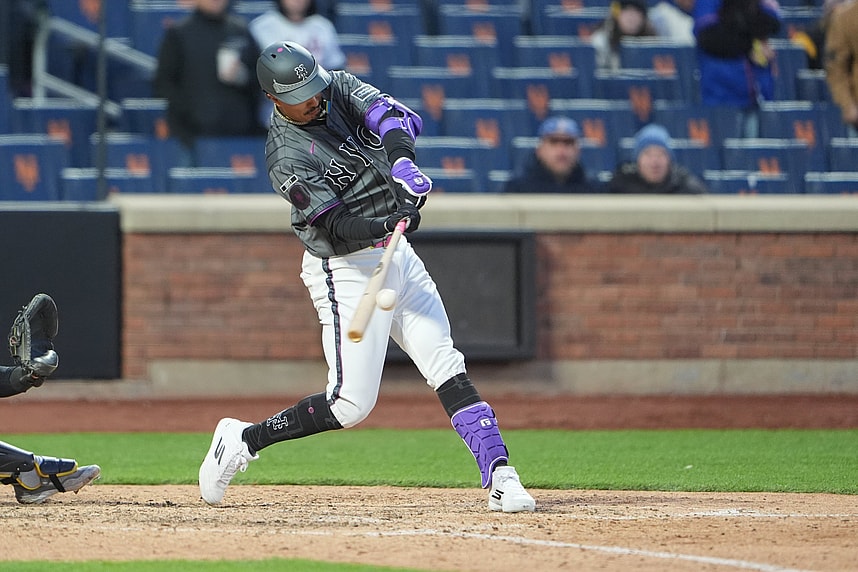
The bat speed reading tells part of the story. Vientos is at 73.4 mph in 2026, up from 71.2 a year ago. That’s not a rounding error. Faster bat speed means more time to read the pitch, later decisions, better coverage. His sweet-spot rate is at 44.4%. His whiff rate has dropped to 25.0%, down from a 6th-percentile mark in 2025 that was quietly one of the worst contact rates in the league. His chase rate is at 29.5%.
The swing-and-miss problem that defined his 2025 collapse looks, through a very small window, like it’s being addressed.
The Position Change Matters More Than It Sounds
Alongside the early offensive signal, Vientos is shifting from third base to first base and DH. That’s not a demotion. That’s a correction.
His defensive metrics at third were a consistent problem. Negative OAA, negative DRS, negative UZR — in 2025 alone, his defense cost the Mets roughly 9 runs by fielding value. That drag was quietly suppressing his overall value even when his bat was producing. A 132 wRC+ in 2024 translated to just 2.9 WAR in part because the glove was giving back what the bat was building.
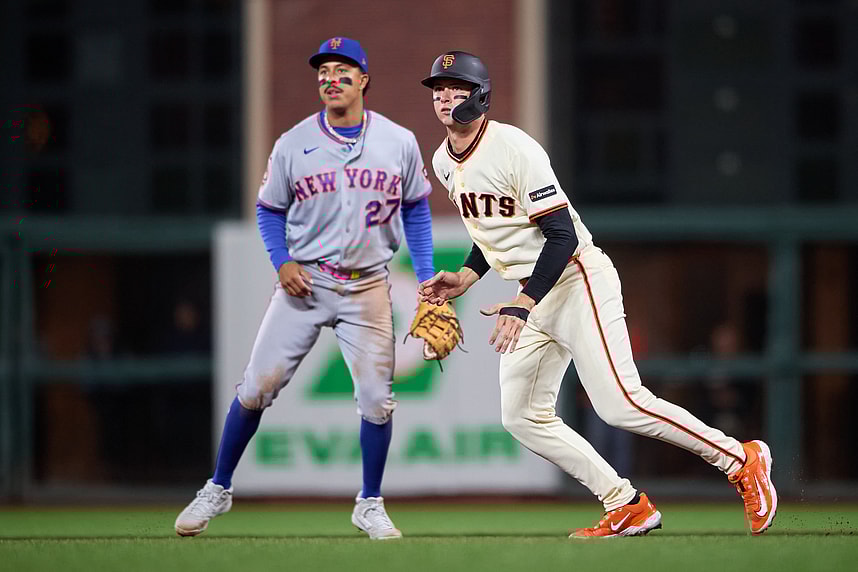
At first base, that equation changes. The positional adjustment is steeper, but a hitter with Vientos’ contact quality profile — elite exit velocity, legitimate barrel rates, now apparently improved bat speed — doesn’t need to be a defensive asset. He needs to hit. First base lets him do that without the fielding penalty following him around.
What the Projections Think vs. What the Profile Suggests
The models are measured. FanGraphs’ own depth chart system projects a .251/.312/.453 line with 19 home runs and a 115 wRC+ for the full season. That’s a useful player. ZiPS lands in a similar range. The systems are appropriately skeptical of 19 plate appearances and are leaning on the larger body of work — including 2025, which pulled his numbers down hard.
But the larger body of work includes something the projections may be underweighting: his 2024 season was a legitimate 132 wRC+ performance, his xwOBA has historically tracked above his actual wOBA, and the Statcast profile he’s flashing early in 2026 looks closer to that version of him than anything he showed a year ago.
If the bat speed improvement holds, if the whiff rate stays in a reasonable range, and if the position change removes the fielding weight from his overall value calculation — the projection models will look conservative by July.
That’s not a guarantee. It’s a hypothesis with better evidence behind it than it had a week ago.
More about:New York Mets
