
 Quinton Fesq
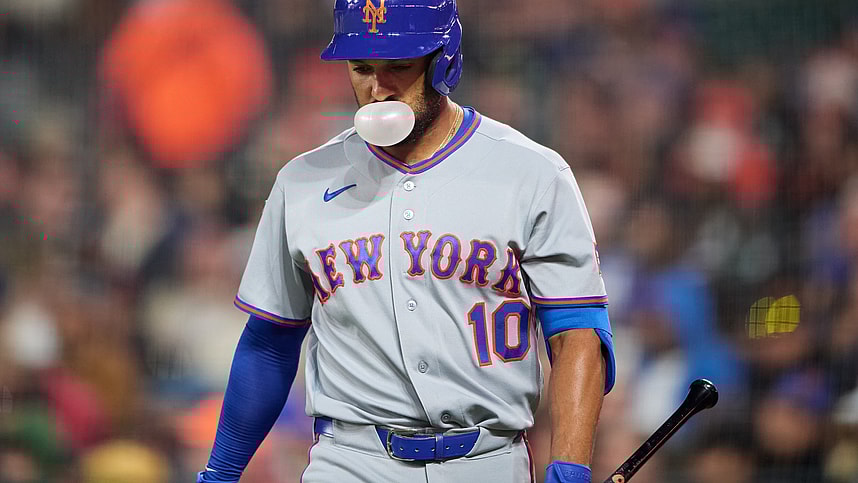
Marcus Semien has faced a lot of things in his career — lean years in Oakland, a reinvention as one of the best offensive second basemen in baseball, a Gold Glove in Texas. He has never started a season quite like this. Through 7 games with the New York Mets, Semien is slashing .130/.250/.174 with a wRC+ of 36. That last number is the one that should make you stop. A wRC+ of 36 means he has been roughly 64% worse than the league-average hitter. That is not a cold stretch. That is a red flag.
The surface numbers are bad enough. But the underlying data is where the real story is.
The Strikeout Rate Is the First Problem
Semien’s strikeout rate through his first 28 plate appearances sits at 28.6% — nearly 11 points higher than his career average of 18.5%, and more than 10 points above his 2023 peak of 14.6%, when he posted a wRC+ of 128 and finished with 6.5 WAR. He struck out 8 times during his 0-for-20 stretch before finally ending it with an infield single Thursday against San Francisco. Manager Carlos Mendoza put it plainly when asked about it: “I feel like [pitchers] are attacking him, they are getting ahead and then they are making him chase,” he told reporters, per the New York Post’s Mike Puma. Mendoza added he still feels good about Semien at the plate. The data is a harder sell.
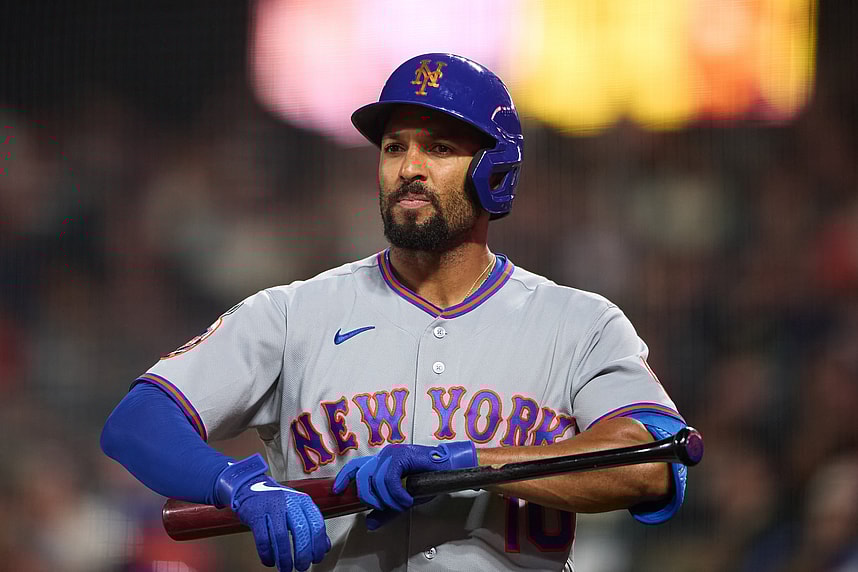
Pitchers getting ahead early is exactly what the first-strike rate confirms. Semien’s F-Strike% in 2026 is 78.6% — compared to career norms that consistently hover around 60%. When you are behind in the count that frequently, you are not hitting. You are surviving.
The Batted Ball Profile Is Where It Gets Mechanical
This is where the slump stops looking like randomness and starts looking like something that needs fixing.
In 2026, Semien’s fly ball rate has spiked to 62.5% — nearly 20 points above his career average of 43.2%. His ground ball rate has cratered to just 25%, compared to a career mark of 36.6%. More telling: his pull rate has collapsed to 18.8%, against a career average of 46.3%. He is hitting almost 70% of his balls to center field right now. That is not an approach — that is a hitter who has lost his timing and is late to everything.
When a right-handed hitter who normally pulls the ball at an elite rate suddenly cannot get out in front of pitches, one of two things is happening: he is seeing fastballs he cannot catch up to, or his bat path has drifted. Semien’s bat speed data offers a small clue — his 2026 reading of 67.2 mph is down slightly from 68.3 and 68.4 in the two prior seasons. That drop is modest and may be within normal variance. But combined with a swing-length metric (SwgLng) that has held steady, what you see is a hitter who is not swinging slower so much as he is making contact later in the zone, generating weaker angles and more passive at-bats.
His max exit velocity of 102.8 mph this year, compared to career highs around 110–112 mph, tells the same story from a different direction. The loud contact simply is not there yet.
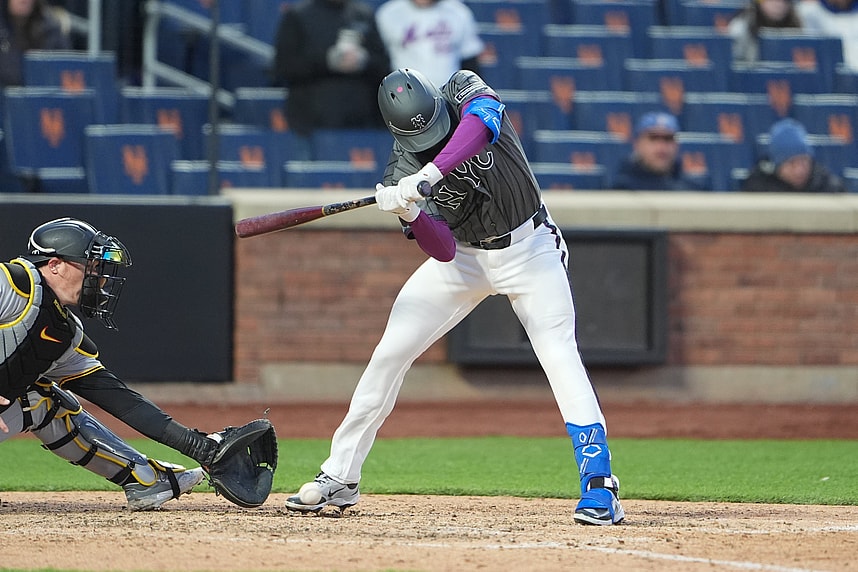
So Is This a Problem — or Just April?
Semien made a fair point to reporters before Thursday’s game. Six games in, one big performance changes the batting average conversation dramatically. He is right about that, and his career gives him credibility here. The man has logged back-to-back 6.5 WAR seasons. He hit .276 with a 128 wRC+ as recently as 2023. The projection systems still see him as a roughly league-average bat for the rest of 2026, with every major model landing him between a 94 and 104 wRC+ for the remainder of the season.
But the mechanical fingerprints of this slump are specific enough to take seriously. He is not just cold — he is late, passive, and pulling nothing. That combination does not self-correct overnight, especially for a 35-year-old coming off a subpar 2025 (.230/.305/.364, 89 wRC+) who is trying to find his footing with a new team on a $175 million contract that runs through 2028.
The good news is that Semien has reinvented himself before. The bad news is that the Mets need him now, not in May. If the pull rate does not come back and the strikeout rate does not drop back toward his career norms within the next two or three weeks, the questions around him are going to get louder — and Carlos Mendoza’s patience is going to become the more interesting story.
More about:New York Mets
