
 Quinton Fesq
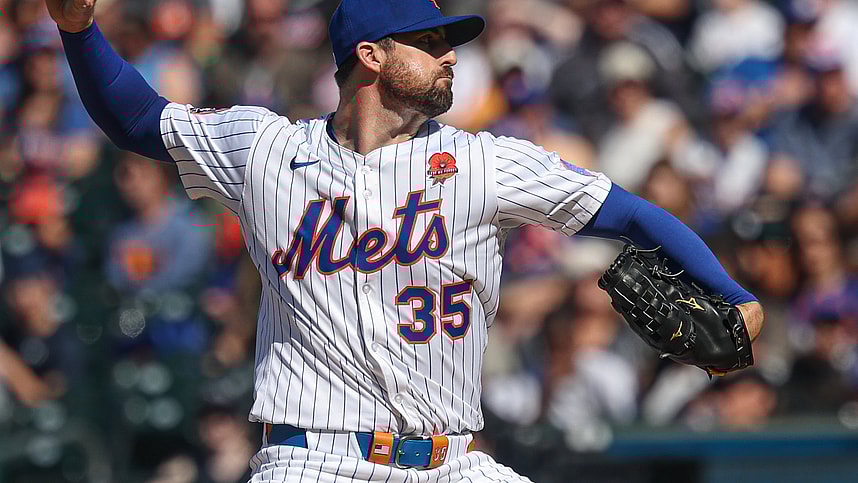
It was not surprising that the decision made by the New York Mets to transform Clay Holmes into a starting pitcher last December left many fans skeptical, yet the raw numbers from his 2025 season suggest that the gamble might’ve paid off. Holmes posted a 3.53 ERA over 165.2 innings, as compared to what we would otherwise expect in the case of a reliever trying to triple their workload. He held a 12-8 record with a 1.30 WHIP, which stabilized a rotation that desperately needed innings. However, his surface-level success hides an unstable underlying profile that suggests that in 2026 the sinkerball pitcher might not be as lucky.
If you take a closer look at his 2025 splits, you will see that Holmes survived on contact management and not dominance. Holmes’ strikeout rate dropped to 18.2%, and his swing-and-miss numbers were lower than what they were when he was the high-leverage reliever in the Bronx. This dip was expected as the velocity change was required for him to convert to a starter, but it put a strain on the Mets defense. His 4.35 xERA (Expected ERA) is far more alarming as it shows that he outperformed his true skill level by almost a full run.
The Fatigue Factor and Pitch Mix Evolution
The most important metric to watch entering 2026 is Holmes’ stamina and velocity, after logging a career-high in innings pitched. The “tale of two halves” narrative from 2025 cannot be overlooked because he had a sub-3.00 ERA until July 2nd (17 starts), but his ERA has fell to a 4.17 in his final 14 games of the season. This points towards a pitcher who hit a physical wall, because the velocity of his sinker decreased, and his control was shaky with 9.3% walk rate.
Despite the fatigue, Holmes was able to expand his arsenal, which could bring some hope for future sustainability. The addition of his “kick changeup” allowed him to generate a 29.9% whiff rate and also a much needed weapon against left-handed hitters. Even though his sinker was slower, it was much more successful in its run value than his failures in 2024, allowing him to be far more accurate in lower part of the zone. The data would indicate that as long as Holmes can continue to maintain the effectiveness of his changeup, while regaining some of the snap on his slider, he can defy the regression that projection systems such as Steamer are projecting.
Clay Holmes’ 2026 Projections
The 2026 projection models are lowering their expectations, roughly putting Holmes at an ERA around 3.90 with a slight decrease in innings pitched. Deep-metric analysts believe that Holmes benefited from an unrealistic amount of “good luck” on balls put in play last season, as he induced an unusually high number of grounders that went straight to fielders. When that luck eventually normalizes, those soft hits will start finding holes in the infield, putting runners on the basepaths. This will increase and potentially balloon his WHIP toward the 1.39 range.
We should also consider the “second-year starter” penalty, where the opposing hitters will have more advanced scouting, and a full season of tape on Holmes to figure out his sequencing. Last season, hitters batted a measly .187 against him with runners in scoring position last year, a “clutch” metric that is notoriously unsteady from year-to-year. If we see his strand rate regresses to the mean, Holmes’ ERA could increase, even if his raw stuff still remains the same.
Value Proposition in the Rotation
Ultimately, Holmes is going into 2026 not as an ace, but as a surprisingly efficient mid-rotation stabilizer who can hopefully provide value. If the projections are right, and Holmes finishes with 150+ innings with a 3.80-3.90 ERA, it would still make him a solid investment in a market where starting pitching contracts continue to skyrocket. He limits damaging runs by keeping the ball on the ground with his 55.8% groundball rate, which led the team’s qualified starters, providing a safety floor even when his command might drift.
The Mets are likely to manage him more in 2026, possibly limiting him to only two times through the order in the early months to preserve his arm for September. The numbers suggest that he is best used as a “five-and-dive” starter who largely relies on his elite infield defense rather than being a dominant strikeout artist who can carry a game into the eighth inning. If fans adjust their expectations to this reality, Holmes’ second year as a starter will likely be viewed as a success, even if the ERA climbs half a run.
More about:New York Mets
