
 Quinton Fesq

On Tuesday, the Mets added left-handed depth to the bullpen by acquiring Bryan Hudson of the Chicago White Sox in exchange for cash considerations. The move follows with placing Reed Garrett on the 60-day injured list, clearing a 40-man roster spot for the 6-foot-8 southpaw. Hudson enters Spring Training as a distressed asset, he’s only one season removed from some elite production, but he’s coming off a season where he regressed and had some serious command issues.
2024: The Breakout Metrics
To explain Hudson’s potential value, we have to go back and look at his 2024 season when he was with the Milwaukee Brewers, where he posted a 1.73 ERA, with a 0.72 WHIP over 62.1 innings. His underlying metrics also supported these elite numbers, as was holding opposing hitters to a .133 batting average, while ranking in the 90th percentile in Pitching Run Value.

He was able to find success using a three-pitch mix: a four-seam fastball which he used 52% of the time, a cutter that was used 24% of the time, and a sweeper used only 23% of the time. Even though his velocity was below average, only averaging 91.3 mph, his physical size allowed it to play up significantly. Hudson ranked in the 99th percentile in extension at 7.4 feet, with his release being closer to the plate than nearly any other pitcher in the league. This added perceived velocity and deception, allowing him to create weak contact even though he lacked any overpowering stuff.
2025: Regression and Velocity Dip
However, there was a steep decline in Hudson’s efficiency in 2025 during his time with the Brewers and White Sox. Through his limited time of 15.0 MLB innings, his ERA jumped to 4.80, and his WHIP more than doubled to 1.87. His main issue seems to be a loss of command, as well as a slight dip in his stuff.
Hudson’s fastball velocity dropped to 90.3 mph in 2025, nearly a full tick down from his 2024 average, according to his Baseball Savant page. While a 1 mph drop may not be an issue for many, for a pitcher who relies on his extension and deception rather than his raw power, the margin for error is slim. His walk rate also spiked, while his Run Values became negative across the board, with -3 Fastball Run Value, and -4 Pitching Run Value. However, his elite extension was still there as he remained in the 99th percentile (7.4 feet), but without the command or that extra mile per hour, hitters were able to sit on his pitches more comfortably.
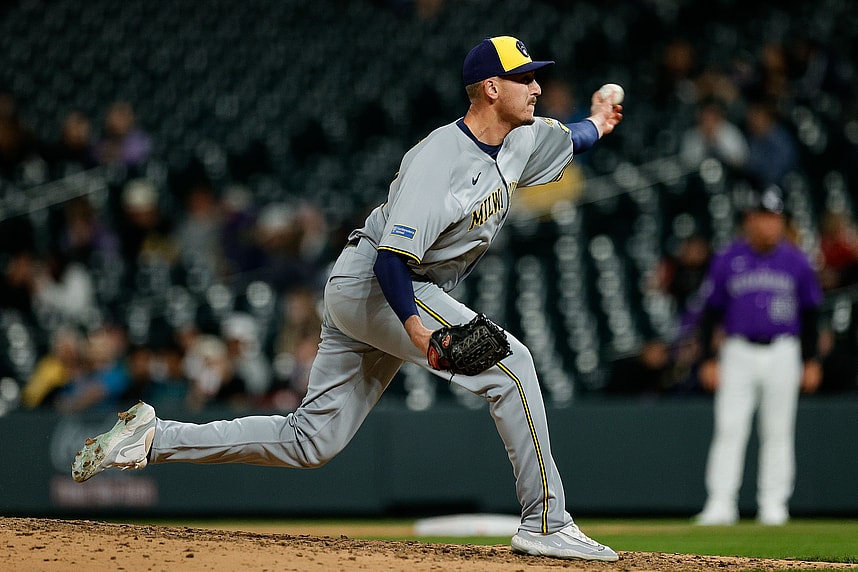
The Physical Anomaly
Despite his poor 2025 results, the Mets are betting on Hudson’s unique physical traits in hopes of a bounce-back 2026 season. At 6-foot-8, his release point creates a steep approach angle that is difficult for hitters to recreate in batting practice. His extension is the key variable here, as a 7.4-foot extension puts him in the top 1% of the league.
If the Mets’ pitching lab can find a mechanical flaw in his game that caused his dip in velocity, or his command regression, then the raw ingredients for a high-leverage reliever are still there. The difference between his 2024 and 2025 seasons suggests that his “stuff” is effective, but only within a specific velocity and command range. When he does fall below that threshold, similar to how he did in 2025, then his deception is not enough to carry him.
Roster Status and Spring Training
Going into 2026, Hudson is out of minor league options, meaning he will likely make the Opening Day roster or risk going back on waivers again. This allows him to compete for a situational lefty role. With Garrett’s injury opening up a spot, Hudson’s path to the roster is clear, assuming he is able to outperform the non-roster invitees and depth pieces.

Bryan Hudson’s 2026 Expectations
The projection systems are cautious with Hudson, but see him as a serviceable middle-inning reliever. Steamer projects a 3.65 ERA, while the FanGraphs Depth Chart (FGDC) is slightly more conservative with a 4.00 ERA. These projections essentially view him as a league-average arm, expecting him to regress to the mean of his elite 2024 and poor 2025.
As for the Mets, the expectation is a low-risk depth. If Hudson is able to return to his 2024 form, specifically getting his fastball back up to the 91-92 mph range, then he offers significant upside as a second lefty out of the bullpen. If his command issues continue, then the team can move on with minimal financial risk. The acquisition of Hudson was a low-risk, high-reward gamble on a pitcher with a brief ceiling.
More about:New York Mets
